Clear Sky Science · en
Decreased Broca-left supplementary motor area connectivity underlying auditory verbal hallucination: A resting-state NIRS study
Why hearing unreal voices matters
Many people with schizophrenia live with an unsettling experience: they hear voices that no one else can hear. These auditory verbal hallucinations can be harsh, distracting, and frightening, making daily life, work, and relationships much harder. Understanding what in the brain makes some people more prone to these voices could help doctors better predict who is at risk and, eventually, design more targeted treatments. This study looks at how different speech‑related brain areas "talk" to each other while people simply rest, and asks whether a specific wiring pattern marks those who have ever heard such voices.
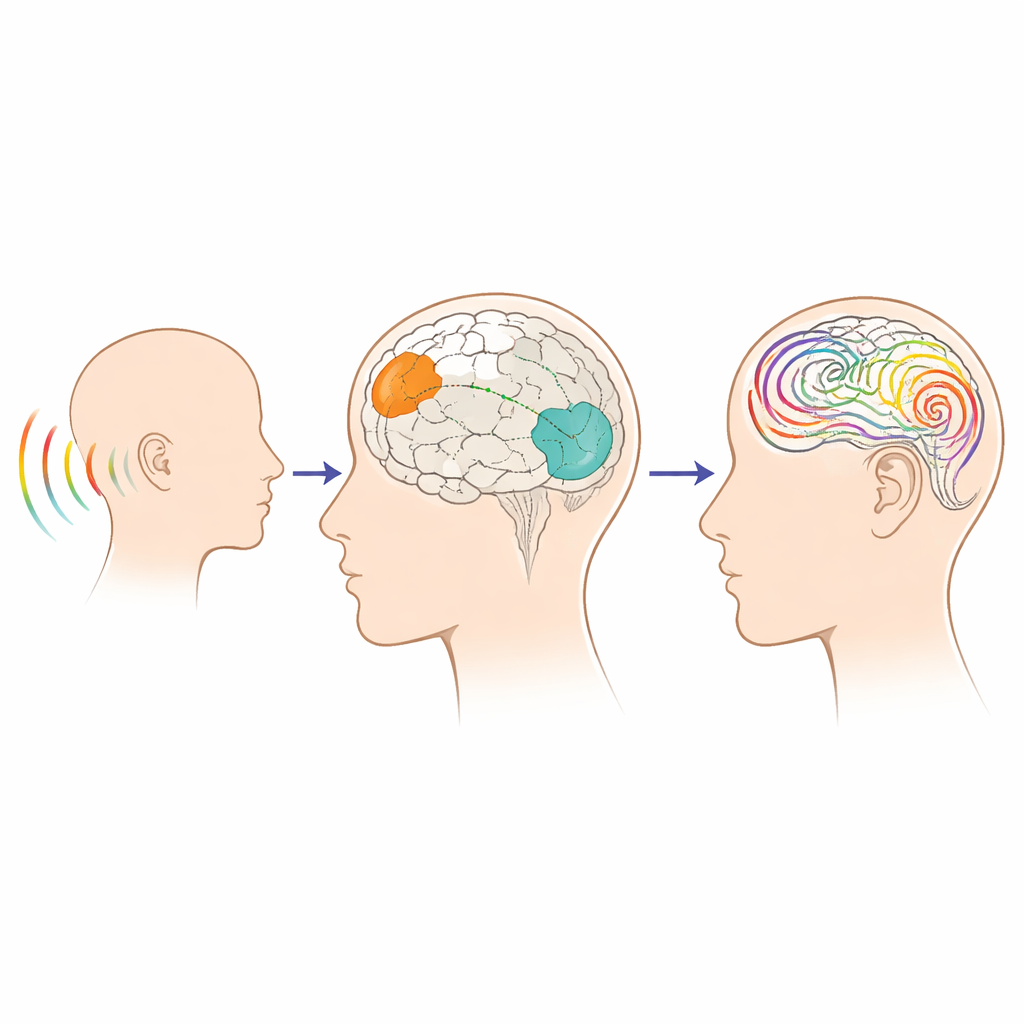
Listening in on the resting brain
Instead of scanning the brain while people were actively hearing voices, the researchers focused on what happens in quiet moments, when no task is required. They reasoned that some brain traits linked to vulnerability for hallucinations might be visible even when symptoms are not happening. To capture this, they used a tool called functional near‑infrared spectroscopy (fNIRS), which shines harmless light through the scalp to track blood oxygen changes in outer brain regions. Thirty‑nine inpatients with schizophrenia and seventeen healthy volunteers sat in a dim room for about eight minutes, simply keeping still and looking at a fixation point, while the device monitored activity across the front and side surfaces of the brain.
Comparing people with and without voices
The patient group was split into two subgroups: those who had ever experienced hearing voices (AVH history positive) and those who had never done so (AVH history negative). Importantly, the two patient subgroups were similar in age, years of illness, education, and medication dose, which makes it more likely that any brain differences are tied to hallucination history rather than to overall illness severity. The fNIRS cap covered key areas involved in language and sound processing on the left side of the brain, including a speech‑production region (Broca’s area), a speech‑understanding region (Wernicke’s area), a sound‑processing strip in the temporal lobe, and a motor planning zone near the top middle of the head called the supplementary motor area.
When internal speech loses its anchor
The team examined how strongly activity in each pair of these regions rose and fell together at rest, a measure known as functional connectivity. Across all possible region pairs, only one connection clearly differed between groups: the link between Broca’s area and the left supplementary motor area was weaker in patients with a history of hearing voices than in patients who had never heard them. Healthy volunteers fell in between and did not differ reliably from either patient subgroup. This specific "under‑connection" fits with the idea that Broca’s area helps generate inner speech and that the supplementary motor area helps time and monitor self‑generated actions and thoughts. If the tie between these two hubs is weakened, the brain may be less able to keep track of which thoughts and inner words are self‑made, opening the door for them to be mis‑experienced as coming from an outside speaker.
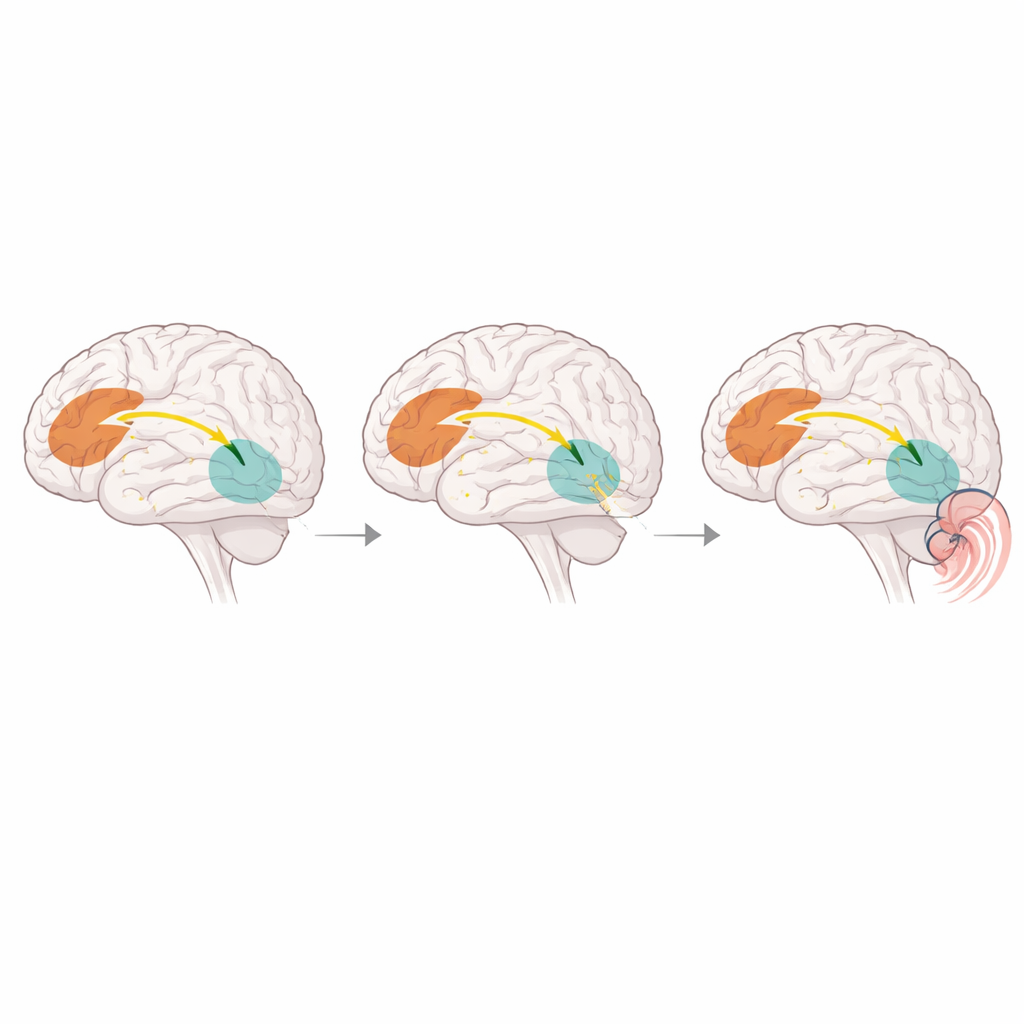
A missing link in brain timing and self‑sense
The authors place their finding in a broader picture in which schizophrenia involves widespread mis‑wiring among brain networks for timing, control, and the sense of agency—the feeling that "I" am the one producing a given action or thought. Other research shows that the supplementary motor area is crucial for estimating time intervals, coordinating complex actions, and detecting mismatches between what we intend and what actually happens. Disturbances in this region have been tied not only to schizophrenia symptoms but also to rare conditions where people feel their own limbs move against their will. The newly observed weakened connection between this timing‑and‑control hub and the speech area suggests that, in hallucination‑prone brains, internal speech may not be properly tagged as "mine" in time, blurring the line between inner voice and external voice.
What this means for people who hear voices
In everyday terms, the study suggests that hearing unreal voices may stem less from a single overactive spot in the brain and more from a frayed conversation between speech and self‑monitoring systems. A consistently weaker link between Broca’s area and the left supplementary motor area showed up only in patients who had ever heard voices, hinting that this pattern could be a stable warning sign of vulnerability rather than a fleeting effect of current symptoms. While the work is limited by modest sample size, surface‑only brain coverage, and a one‑time snapshot, it points toward future studies that follow patients over time and combine resting measurements with tasks that probe timing, inner speech, and self‑agency. Ultimately, such research could help clinicians better identify who is most at risk for persistent voices and guide new strategies that strengthen or rebalance this fragile brain circuit.
Citation: Huang, Z., Ma, Y., Wang, J. et al. Decreased Broca-left supplementary motor area connectivity underlying auditory verbal hallucination: A resting-state NIRS study. Transl Psychiatry 16, 122 (2026). https://doi.org/10.1038/s41398-026-03839-4
Keywords: auditory verbal hallucinations, schizophrenia, brain connectivity, inner speech, functional near-infrared spectroscopy