Clear Sky Science · en
The effect and neural changes underlying mindfulness meditation training in patients with comorbid internet gaming disorder and depression: A randomized clinical trial
Why this matters for everyday life
Many families know the worry of a young person who cannot put down online games, especially when their mood sinks at the same time. This study looks at whether a simple, low‑cost practice—mindfulness meditation—can help people who struggle with both heavy internet gaming and depression. By comparing it with a standard relaxation method and scanning the brain before and after training, the researchers show how a mental habit practiced with closed eyes can reshape brain networks linked to craving, mood, and self‑control.
When gaming becomes a trap
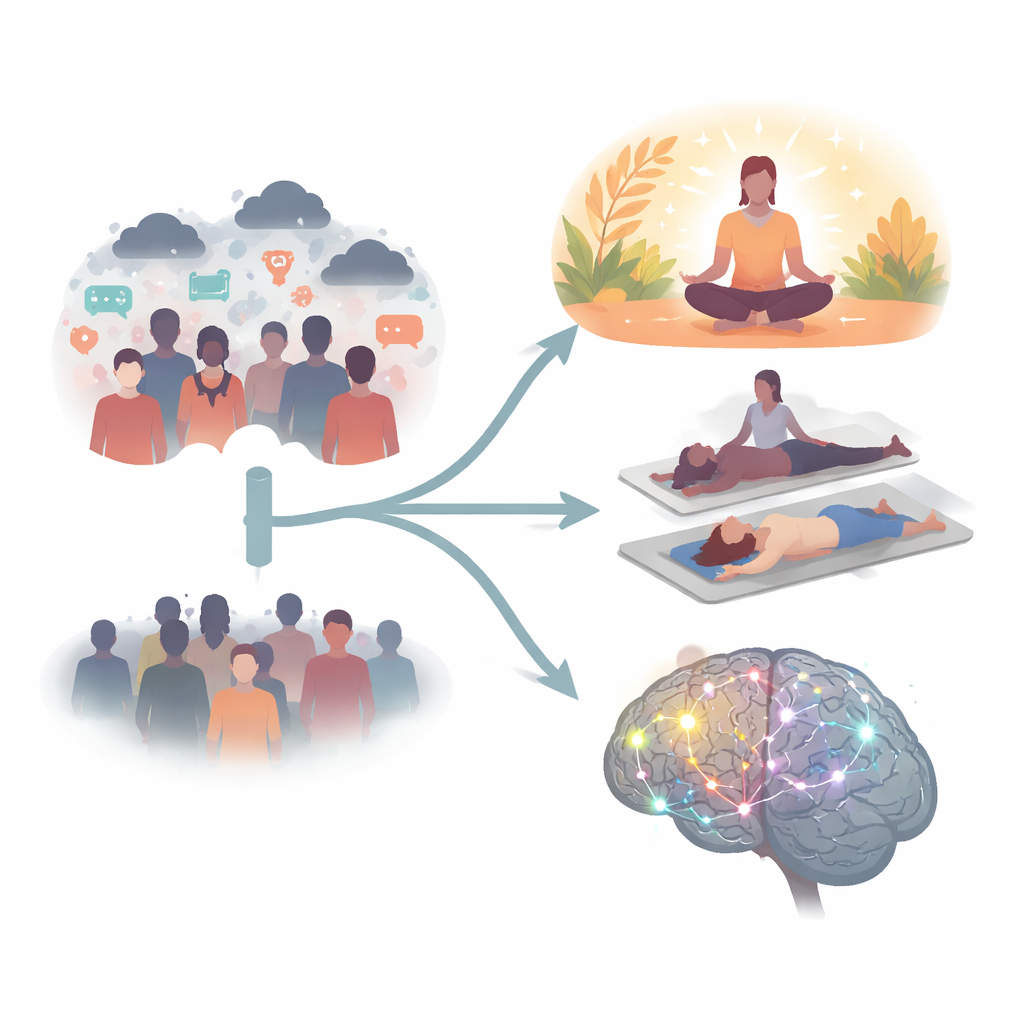
Internet gaming disorder describes a pattern of uncontrolled, repetitive game play that harms school, work, health, or relationships. It is not just “liking games too much”: many affected people also have other mental health problems, most often depression. Those with both conditions tend to suffer more symptoms, carry a heavier emotional burden, and respond less well to treatment than people with gaming problems alone. Traditional approaches—such as cognitive behavioral therapy, medications, or brain stimulation—show promise but have limits, including side effects, the need for strong motivation, or uncertain benefits over the long term. This has created a need for treatments that are safe, acceptable, and able to ease both gaming problems and low mood.
A month of training in two different styles
The researchers recruited 70 college students with both serious gaming problems and significant depression. After careful screening interviews and questionnaires, the volunteers were randomly assigned to two groups. One group received mindfulness meditation training, which teaches people to pay steady, non‑judgmental attention to their present‑moment experience—thoughts, feelings, body sensations, and urges. The other group practiced progressive muscle relaxation, a well‑established method that focuses on tensing and relaxing muscle groups to calm the body. Both groups met in small classes, twice a week for four weeks, with sessions lasting about three hours, so that time, attention, and social contact were similar across groups.
Changes in mood, craving, and daily functioning
Before and after the training, participants completed standard questionnaires measuring the severity of their gaming addiction, their cravings to play, and their level of depression. They also lay in an MRI scanner at rest so that the researchers could study how different brain regions talk to one another. After one month, the mindfulness group showed clear and sizable drops in depression, gaming addiction scores, and cravings, and their reported mindfulness skills increased. The relaxation group also showed some improvement—likely a placebo or general stress‑relief effect—but their symptoms remained in the clinical range, and their gains were smaller. Only in the mindfulness group did better mood and reduced gaming problems strongly track with specific changes in brain connectivity.
How the brain’s control and reward circuits shifted
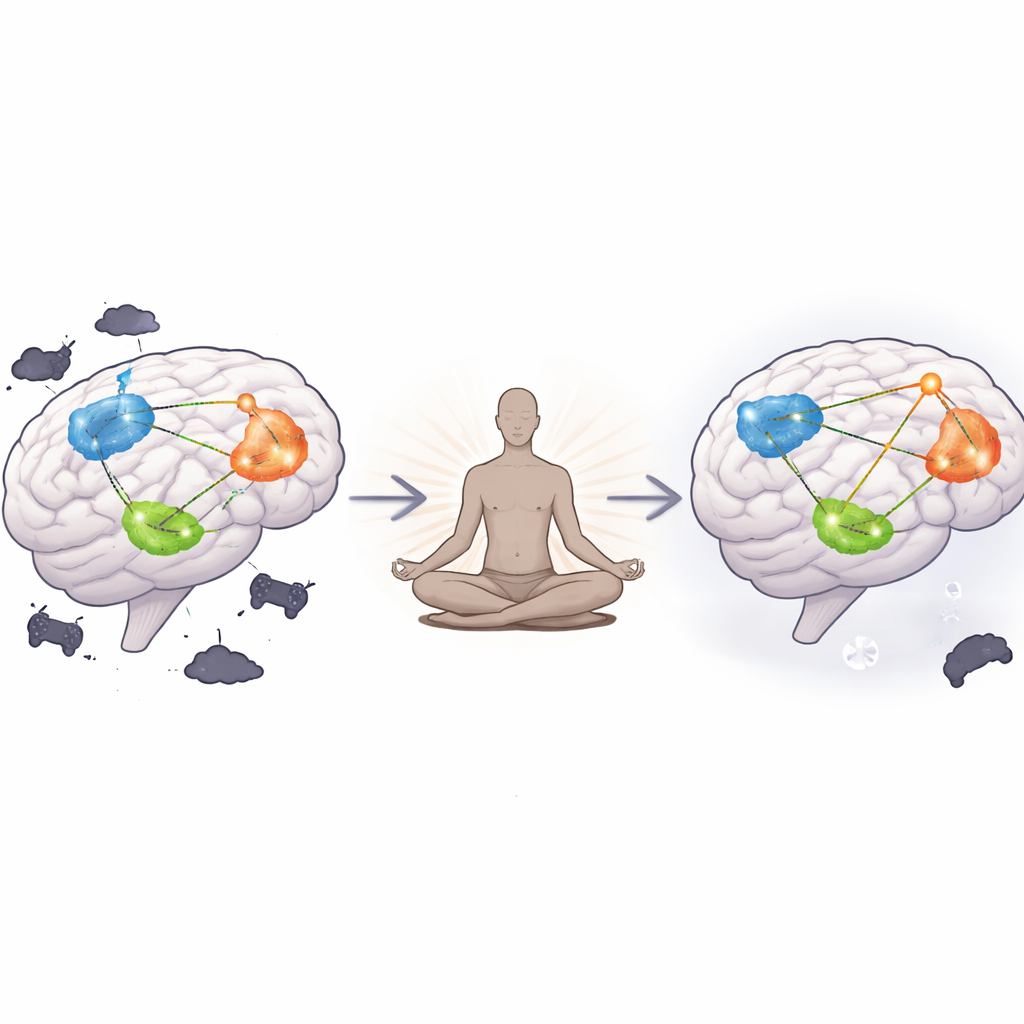
Brain analyses focused on how activity in key hubs became more synchronized with the rest of the brain. After mindfulness training, connections strengthened within and between several important networks. The “executive control” network in the frontal lobes, crucial for attention and self‑control, showed tighter links with regions involved in sensing the body and evaluating rewards. The “default mode” network, which supports inward‑focused thinking and sense of self, became more strongly connected with a region that monitors conflict and helps regulate emotion. Links between the frontal lobes and the amygdala, a deep structure tied to fear and negative feelings, also grew stronger, suggesting better top‑down calming of emotional reactions. In addition, pathways connecting frontal areas with the brain’s reward and habit centers—the striatum and related structures—became more coordinated, which is thought to support healthier control over cravings and pleasure.
From brain chemistry to lived experience
To connect these patterns to underlying chemistry, the team compared their brain‑scan results with maps of where different signaling molecules are most active in the brain. The strengthened connections overlapped with systems that use serotonin, dopamine, acetylcholine, and related transmitters, all known to be involved in mood, motivation, and reward. Importantly, the more a person’s brain connections changed in certain pathways, the more their depression, craving, and gaming addiction scores improved. This points to a coherent picture: mindfulness practice appears to rebalance networks that normally keep emotions in check, guide attention, and weigh long‑term goals against short‑term rewards.
What this means for people who struggle
In plain terms, the study suggests that mindfulness meditation can help people who are caught in a cycle of compulsive gaming and low mood by strengthening the brain’s “brakes” and softening the pull of automatic habits. Rather than simply relaxing the body, mindfulness seems to retrain how attention and emotion work together, interrupting a vicious loop in which gaming is used to escape negative feelings but ultimately deepens them. While the research was done in college students and needs to be repeated in broader groups, it provides strong early evidence that a structured, group‑based mindfulness program is a promising, brain‑based treatment option for those facing both internet gaming disorder and depression.
Citation: Xu, X., Wang, H., Cui, S. et al. The effect and neural changes underlying mindfulness meditation training in patients with comorbid internet gaming disorder and depression: A randomized clinical trial. Transl Psychiatry 16, 131 (2026). https://doi.org/10.1038/s41398-026-03837-6
Keywords: internet gaming disorder, mindfulness meditation, depression, brain connectivity, addiction treatment