Clear Sky Science · en
Psychopathology profiles and longitudinal correlates of nonsuicidal self-injury in youth: a machine-learning approach
Why this research matters for families and communities
Nonsuicidal self-injury (NSSI) — deliberately harming one’s own body without intending to die — is alarmingly common in teenagers and young adults. It is frightening for parents, painful for young people, and closely linked to later mental health problems and suicide risk. This study followed Brazilian children from childhood into early adulthood to ask a crucial question: are there different kinds of young people who end up self-injuring, and can we spot who is most at risk early enough to offer help?
Two different paths to the same harmful behavior
Using data from more than 1,300 children in the Brazilian High-Risk Cohort Study, researchers applied machine-learning tools to sort adolescents and young adults who reported NSSI into groups based on their mental health profiles. These tools, which look for patterns in large datasets, revealed two clear profiles among 244 youth who had self-injured: one with generally high levels of psychological difficulties, and one with relatively low levels. A comparison group of over 1,100 peers who did not report NSSI helped the team understand what made the self-injury groups different. Despite sharing the same behavior, the two NSSI groups had distinct histories and patterns of challenges over time. 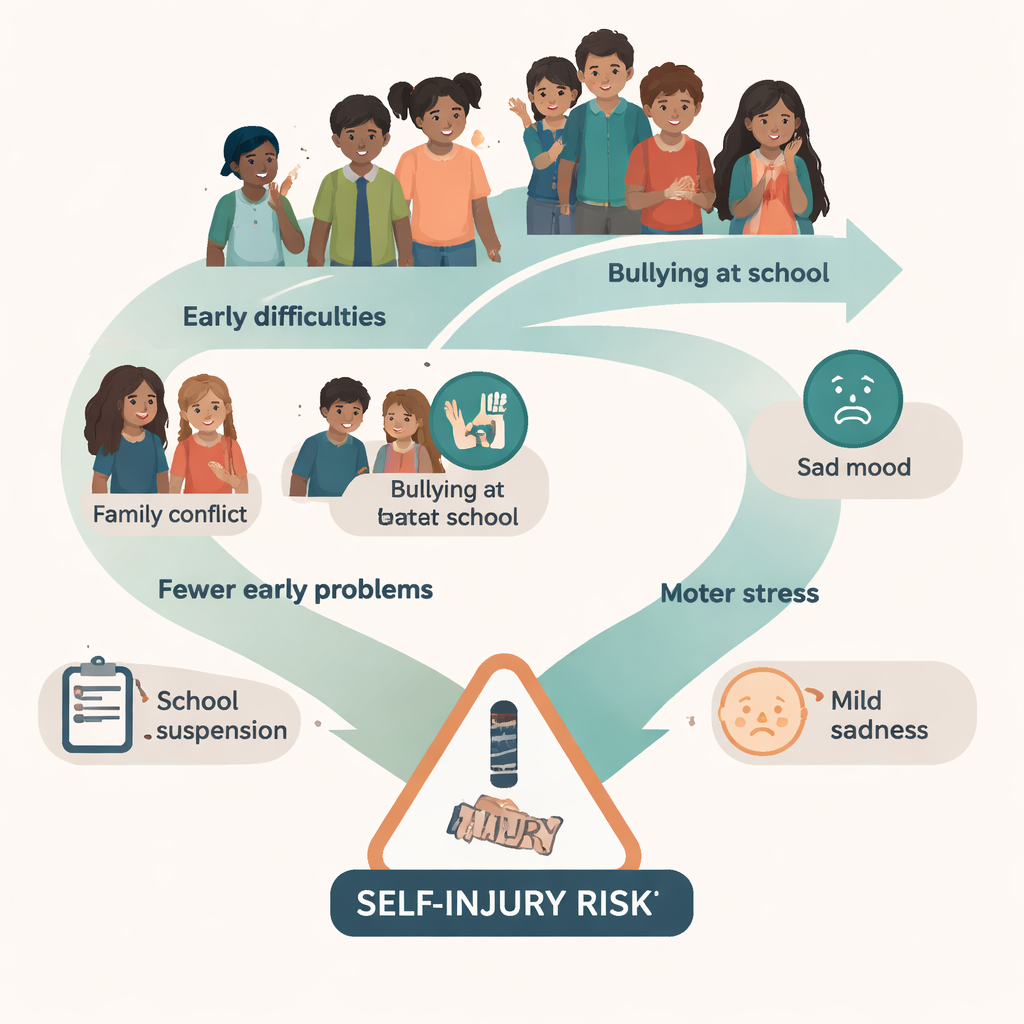
A high-struggle group with early and persistent problems
The first profile — the “high difficulties” group — included young people who had noticeable problems from an early age. As children, they were more likely to have attention-deficit/hyperactivity disorder (ADHD), conflict between parents, strained relationships with caregivers, and a parent with a mood disorder. As they moved into adolescence, their emotional and behavioral problems grew: more anxiety and depression, withdrawal, eating problems, emotional outbursts, bullying victimization, and even being overweight — all signals of mounting distress. By late adolescence and early adulthood, this group showed high rates of diagnosed depression, aggressive behavior, trauma history, and use of psychiatric medications. Their self-injury tended to be more frequent and severe, reflecting a long-running cascade of difficulties at home, at school, and within themselves.
A quieter, lower-symptom path that still leads to self-injury
The second profile — the “lower difficulties” group — looked much closer to the general population for much of childhood. These youth had fewer early mental health symptoms and, on average, better self-control, a thinking skill that helps people pause before acting. They also reported fewer family conflicts and substance exposures early on. Their challenges emerged later, around mid-adolescence, in the form of school suspensions, part-time schooling, some obsessive-compulsive or attention problems, and work or side jobs. By late adolescence, they reported depressive feelings and some dips in optimism and well-being, but did not show the broad, severe psychiatric picture of the first group. Many remained engaged in school, cultural activities, and work. For them, NSSI appears less tied to long-standing mental illness and more to using self-harm as a maladaptive way to cope when ordinary life stress begins to exceed their coping resources.
How machine learning helped connect the dots
Standard statistical methods often struggle to predict who will self-injure, because risk factors overlap and interact in complex ways. Here, the researchers used a two-step machine-learning pipeline. First, an algorithm called a Self-Organizing Map created a “map” of youths’ mental health profiles, and a clustering method split this map into the two NSSI subgroups and the non-NSSI comparison group. Second, other algorithms — including elastic net and random forest models — sifted through dozens of variables collected at three time points, such as diagnoses, symptoms, family factors, school experiences, and cognition. These models performed better than chance at distinguishing the groups, especially the high-difficulties profile, and highlighted combinations of factors like ADHD, bullying, trauma, and parental mood problems for the high-risk group, and school suspension, perfectionism, and later emerging symptoms for the lower-difficulties group. 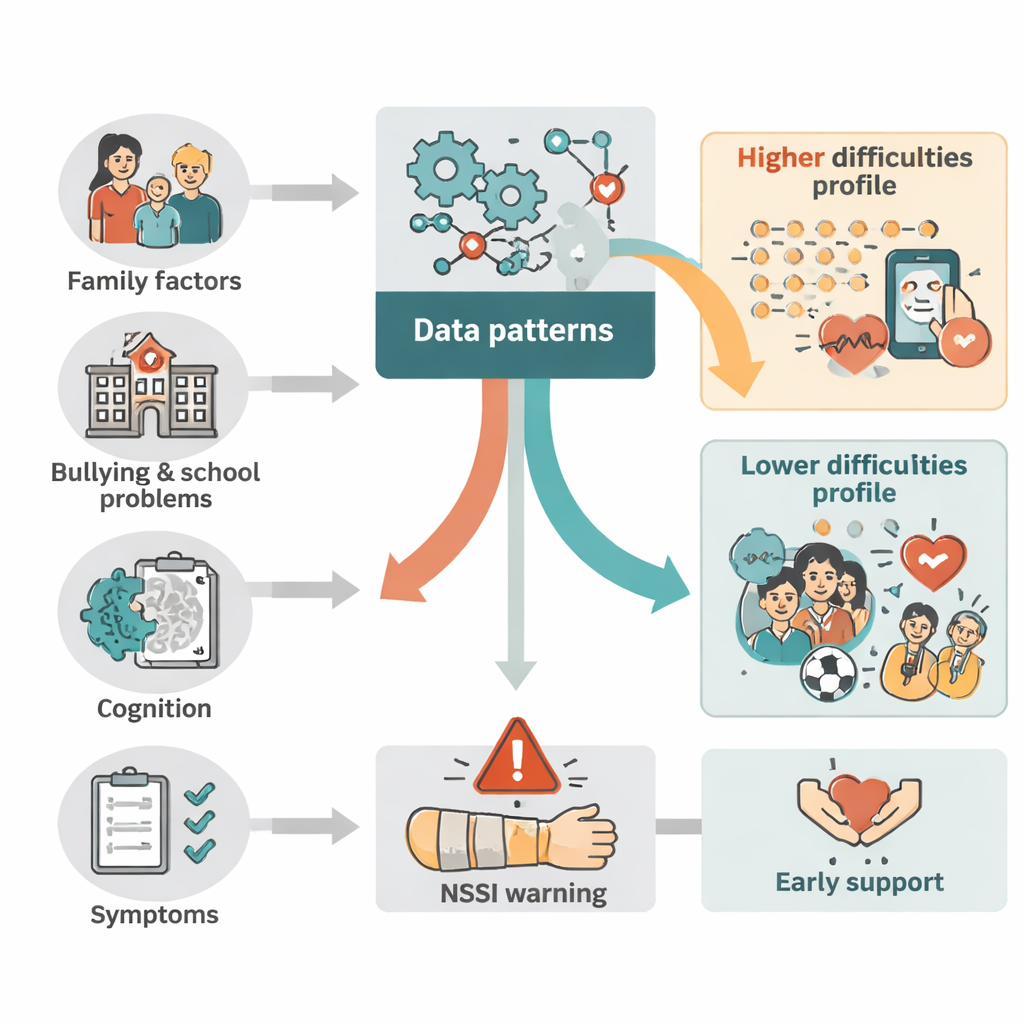
What this means for prevention and support
For a general reader, the main message is that not all youth who self-injure fit the same pattern. Some struggle visibly for years, with multiple mental health and social problems piling up. Others look relatively well-adjusted until later adolescence, when stress and milder problems gradually overwhelm their coping skills. Self-injury in both groups is a red flag for distress, not simply “attention-seeking.” The study suggests that prevention must work on several levels: early identification and treatment of childhood mental health problems and family stress; school and community efforts to reduce bullying; and easy access to brief, skills-based interventions that teach healthier ways to manage emotions, even for teens who do not meet criteria for a formal mental disorder. By recognizing that different pathways can lead to the same dangerous behavior, families, schools, and health systems can respond more flexibly — and, ultimately, more effectively — to protect young people’s futures.
Citation: Croci, M.S., Brañas, M.J., Finch, E.F. et al. Psychopathology profiles and longitudinal correlates of nonsuicidal self-injury in youth: a machine-learning approach. Transl Psychiatry 16, 99 (2026). https://doi.org/10.1038/s41398-026-03832-x
Keywords: nonsuicidal self-injury, youth mental health, machine learning, adolescent development, risk and protective factors