Clear Sky Science · en
Characterizing the co-occurrence of alcohol experimentation and suicidal thoughts and behaviors in early adolescence
Why this research matters for families
Parents often worry when they hear that a child has tried alcohol or expressed feeling hopeless. This study asks a pressing question: when young teens both experiment with alcohol and report suicidal thoughts or behaviors, what is happening inside their minds, and how much of that risk is tied to their genes? Using one of the largest brain and behavior studies of children in the United States, the researchers explored how early sipping of alcohol, patterns of impulsive decision-making, and inherited tendencies might intersect to influence suicidal thoughts and behaviors in early adolescence.
Looking at early warning signs
Suicidal thoughts and behaviors in young people are a major public health concern, and they often appear alongside alcohol and other substance use. Earlier work has shown that even low levels of drinking in children as young as nine can be linked to suicidal thoughts, suggesting that there may be shared underlying vulnerabilities. In adults, both heavy drinking and alcohol use disorder are associated with an increased risk of suicide, through direct effects of alcohol on the brain and through shared genetic factors. This study focused on preteens and young teens, a period when most have had little exposure to alcohol, to better distinguish early vulnerabilities from the later damage caused by heavy drinking. 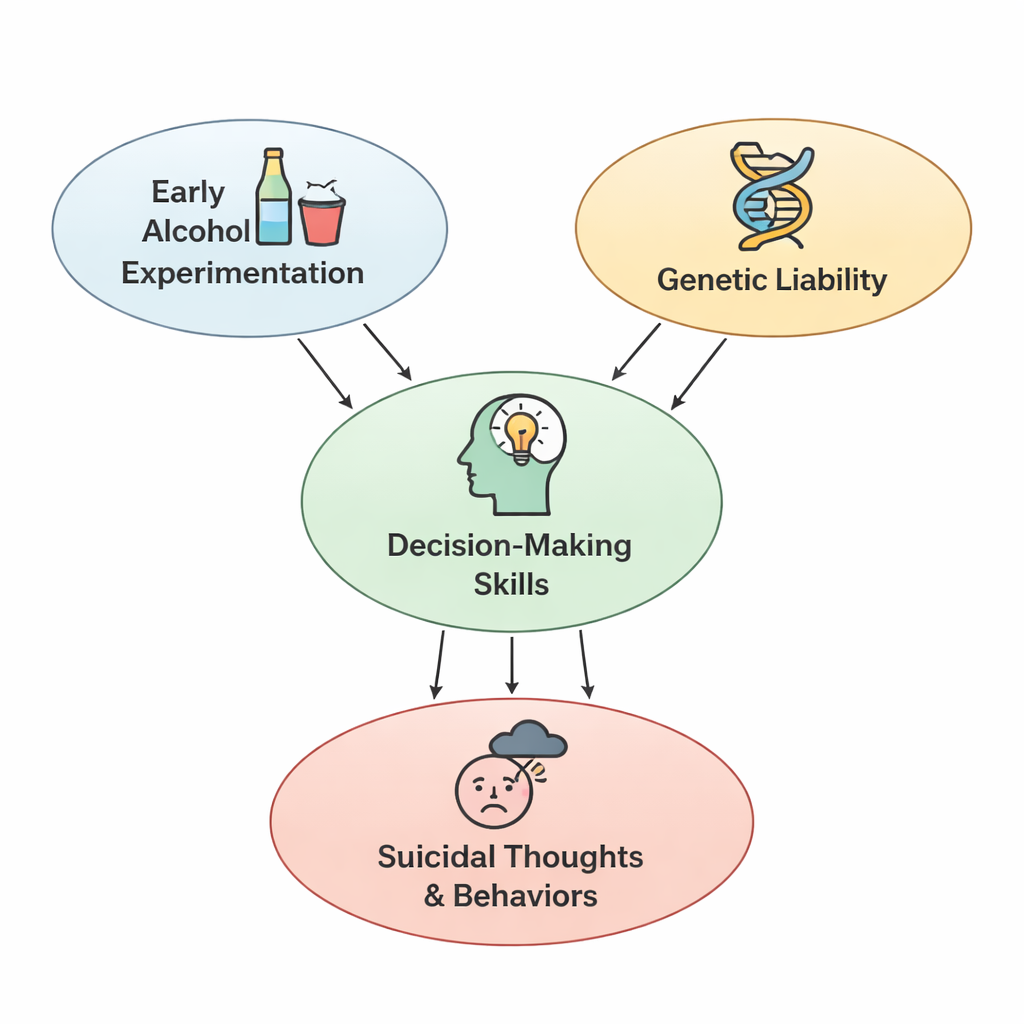
Decision-making under pressure
The authors used data from more than 11,000 participants in the Adolescent Brain Cognitive Development (ABCD) Study, who were first assessed at ages 9–10 and followed yearly. The children completed computer tasks and questionnaires that measured different aspects of decision-making: their ability to focus and switch rules, their willingness to take risks, how strongly they sought excitement, and whether they tended to act rashly when highly emotional. Through statistical modeling, the researchers found that these many measures could be grouped into three broad patterns: a general thinking-skills factor (covering attention, flexibility, and cautious choices), an “emotional impulsivity” factor (tendencies to act quickly when excited or upset and to seek thrills), and a “premeditation-perseverance” factor (how much youths think ahead and stick with tasks).
Genes, alcohol, and suicidal thoughts
The team then asked how these decision-making patterns, along with genetic tendencies, were related to alcohol experimentation (more than one sip) at ages 9–10 and to later suicidal thoughts or suicide attempts about three years later. They analyzed three ancestry-defined groups—European, African, and admixed American—to reduce bias and to see whether patterns held across groups. Overall, between roughly 12% and 28% of youth had tried alcohol, and between about 4% and 5% had experienced suicidal thoughts or attempts. In youth of European ancestry, having tried alcohol was associated with about a 44% higher chance of reporting suicidal thoughts or behaviors later on, even at this low “sipping” level. In contrast, this link was not statistically clear in the African- or American-ancestry groups, likely in part because there were fewer participants and therefore less statistical power.
How impulsivity helps explain the link
To understand how these pieces fit together, the researchers used models that test whether some factors act as bridges between others. In European-ancestry youth, lower emotional impulsivity (that is, being less likely to act rashly when emotional) and better premeditation and perseverance were both associated with fewer suicidal thoughts and behaviors across all groups. Critically, in European-ancestry participants, these two behavioral traits explained part of the connection between early alcohol experimentation and later suicidal thoughts: about 15% of the link ran through emotional impulsivity and about 23% through planning and perseverance. The study also used “polygenic scores” that summarize genetic liability for traits like externalizing behaviors (such as rule-breaking) and delay discounting (favoring smaller immediate rewards over larger delayed ones). In European-ancestry youth, higher genetic risk for externalizing behavior and for steeper delay discounting was related to a greater likelihood of suicidal thoughts and behaviors, in part because these genetic tendencies were associated with more emotional impulsivity and poorer planning and perseverance. 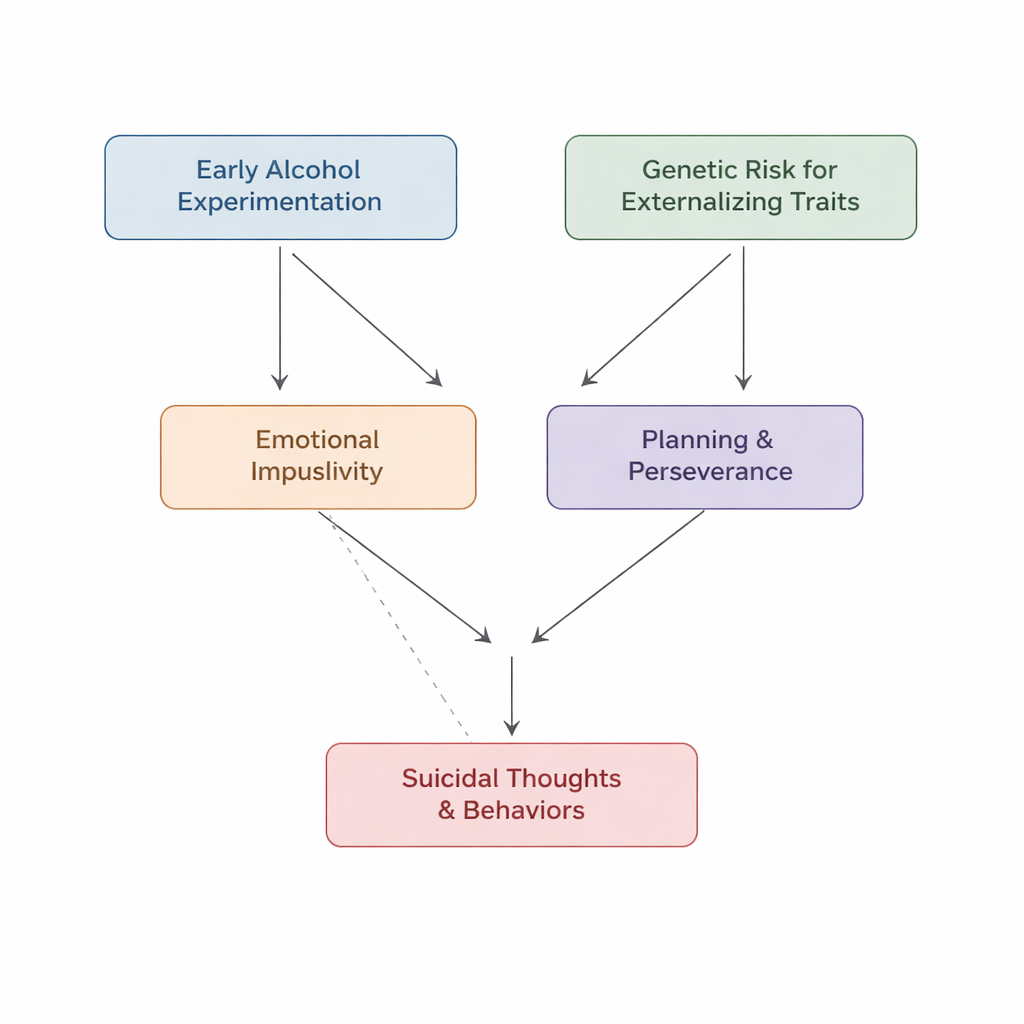
What this means for prevention
For a lay reader, the main message is that even very early, seemingly harmless exposure to alcohol in childhood may flag a broader pattern of risk, especially in young people who struggle with emotion-driven impulsivity and with planning ahead and sticking to goals. While our genes cannot be changed, the decision-making processes highlighted in this study are potentially trainable through psychological and educational interventions that help youths manage emotions, pause before acting, and practice persistence. The findings also suggest that focusing solely on whether a child has sipped alcohol may miss the bigger picture: it is the combination of early alcohol use with certain impulsive tendencies, partly shaped by genetics, that appears most closely tied to suicidal thoughts and behaviors. Strengthening emotion regulation and planning skills in at-risk youths may therefore be a promising path to reducing suicide risk, either on its own or alongside efforts to delay and limit alcohol use.
Citation: Lannoy, S., Bjork, J.M., Stephenson, M. et al. Characterizing the co-occurrence of alcohol experimentation and suicidal thoughts and behaviors in early adolescence. Transl Psychiatry 16, 112 (2026). https://doi.org/10.1038/s41398-026-03826-9
Keywords: adolescent alcohol use, suicidal thoughts and behaviors, impulsivity, genetic risk, decision-making