Clear Sky Science · en
SARS-CoV-2 infection during pregnancy and neurodevelopmental outcomes in early childhood
Why this research matters for parents
The COVID‑19 pandemic left many expectant parents wondering whether catching the virus during pregnancy might affect their baby’s brain and behavior in the long run. This large study from Northern California followed nearly 70,000 children born in the first two years of the pandemic to see whether exposure to SARS‑CoV‑2 in the womb was linked to early developmental diagnoses, including autism. The findings offer both reassurance and a note of caution, especially for families of girls.
A closer look at pregnancy and COVID-19
Researchers used electronic health records from an integrated health system to track 69,987 children born between January 2020 and September 2021 and their mothers. Any mother with a positive PCR test for SARS‑CoV‑2 at any point from her last menstrual period through delivery was considered to have had a COVID‑19 infection during pregnancy. About 4% of pregnancies fell into this exposed group. The team then followed the children from age 3 months up to 4 years, watching for medically diagnosed developmental conditions such as autism, speech or language delay, and motor delay. 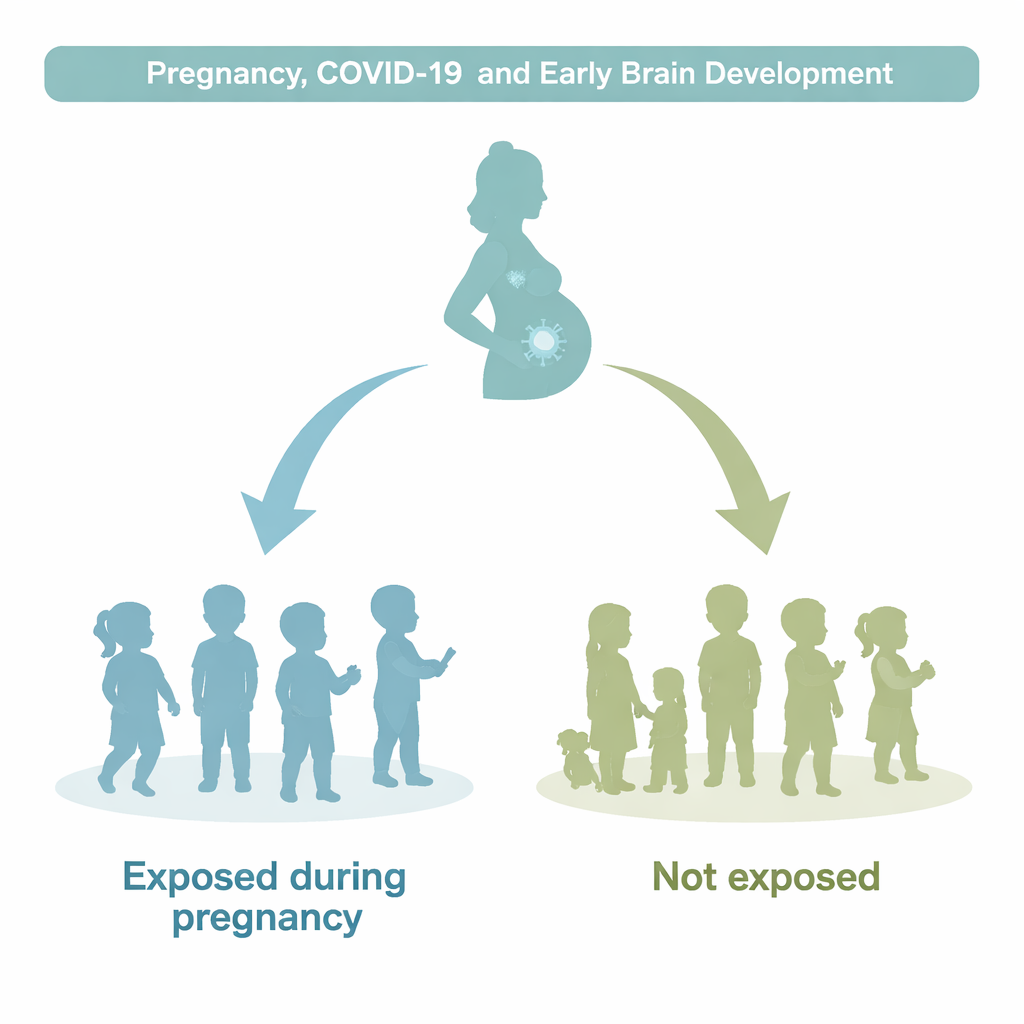
What the researchers measured in children
Because this health system routinely screens toddlers for developmental concerns and autism, most children who showed early warning signs were referred for in‑depth evaluation. By the end of 2023, just over 17% of the children had at least one neurodevelopmental diagnosis, most commonly speech or language delay, followed by autism and motor delay. The researchers compared rates of these diagnoses between children whose mothers had COVID‑19 in pregnancy and those whose mothers did not, while taking into account many other factors that could influence risk, such as maternal age, underlying health conditions, insurance type, and whether the mother was vaccinated during pregnancy.
Reassuring news with one important exception
Overall, maternal COVID‑19 infection during pregnancy was not linked to a higher combined risk of any developmental diagnosis in early childhood. Nor was it associated with increased risk of speech or language delay or motor delay when all children were considered together. However, when the team looked specifically at autism, they saw a small but notable signal: children exposed in the womb had a somewhat higher rate of autism diagnoses than unexposed children. This pattern became clearer when boys and girls were analyzed separately. Girls whose mothers had COVID‑19 while pregnant had about a 44% higher relative risk of an autism diagnosis, while boys showed no meaningful increase in risk. 
Timing during pregnancy and possible biological clues
The study also explored whether the stage of pregnancy when infection occurred made a difference. Infections during the first and second trimesters were linked to a suggestive rise in autism risk, while third‑trimester infections were not. Although these differences did not reach strong statistical certainty, they align with existing evidence that early pregnancy is a sensitive period for brain development. The authors discuss one possible explanation: when a pregnant person’s immune system fights an infection, chemical signals involved in inflammation can reach the placenta and fetus. Prior research suggests these immune signals, which may differ depending on the baby’s sex, can subtly influence how the developing brain is wired.
What this means for families and the future
For most developmental outcomes studied, COVID‑19 in pregnancy did not appear to increase early childhood risk, which is encouraging news. The possible higher autism risk seen only in girls, especially when infection occurred earlier in pregnancy, is more tentative. It points to a need for continued follow‑up of these children as they grow older and for additional studies in other populations. For now, the findings support ongoing efforts to prevent severe infection in pregnancy—such as vaccination—while also reassuring most families that a COVID‑19 illness during pregnancy is unlikely to cause broad developmental problems. The signal seen for autism in girls should be viewed as an early warning to investigate further, not as a cause for alarm for any individual child.
Citation: Croen, L.A., Qian, Y., Grosvenor, L. et al. SARS-CoV-2 infection during pregnancy and neurodevelopmental outcomes in early childhood. Transl Psychiatry 16, 68 (2026). https://doi.org/10.1038/s41398-026-03818-9
Keywords: COVID-19 in pregnancy, autism risk, child development, maternal infection, SARS-CoV-2