Clear Sky Science · en
Intranasal dantrolene nanoparticles inhibit lipopolysaccharide-induced depression and anxiety behavior in mice
Why calming brain inflammation matters
Depression and anxiety affect hundreds of millions of people worldwide, yet many patients do not get enough relief from current medicines, or must wait weeks before they start to feel better. A growing body of research suggests that, in at least some cases, these conditions are linked to smoldering inflammation inside the brain that damages connections between nerve cells. This study explores a novel idea: delivering an existing drug, dantrolene, directly into the nose as tiny nanoparticles to calm this inflammation before it can trigger depression- and anxiety-like behavior, at least in mice.
A new use for a familiar drug
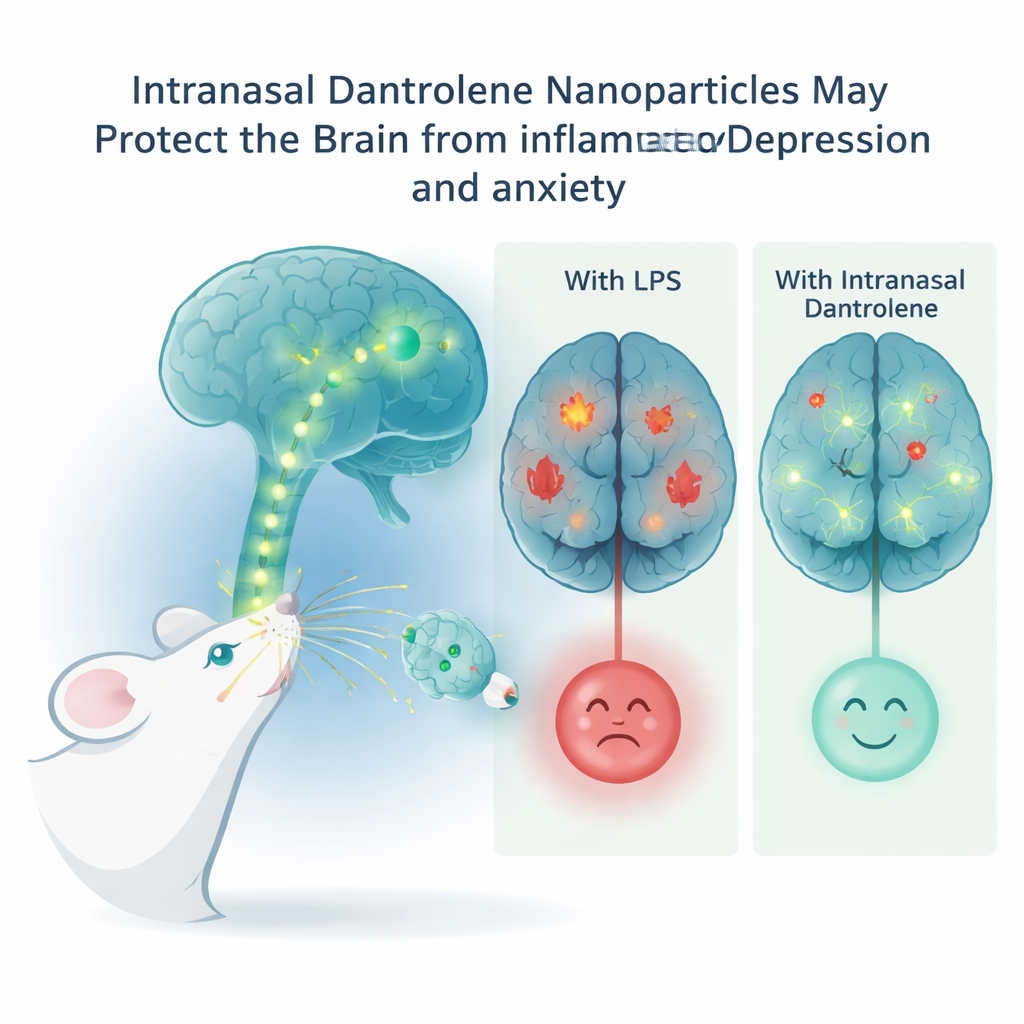
Dantrolene is already approved to treat dangerous muscle problems, but it also acts on a key calcium channel inside cells called the ryanodine receptor. When this channel is overactive in brain cells, calcium levels become chaotic, disturbing energy production in mitochondria and triggering inflammatory processes that can harm neurons. The researchers reasoned that, if they could damp down this early calcium disruption, they might also reduce the wave of inflammation and cell damage that follows—and in turn, lessen depression- and anxiety-like behavior. To get more of the drug into the brain with fewer whole-body side effects, they packaged dantrolene into nanoparticles and delivered it through the nose, a route known to help medicines bypass the blood-brain barrier.
Putting the idea to the test in mice
To mimic inflammation-linked depression and anxiety, the team injected adult mice once with lipopolysaccharide (LPS), a bacterial component that reliably provokes a strong immune response and short-term sickness behavior. Before this challenge, some mice received four weeks of intranasal dantrolene nanoparticles, others received an empty vehicle, and a control group received no pretreatment. One day after the LPS injection, the animals were put through a series of standard behavioral tests: the forced swim and tail suspension tests, which measure how quickly mice give up active escape attempts (a proxy for helplessness or depression-like behavior), and the elevated plus maze and open field tests, which gauge anxiety by tracking how readily mice explore more exposed areas.
Dampening despair and fear-like behavior
Mice that received LPS alone showed clear signs of distress. They spent much more time immobile in the forced swim and tail suspension tests, and they preferred the closed arms of the elevated maze and stayed still longer in the open field, patterns interpreted as stronger depression- and anxiety-like behavior. In contrast, mice that had been pretreated with intranasal dantrolene nanoparticles were far less affected: their immobility times dropped by roughly half, and they ventured more into open spaces. These protective effects were not seen in animals given the vehicle without dantrolene, indicating that the active drug—not just the delivery method—made the difference. Interestingly, the benefits were generally stronger in female mice than in males, echoing the higher real-world burden of depression and anxiety in women.
Quieting inflammatory signals and protecting synapses
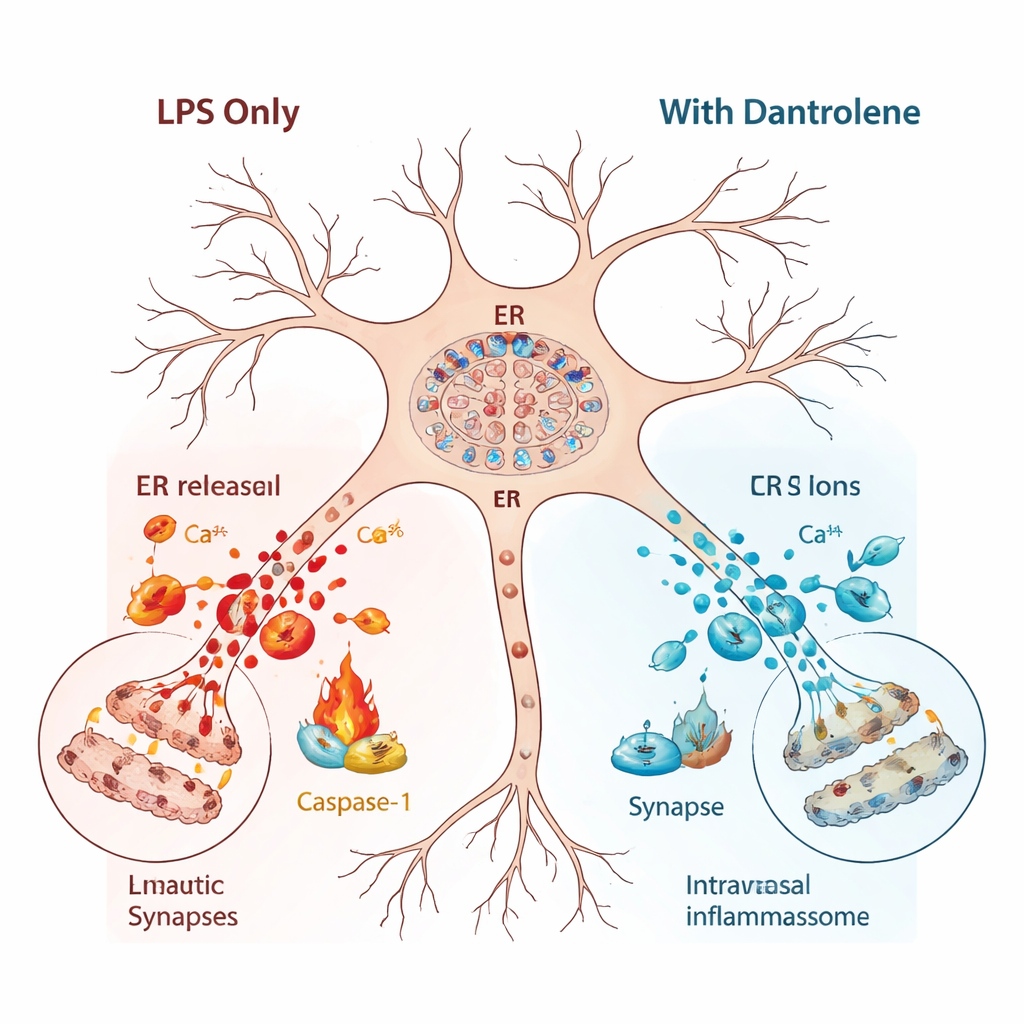
The behavioral changes tracked closely with biological markers of inflammation and brain damage. LPS sharply boosted levels of two inflammatory messenger proteins, IL-1β and IL-18, in both blood and brain tissue, and activated a cell-death pathway called pyroptosis, which involves proteins such as caspase-1 and gasdermin D. It also reduced levels of key synaptic proteins, PSD-95 and synapsin-1, which help maintain healthy connections between neurons. Pretreatment with intranasal dantrolene nanoparticles substantially blunted the rise in IL-1β and IL-18, reduced activation of caspase-1, and largely restored synaptic protein levels. These findings suggest that the drug not only eases behavior but also shields the physical wiring of brain circuits from inflammation-driven damage.
What this could mean for future treatments
For non-specialists, the takeaway is straightforward: by calming overactive calcium signals inside brain cells and dialing down inflammation, intranasal dantrolene nanoparticles prevented mice from developing strong depression- and anxiety-like behaviors after an inflammatory shock. While mouse studies do not guarantee success in people, this work points to a possible new class of treatments that target the root cellular disturbances behind mood disorders, rather than just the chemical messengers between neurons. If future research confirms that this approach is safe and effective in humans, it could offer faster-acting, more targeted options for people with hard-to-treat depression or anxiety.
Citation: Liu, J., Lu, Y., Bhuiyan, P. et al. Intranasal dantrolene nanoparticles inhibit lipopolysaccharide-induced depression and anxiety behavior in mice. Transl Psychiatry 16, 104 (2026). https://doi.org/10.1038/s41398-026-03816-x
Keywords: depression, anxiety, brain inflammation, intranasal drug delivery, dantrolene