Clear Sky Science · en
Cannabidiol blood metabolite levels after cannabidiol treatment are associated with broadband EEG changes and improvements in visuomotor and non-verbal cognitive abilities in boys with autism requiring higher levels of support
How a Cannabis Compound May Help Kids with Severe Autism
Families of children with autism who need constant support are often desperate for safer treatments that can ease behavior problems and boost learning. This study asked whether a purified form of cannabidiol (CBD) — a non‑intoxicating component of cannabis already approved for rare epilepsies — might gently shift brain activity and support thinking and coordination in boys with severe autism, and whether simple brain‑wave recordings could help track who benefits most.
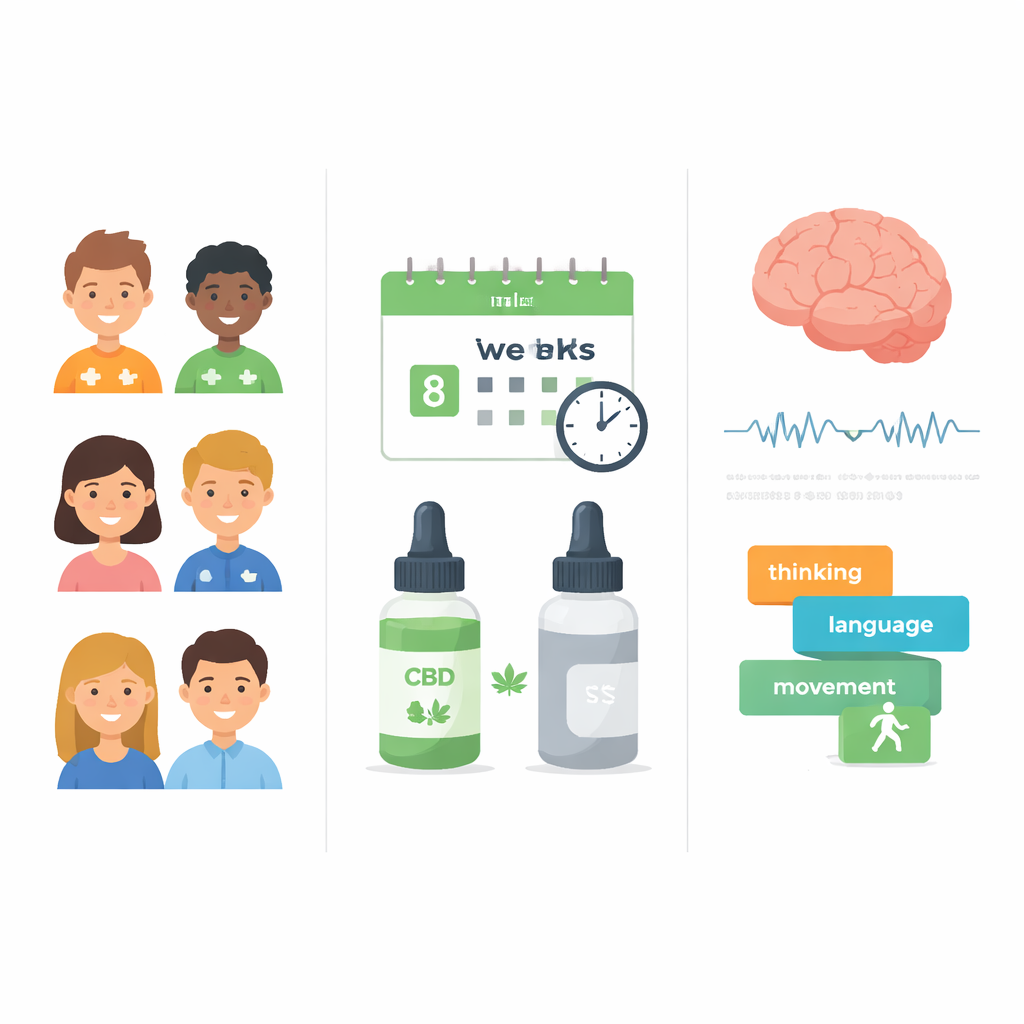
Testing CBD in Children Who Need the Most Help
The researchers re‑analyzed data from a rigorous clinical trial of 24 boys aged 7 to 14 with autism who all required round‑the‑clock supervision. In a double‑blind, placebo‑controlled, crossover design, each child received eight weeks of daily purified CBD (up to 20 milligrams per kilogram of body weight per day) and eight weeks of placebo, with a four‑week break in between. At four key time points — before treatment, after CBD, after placebo, and after the washout — the team collected blood samples, measured behavior and thinking skills, and recorded resting brain activity using a cap that detects the brain’s tiny electrical signals (EEG).
Looking Under the Hood of Brain Waves
Instead of focusing only on well‑known brain rhythms such as alpha waves, the scientists separated EEG signals into two parts: repeating rhythms and a “background hum” spread across many frequencies. That background activity is thought to reflect how active networks of brain cells are overall, and how well excitation and inhibition are balanced. Using advanced computer methods, the team measured features of this background signal across frontal, central, and back‑of‑the‑head (occipital) regions, then related those measures to the actual CBD and CBD‑related substances circulating in the children’s blood.
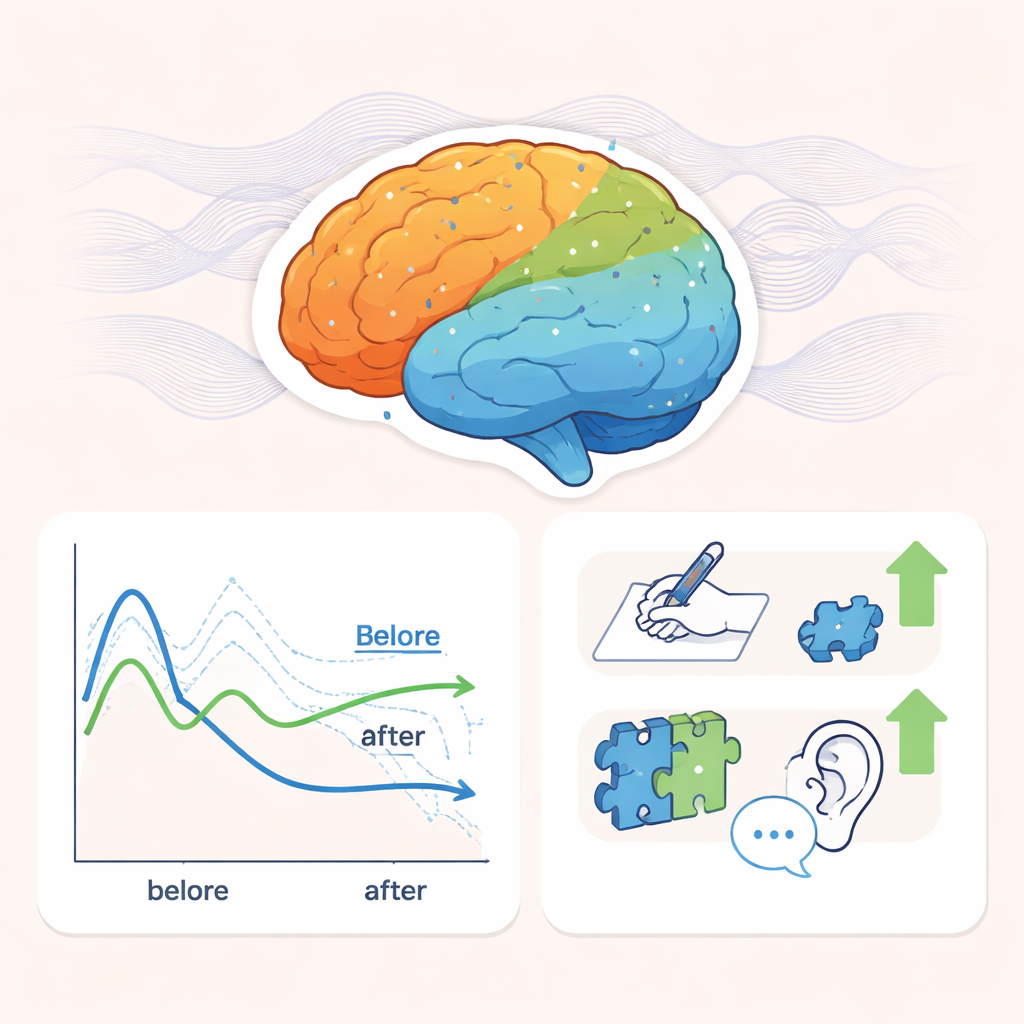
CBD Metabolites Track Subtle Shifts in Brain Activity
After eight weeks on CBD, levels of CBD and its breakdown products in the blood rose sharply, confirming that the children were consistently exposed to the drug. Higher levels of one major CBD metabolite, called 7‑carboxy‑CBD, were tied to a general increase in the overall strength of the background EEG signal across much of the scalp, and to a slight flattening of the signal in back‑of‑the‑head regions. These patterns are similar to some changes seen in typical brain development and suggest that CBD may be nudging the activity of large networks of brain cells, rather than just tweaking a single type of brain rhythm.
Hints of Gains in Thinking, Language, and Coordination
To see whether these brain changes mattered for everyday abilities, the team examined standard tests the boys completed, such as matching pictures to spoken words (receptive vocabulary), solving non‑verbal puzzles, and copying shapes that require hand‑eye coordination. Overall, higher CBD metabolite levels were modestly linked with better understanding of spoken words, slightly higher non‑verbal reasoning scores, and — most clearly — better visuomotor skills like drawing shapes accurately. Not every child improved, and some showed little or no change, but the strongest and most consistent gains appeared in the tests that rely on coordinating what the eyes see with how the hands move.
What This Means for Families and Future Treatments
For parents and clinicians, these results do not yet prove that CBD is a miracle treatment for severe autism. The study was small, involved only boys, and the improvements in thinking and behavior were generally modest and varied from child to child. However, the work shows that a purified, regulated CBD preparation can be given safely over weeks, that it is linked to measurable shifts in brain‑wave patterns, and that some children show meaningful gains in coordination and certain thinking skills. Just as important, the study highlights new EEG‑based measures that could serve as simple, non‑invasive markers to track how a child’s brain responds to future autism treatments, helping to tailor therapies to those most likely to benefit.
Citation: Cazares, C., Hutton, A., Paez, G. et al. Cannabidiol blood metabolite levels after cannabidiol treatment are associated with broadband EEG changes and improvements in visuomotor and non-verbal cognitive abilities in boys with autism requiring higher levels of support. Transl Psychiatry 16, 109 (2026). https://doi.org/10.1038/s41398-026-03815-y
Keywords: cannabidiol, autism, EEG, visuomotor skills, child neurodevelopment