Clear Sky Science · en
Identifying drug targets for schizophrenia through gene prioritization
Why genes matter for better schizophrenia treatments
Schizophrenia affects how people think, feel, and perceive the world, and current medications often leave many symptoms—especially thinking and motivation problems—only partly treated. This article explains how scientists are using large genetic studies to draw up a short list of specific genes that appear to raise the risk of schizophrenia and could be turned into targets for new or repurposed drugs. For a lay reader, it offers a window into why modern genetics is changing how we search for psychiatric medicines, and why this might finally lead to treatments that work better and have fewer side effects.
From scattered genetic clues to a focused map
Over the past decade, genome-wide association studies (GWAS) have compared the DNA of tens of thousands of people with and without schizophrenia, revealing more than 250 regions of the genome linked to the illness. Each region can contain many genes, making it unclear which ones truly matter. Earlier efforts mostly zoomed in on whichever genes sat closest to the genetic signals, or on those whose activity in the brain seemed altered. The authors of this paper argue that such “local” approaches miss important information in the rest of the genome and can be imprecise, sometimes pointing to the wrong gene. Their goal was to combine several high-precision methods to build a more reliable list of genes that genuinely influence schizophrenia risk.
Combining powerful tools to pick out key genes
Using genetic data from more than 67,000 people with schizophrenia and 94,000 controls, the researchers applied three main strategies. First, they used a statistical method called MAGMA to estimate how strongly each gene across the genome is linked to the disorder, then fed those results into a tool called PoPS, which learns what “features” (such as expression in certain brain cells or membership in known pathways) tend to mark true risk genes. Second, they fine-mapped genetic regions to pinpoint rare protein-changing variants that are very likely to alter gene function. Third, they drew on an independent study of ultra-rare mutations that strongly increase schizophrenia risk. By insisting that prioritized genes pass strict cutoffs—for example, ranking in the top 10% of PoPS scores—they whittled down thousands of candidates to 101 high-confidence genes. 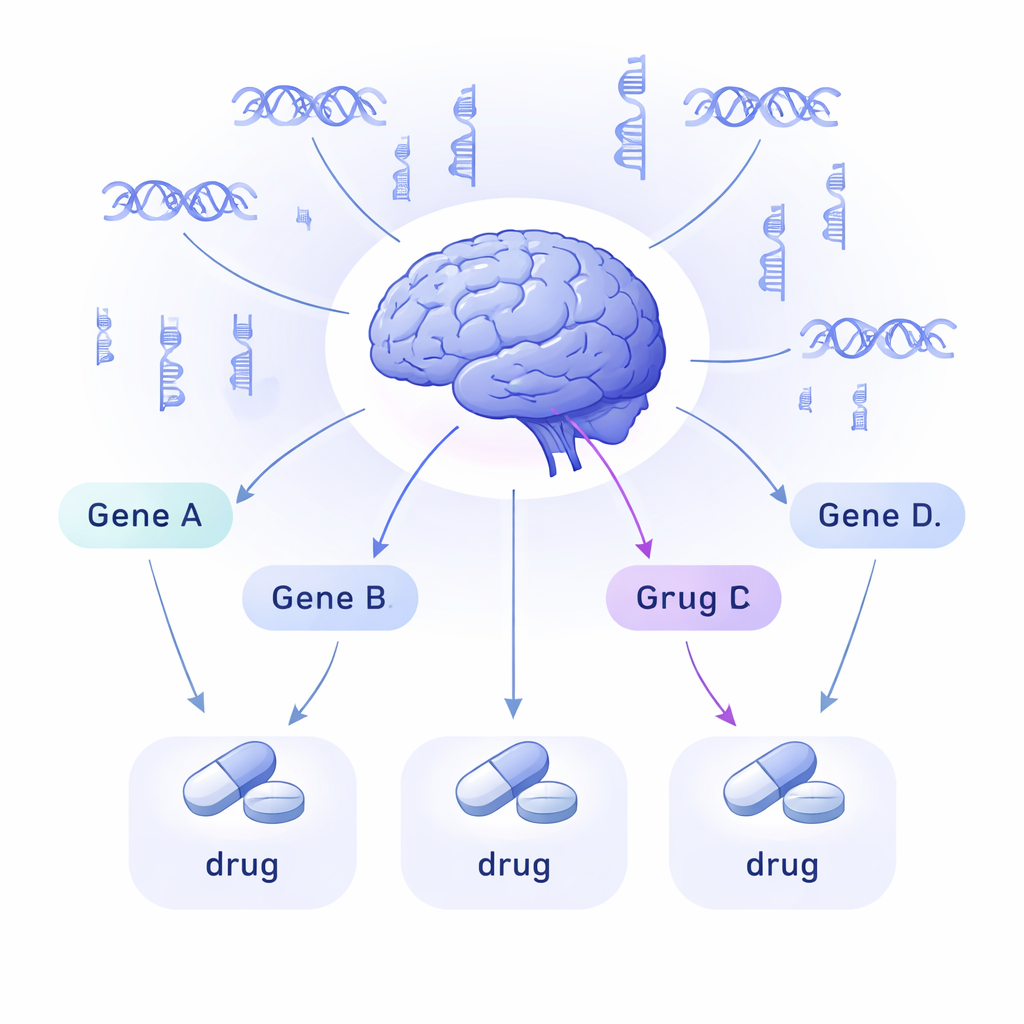
What the prioritized genes reveal about brain pathways
The 101 genes highlight several biological systems that have long been suspected in schizophrenia, but with new precision. Some are involved in glutamate signaling (for example GRIN2A, GRM3, GRM1), which affects learning, memory, and how nerve cells communicate. Others encode calcium channels (such as CACNA1C, CACNB2, CACNA1I) that help control the electrical activity of brain cells and may influence mood and cognition. Additional genes are tied to GABA signaling (GABBR2), the brain’s main inhibitory system, and to dopamine (DRD2), the very receptor targeted by most existing antipsychotic drugs. The study also found overlaps with genes linked to autism, developmental delay, and addiction, suggesting that some underlying brain mechanisms are shared across these conditions.
Turning genetic insights into drug opportunities
A key aim of the work was to identify genes already targeted by approved or experimental drugs, raising the possibility of repurposing them for schizophrenia. The team found 15 such genes, including DRD2, GRIN2A, CACNA1C, GABBR2, and PDE4B. Some of these have been or are being tested in schizophrenia trials, for example drugs that enhance NMDA-type glutamate receptors for cognitive symptoms, or calcium channel blockers that might aid mood and thinking. Others, such as AKT3 and SNCA (a major player in Parkinson’s disease), have drugs in cancer or neurological trials but have not yet been studied in psychiatric patients. The authors also flagged seven genes that are not yet drugged but belong to protein families considered “druggable,” meaning that, in principle, small molecules can be designed to modulate their activity. 
Shared biology with addiction and future directions
Intriguingly, the study found that some schizophrenia genes—especially PDE4B and VRK2—also appear in large genetic studies of substance use disorders. Because addiction can be modeled more reliably in animals than schizophrenia, the authors suggest using rodent addiction models to test whether drugs acting on these shared genes could benefit both conditions. They stress, however, that their list comes from computational analyses and must be followed by detailed laboratory and clinical work. Not every prioritized gene will prove to be a safe or effective drug target, and the effects of turning a gene “up” or “down” in the brain need to be carefully understood.
What this means for people living with schizophrenia
For non-specialists, the main message is that scientists are no longer guessing blindly at drug targets for schizophrenia. By integrating massive genetic datasets with advanced statistical tools, this study provides a vetted shortlist of 101 genes that most likely contribute to the disorder and highlights which of them already have drugs pointed at them. Over time, this roadmap could guide the redesign of existing medicines and inspire new ones, with the hope of treatments that better address thinking and motivation problems, work in people who do not respond to current drugs, and perhaps even tackle overlapping issues like addiction.
Citation: Kraft, J., Braun, A., Awasthi, S. et al. Identifying drug targets for schizophrenia through gene prioritization. Transl Psychiatry 16, 102 (2026). https://doi.org/10.1038/s41398-026-03813-0
Keywords: schizophrenia genetics, drug targets, GWAS, drug repurposing, brain pathways