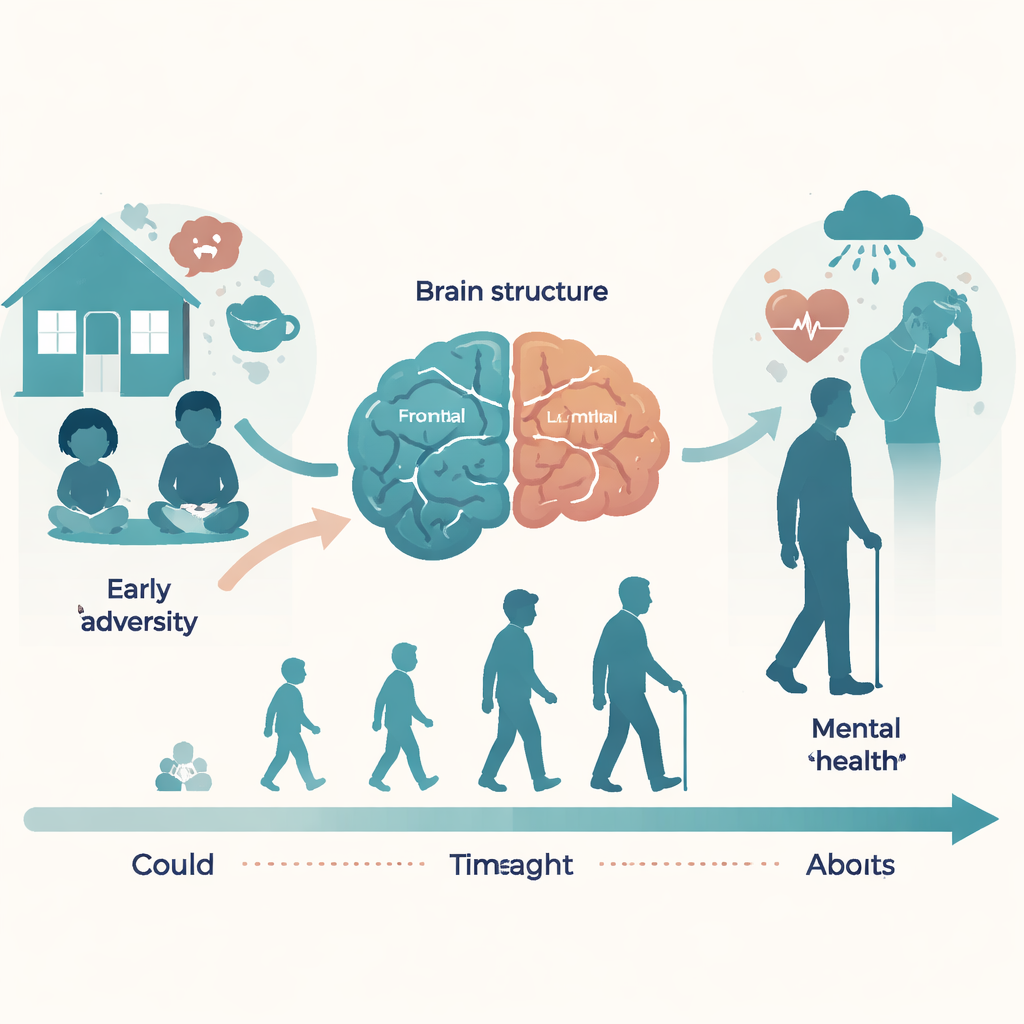
Many people assume that childhood is long behind us once we reach midlife. Yet experiences like abuse, neglect, or growing up in a chaotic home can leave deep marks that echo into old age. This study asks a pressing question for our aging societies: do the emotional shocks of early life still show up in the brains and mental health of people in their 50s, 60s, and 70s—and if so, how?
A closer look at childhood adversity
The researchers focused on "adverse childhood experiences," or ACEs—ten types of difficulties before age 18, including emotional and physical abuse or neglect, sexual abuse, and serious problems at home such as violence or substance misuse. Earlier work had already linked ACEs to higher risks of depression, anxiety, physical illnesses, and brain changes in younger and middle-aged adults. But most of those studies were small and rarely included older people, leaving open whether these effects fade, intensify, or change as we age.
Following thousands of adults in one city Figure 1.
To address this gap, the team used data from the Hamburg City Health Study, a large health project in Germany. They analyzed 1,900 adults aged 46 to 78 who completed brain scans and detailed questionnaires. Participants reported how many types of ACEs they had experienced (from none to four or more). They also answered questions about symptoms of depression and anxiety. Brain scans measured both specific areas long suspected to be affected by early stress—such as the hippocampus, amygdala, and a part of the frontal lobe involved in planning and control—and, in a second step, the entire brain.
Childhood hurts still shape mood in later life
The results were strikingly clear for mental health. The more ACEs a person had experienced, the higher their average scores for depression and anxiety symptoms—even decades later. People with no ACEs had only mild symptom levels on average, while those with four or more types of adversity scored more than twice as high. This pattern held even though the group came from the general population rather than a psychiatric clinic, meaning most participants were not severely ill. The findings suggest that childhood hardship leaves a cumulative emotional footprint that does not simply vanish with time.
Subtle but widespread changes in the brain
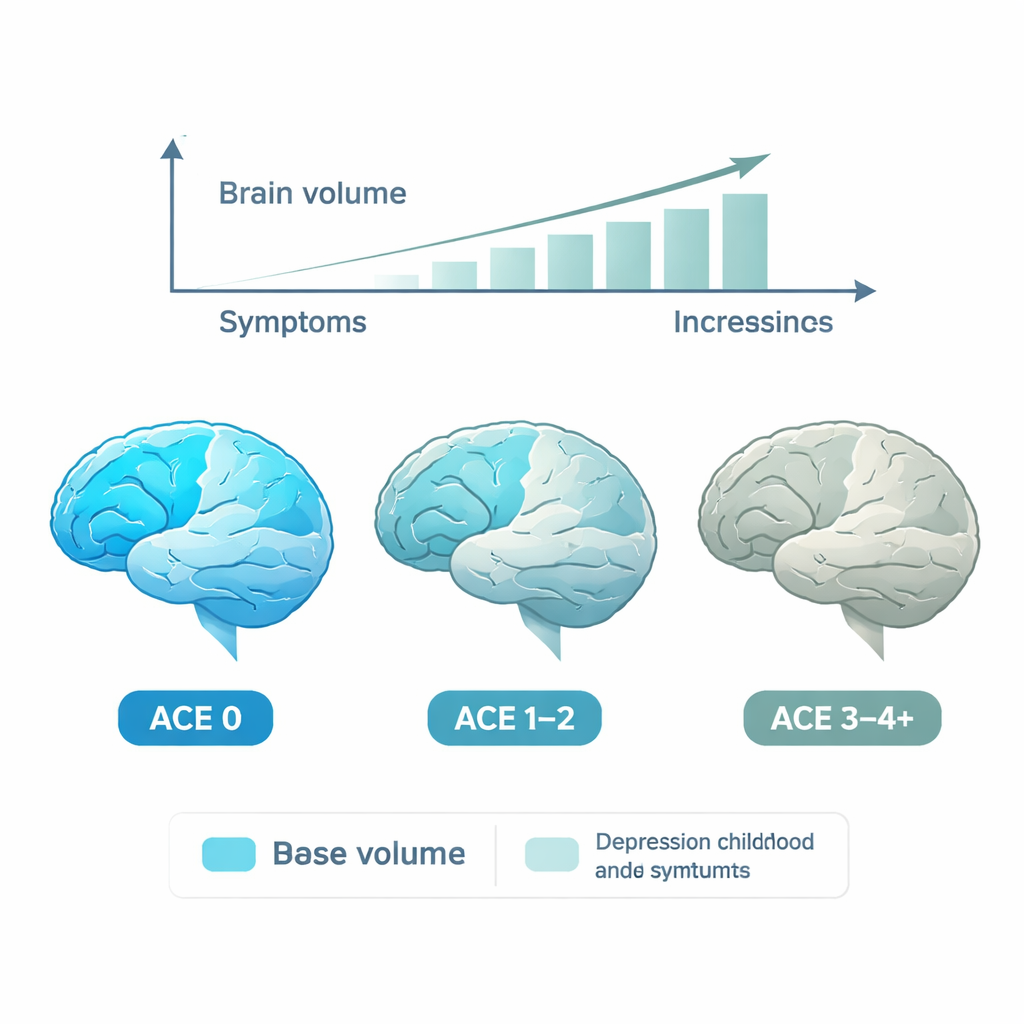
When the researchers looked at their original “suspect” brain regions, they found no convincing evidence that differences in the size of the hippocampus, amygdala, or a key frontal area explained the link between ACEs and mental health in older age. But when they broadened their view to the whole brain, a more nuanced picture emerged. People with three ACEs already showed smaller volumes of grey matter—the brain’s working tissue—in several areas involved in reward, emotion, and self-control, including parts of the frontal lobes, the insula, and a reward hub called the nucleus accumbens. For those with four or more ACEs, these reductions were more widespread, extending into frontal, limbic, parietal, temporal, occipital regions, and even the cerebellum. Notably, there were no areas where brain tissue was larger in people with more ACEs.
A threshold where the brain struggles Figure 2.
Taken together, the findings suggest a dose–response pattern: a single or a couple of adverse experiences were not clearly tied to brain differences in this older group, but three or especially four or more types of adversity marked a potential threshold where structural changes were easier to detect. Importantly, these brain differences did not fully explain the ongoing emotional difficulties, hinting that other factors—such as how people cope, their life circumstances, or their brain’s overall "reserve"—also play major roles.
What this means for everyday life and policy
For a layperson, the message is sobering but also clarifying: serious difficulties in childhood can leave a scar that is visible not only in people’s mood and anxiety levels, but also in the structure of their brains well into later life. Yet the study also suggests that it is the piling up of multiple kinds of adversity that is particularly harmful. This underlines the importance of early prevention, social support, and long-term monitoring for those with heavy childhood burdens. As populations age and global crises threaten to expose more children to trauma, understanding and reducing these lifelong effects—on both mind and brain—may become a central task for public health and social policy.
Citation: Klimesch, A., Ascone, L., Thomalla, G. et al. Echoes of childhood trauma: the relationship between adverse childhood experiences, brain structure, and mental health in aging adults.
Transl Psychiatry16, 52 (2026). https://doi.org/10.1038/s41398-026-03811-2