Clear Sky Science · en
Several novel classes of small regulatory RNAs show widespread changes in schizophrenia and bipolar disorder and extensive linkages to critical brain processes
Hidden Messages in the Brain
Schizophrenia and bipolar disorder can dramatically alter how people think, feel, and behave, yet the biological roots of these illnesses are still being uncovered. This study zooms in on a little-known layer of brain chemistry: tiny RNA molecules that do not make proteins but instead help control which genes are turned on or off. By exploring these “molecular whispers” in brain tissue from people with and without these disorders, the researchers reveal new clues about how brain cells communicate, age, and support memory and thought.
Tiny Regulators with Big Influence
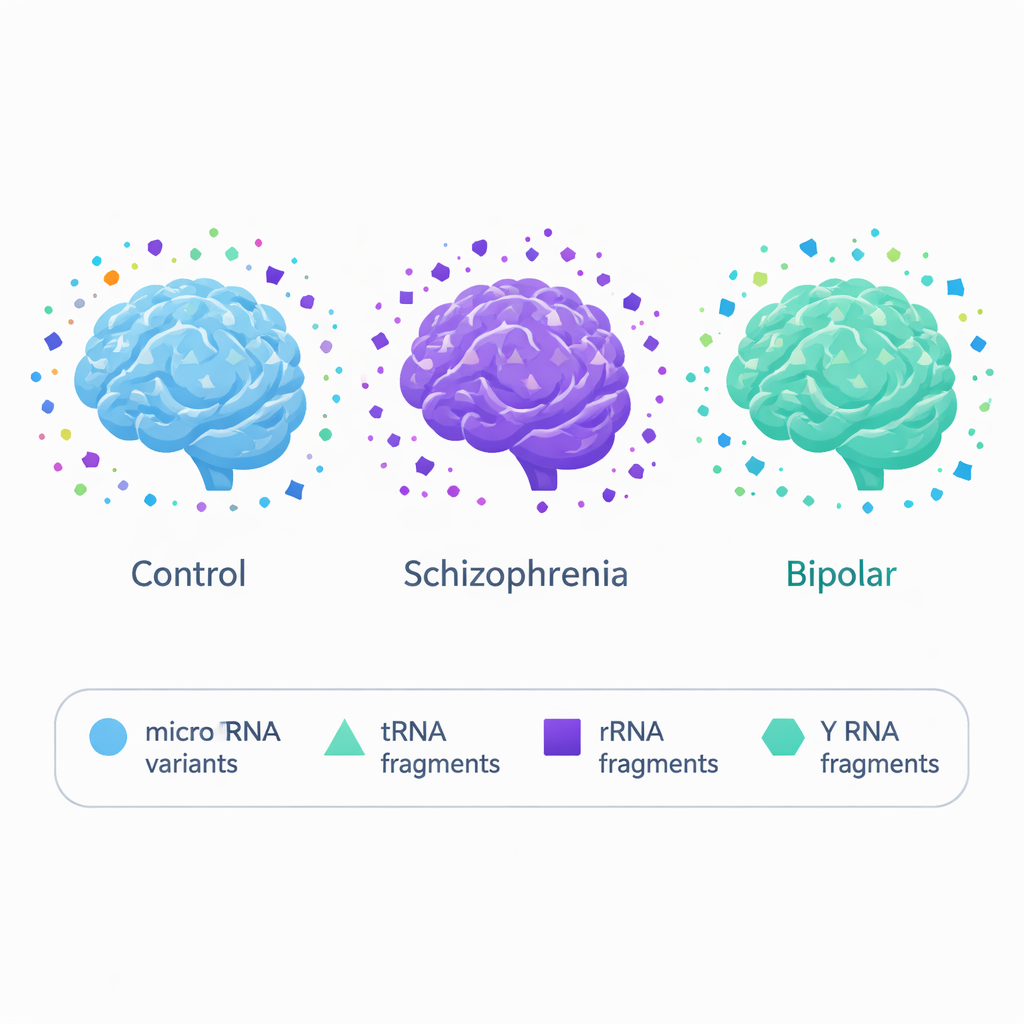
Most genetic research on schizophrenia and bipolar disorder has focused on genes that encode proteins. But the brain also teems with small non-coding RNAs—short stretches of RNA that fine-tune gene activity. The team analyzed post-mortem samples of the prefrontal cortex, a region important for decision-making and emotion, from 53 people with schizophrenia, 40 with bipolar disorder, and 77 unaffected controls. They used high-depth sequencing and a specialized computational pipeline to catalog several types of small RNAs, including microRNA variants (called isomiRs), fragments derived from transfer RNA (tRFs), ribosomal RNA (rRFs), and Y RNA (yRFs). Remarkably, these four groups alone made up about 98 percent of all small RNAs detected in the samples.
Widespread Shifts in the Diseased Brain
When the scientists compared patients with schizophrenia to controls, about 15 percent of the small RNAs they measured showed significant changes in abundance. Many of these shifts were also present, though more mildly, in bipolar disorder. Some microRNA variants that were already very abundant became even more plentiful, while many tRNA-, rRNA-, and Y RNA–derived fragments were reduced. Within each RNA family, closely related molecules could move in opposite directions, underscoring how finely tuned this regulatory layer is. The study also found that a substantial fraction of microRNA variants carry extra, non-genetic nucleotides at their tail ends, and that the specific added letter—especially guanine—was strongly linked to whether the molecule went up or down in schizophrenia.
Gene Activity and an Accelerated Aging Signature
The researchers paired their small RNA data with conventional measurements of messenger RNA, the molecules that carry the instructions for making proteins. They saw coordinated changes: genes related to synaptic signaling, neuron growth, and brain connectivity tended to be less active in schizophrenia, whereas genes involved in protein translation and cellular stress responses tended to be more active. Strikingly, when they compared the gene-expression patterns seen in schizophrenia and bipolar disorder with those seen in normal brain aging, the similarities were strong. In younger patients, differences from controls were pronounced, but in older individuals these differences largely faded—suggesting that the diseased brain’s molecular profile looks “older” than expected for the person’s age.
Networks Connecting Small RNAs to Brain Functions
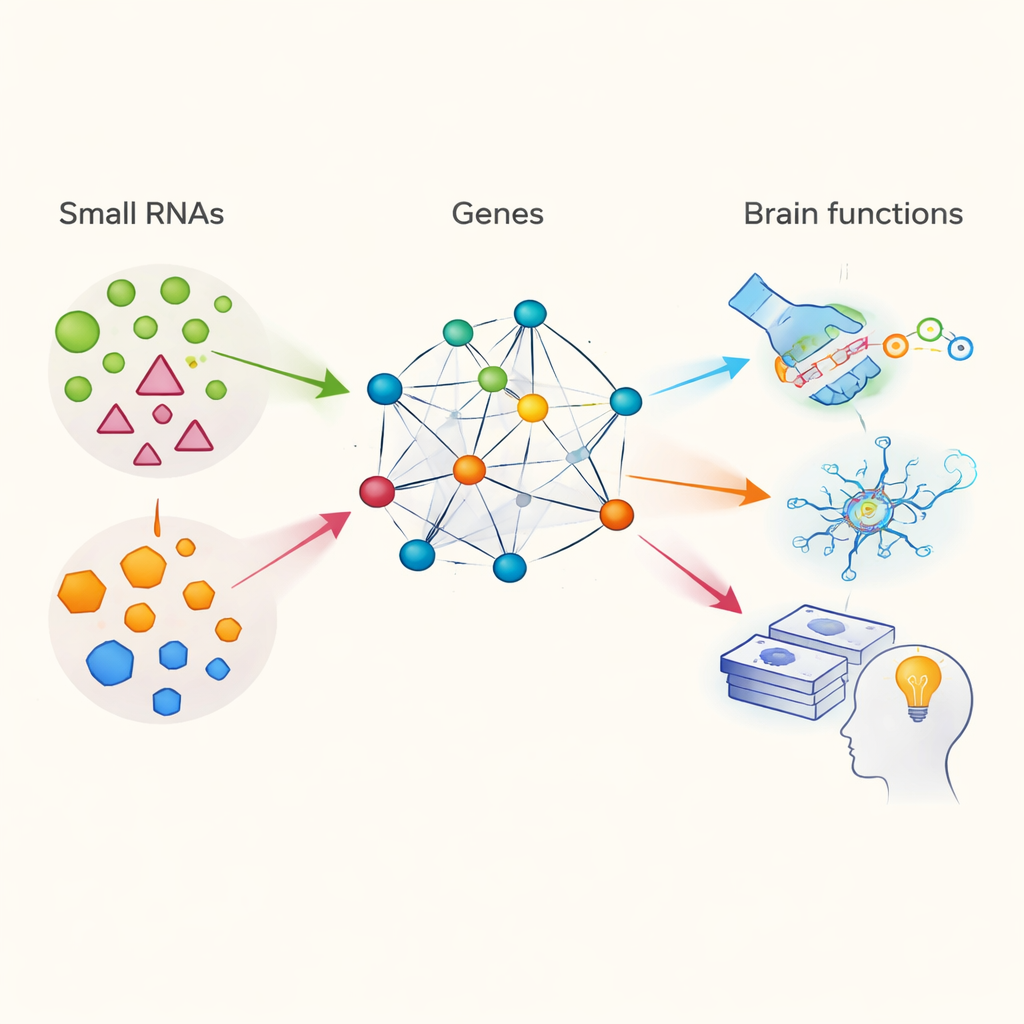
To move beyond simple one-to-one comparisons, the team examined how groups of small RNAs and genes change together once major confounding factors such as diagnosis, age, and sex were mathematically removed. They found distinct co-expression modules: clusters of small RNAs whose levels rose and fell in sync with specific sets of genes. Some modules were enriched for genes involved in synaptic communication, memory, behavior, and cognition, while others were tied to stress responses and cell survival. Certain highly abundant microRNA families, such as let-7 and miR-29, stood out because their predicted and experimentally supported target genes were more likely to be reduced in schizophrenia, in line with their known role in dampening gene activity.
What This Means for Understanding Mental Illness
To a non-specialist, the key message is that schizophrenia and bipolar disorder are not just “chemical imbalances” in the usual sense of transmitters and receptors. They also involve broad, subtle rewiring of the brain’s gene-control circuits, carried out by many classes of tiny RNA molecules. These small RNAs shift in coordinated ways, are linked to genes that support synapses, memory, and cognition, and together create a pattern that resembles early aging of the brain. While the work does not yet translate directly into new treatments, it maps out a rich landscape of molecular signals that may eventually help explain why these disorders arise, why they affect thinking and behavior, and how future therapies might restore healthier patterns of gene regulation.
Citation: Nersisyan, S., Loher, P., Nazeraj, I. et al. Several novel classes of small regulatory RNAs show widespread changes in schizophrenia and bipolar disorder and extensive linkages to critical brain processes. Transl Psychiatry 16, 72 (2026). https://doi.org/10.1038/s41398-026-03808-x
Keywords: schizophrenia, bipolar disorder, small non-coding RNA, brain aging, gene regulation