Clear Sky Science · en
A functional ancestry-linked regulatory haplotype influences CYP2D6 expression
Why some medicines work differently for different people
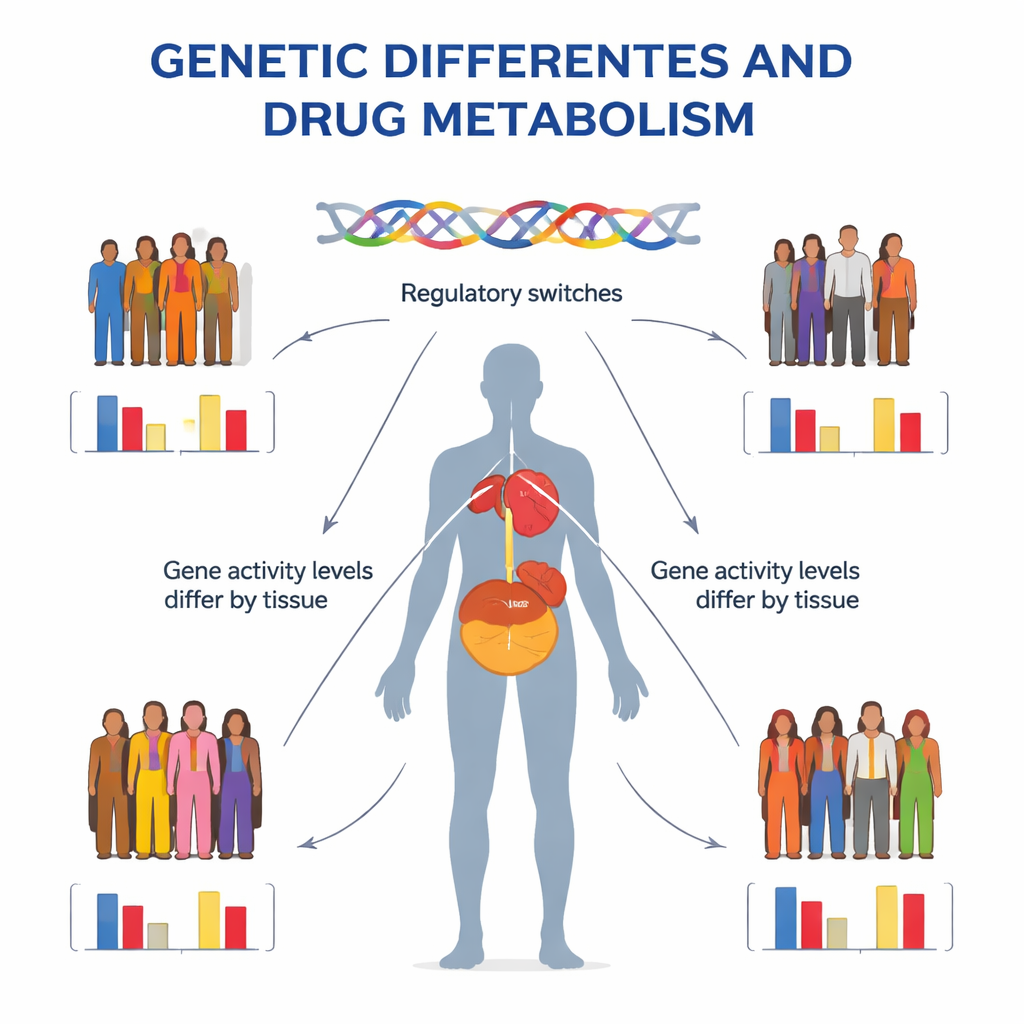
Many people are surprised to learn that the same dose of a common medicine can help one person, barely affect another, and cause strong side effects in a third—even when they are the same age and weight. One major reason is our genes, which control how quickly our bodies break down drugs. This study explores how subtle "on–off" switches in DNA, which vary across ancestries, change the activity of a key drug-processing gene called CYP2D6 and may help explain why drug responses often differ between populations.
The body’s chemical clean-up crew
Our liver, intestines, and kidneys act like a chemical clean-up crew, using families of enzymes to transform drugs so they can be used or removed from the body. One of the most important enzyme families is called cytochrome P450, which helps process 70–80% of prescribed medicines. Scientists have long known that changes in the parts of these genes that code directly for the enzymes can make people faster or slower at handling drugs such as antidepressants, painkillers, and blood thinners. But far less is known about changes in nearby DNA regions that act more like dimmer switches, turning gene activity up or down in specific organs.
Looking for hidden genetic dimmer switches
To uncover these hidden controls, the researcher mined a large public resource called GTEx, which links DNA differences to gene activity across many human tissues. He focused on 54 drug-processing genes and searched for variants—small changes in DNA—that consistently raised or lowered gene activity, especially in the liver, kidney, and intestine. One gene, CYP2D6, quickly stood out. It had far more regulatory variants than the others and, on average, those variants had a stronger impact on how much CYP2D6 was made. Some of these changes were powerful enough to double gene activity.
A powerful regulatory haplotype in CYP2D6
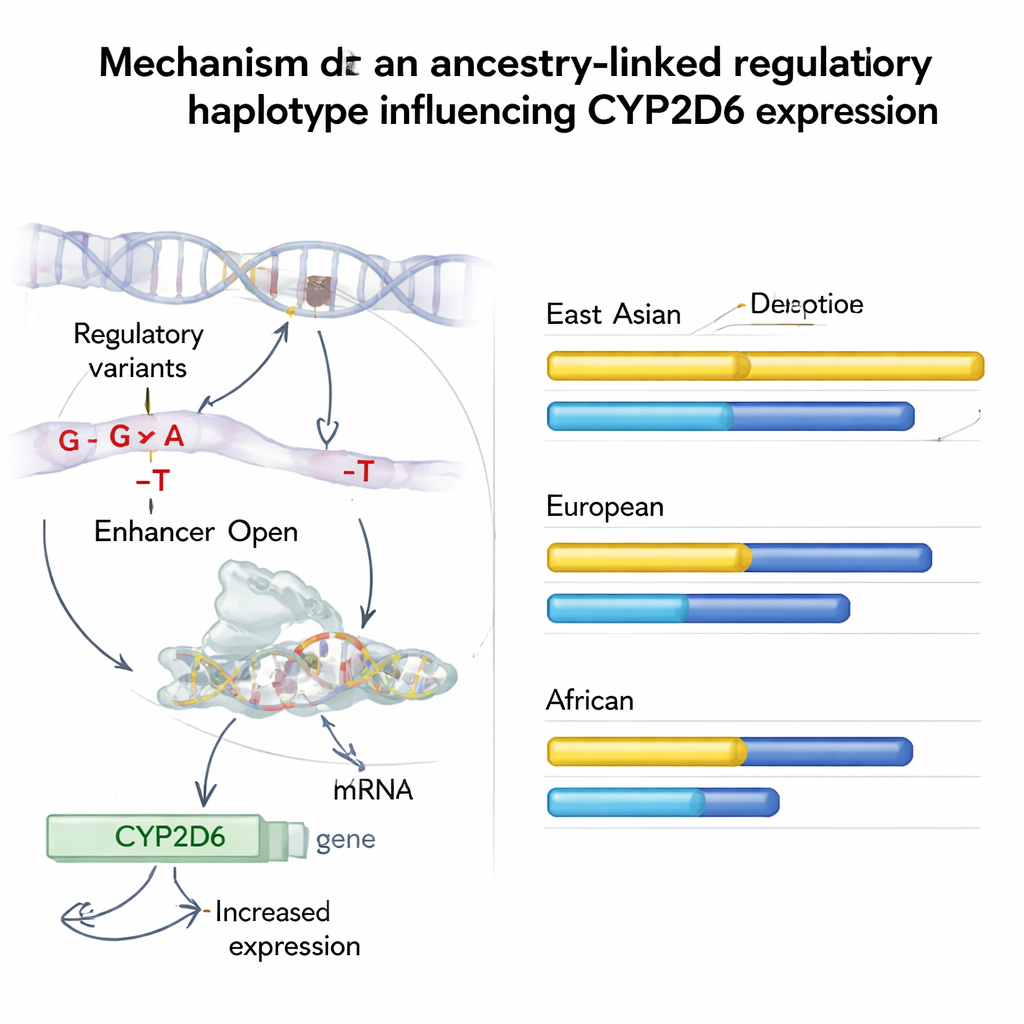
Digging deeper into CYP2D6, the study highlighted two closely linked DNA changes near the gene that behave as a unit, called a regulatory haplotype. Computer analyses predicted that these changes disrupt thousands of docking sites where transcription factors—proteins that control gene activity—normally bind. One of the variants sits in a region of DNA that is unusually open and accessible in liver cells, a hallmark of a strong control element. This suggests the haplotype can substantially alter how much CYP2D6 enzyme the liver produces, without changing the enzyme’s structure itself.
Why ancestry matters for these variants
When the researcher examined global DNA databases, he found that this regulatory haplotype is far from evenly distributed around the world. It occurs in nearly half of East Asian individuals but in only about 1 in 40 people of European descent, with African and South Asian populations in between. Importantly, the haplotype is tightly linked to a well-known CYP2D6 variant called *10, which reduces the enzyme’s efficiency. In East Asian and African groups, people who carry the *10 variant very often also carry the expression-boosting regulatory haplotype, potentially offsetting some of the loss of enzyme function. In Europeans, *10 more often appears without this compensation, so its impact may be stronger.
What this means for personalized medicine
Today, most clinical genetic tests for drug response focus on changes that directly alter the structure of drug-processing enzymes. This work shows that regulatory variants—those that act like volume knobs on gene activity—can be just as important, and that their frequencies differ sharply between ancestries. For CYP2D6, an ancestry-linked regulatory haplotype may partially neutralize a "weaker" enzyme variant in some populations but not others, helping explain why the same genetic label (such as "intermediate metabolizer") can translate into different real-world drug responses across groups. The study argues that to make personalized medicine fairer and more accurate for everyone, genetic testing panels need to include these powerful regulatory switches and interpret them in the context of each patient’s ancestry.
Citation: McCoy, M. A functional ancestry-linked regulatory haplotype influences CYP2D6 expression. Pharmacogenomics J 26, 4 (2026). https://doi.org/10.1038/s41397-026-00398-1
Keywords: pharmacogenomics, CYP2D6, drug metabolism, genetic ancestry, regulatory variants