Clear Sky Science · en
Oligodendrocyte precursor cells–microglia crosstalk via BMP4 drives microglial neuroprotective response and mitigates Alzheimer’s disease
How the Brain’s Own Support Cells May Help Fight Alzheimer’s
Alzheimer’s disease is often described as a slow, unstoppable loss of memory and thinking. But inside the brain, certain cells are not just bystanders—they actively try to protect nerve cells from damage. This study uncovers an unexpected partnership between two such cell types and shows how boosting their natural conversation might help the brain hold Alzheimer’s at bay for longer.
A Hidden Conversation Inside the Diseased Brain
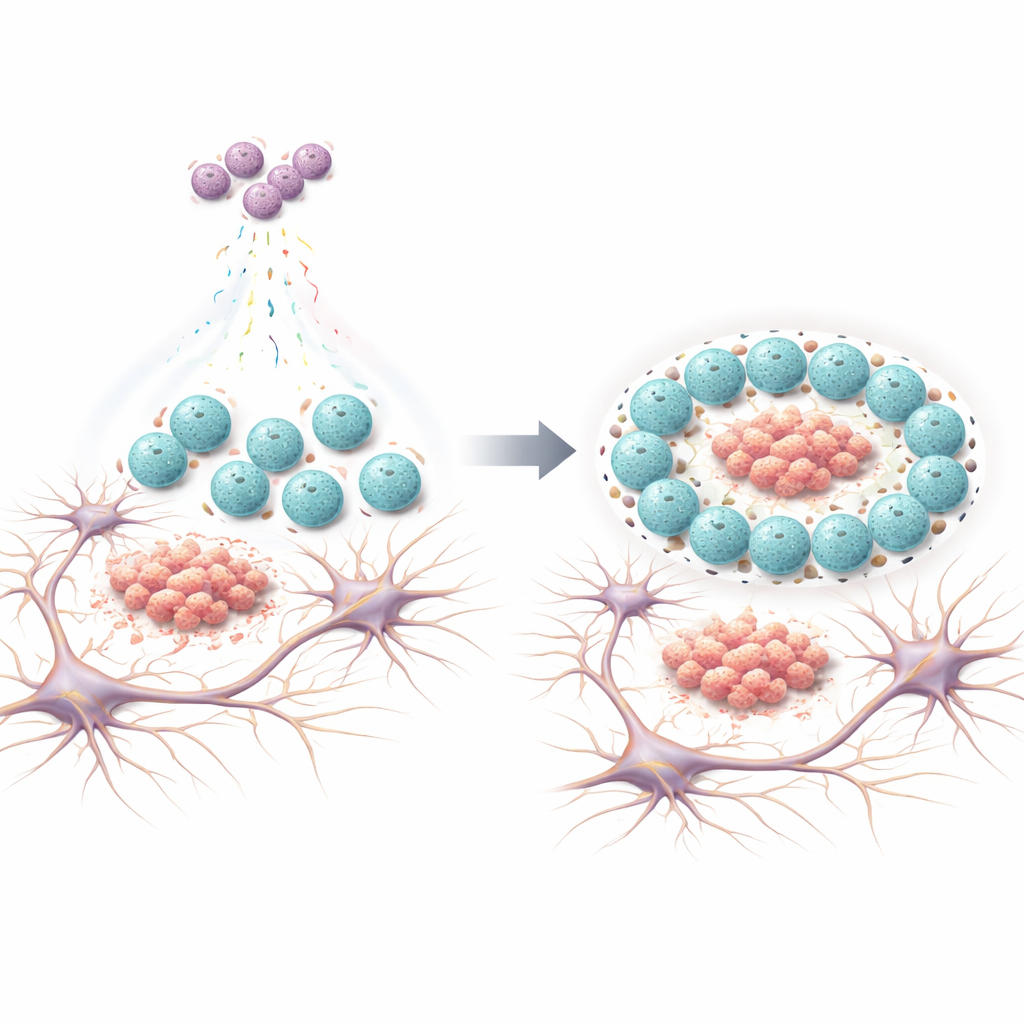
Our brains contain many more cells than just neurons. Among them are oligodendrocyte precursor cells, or OPCs, which usually mature into cells that wrap nerve fibers with insulating myelin, helping signals travel quickly. Microglia, another key cell type, patrol the brain like resident immune guards, clearing waste and reacting to damage. In early Alzheimer’s, microglia can adopt a “disease-associated” protective mode, clustering around clumps of amyloid-beta protein (plaques) to compact and contain them. However, what pushes microglia into this helpful state has been unclear. The authors of this study suspected that a special subset of OPCs, called committed oligodendrocyte precursors (COPs), might be sending a crucial signal.
A Protective Signal Called BMP4
By examining mouse models of Alzheimer’s and human brain tissue, the researchers found that COPs near amyloid plaques produce high levels of a signaling molecule called BMP4. When plaques begin to appear, COPs ramp up BMP4 production and release it into the surrounding brain tissue and tiny membrane-bound packets. Microglia nearby carry a matching receptor, BMPR1A, and show activation of an internal pathway (SMAD1/5/8) that responds specifically to BMP signals. As disease progresses, the number of BMP4-producing COPs falls even as inflammation rises, suggesting that this COP–microglia communication is an early, time-limited protective response that becomes exhausted over time.
What Happens When the Signal Is Cut Off?
To test whether COP-derived BMP4 truly matters for protection, the team selectively removed the Bmp4 gene from OPCs in Alzheimer’s model mice. These animals initially showed slightly improved myelin coverage, but they developed more and larger amyloid plaques over time, along with worse memory performance. Detailed cell analyses revealed that microglia in these mice clustered less around plaques, carried fewer phagocytic (garbage-eating) compartments, and had simpler, less exploratory branches. Crucially, genes and proteins that define the protective, disease-associated microglia state—including a key receptor called Trem2—were sharply reduced. Plaques became less compact and more damaging, nerve fibers showed more swellings, and synaptic proteins that support communication between neurons were lost.
How BMP4 Tunes Microglia Into Defenders
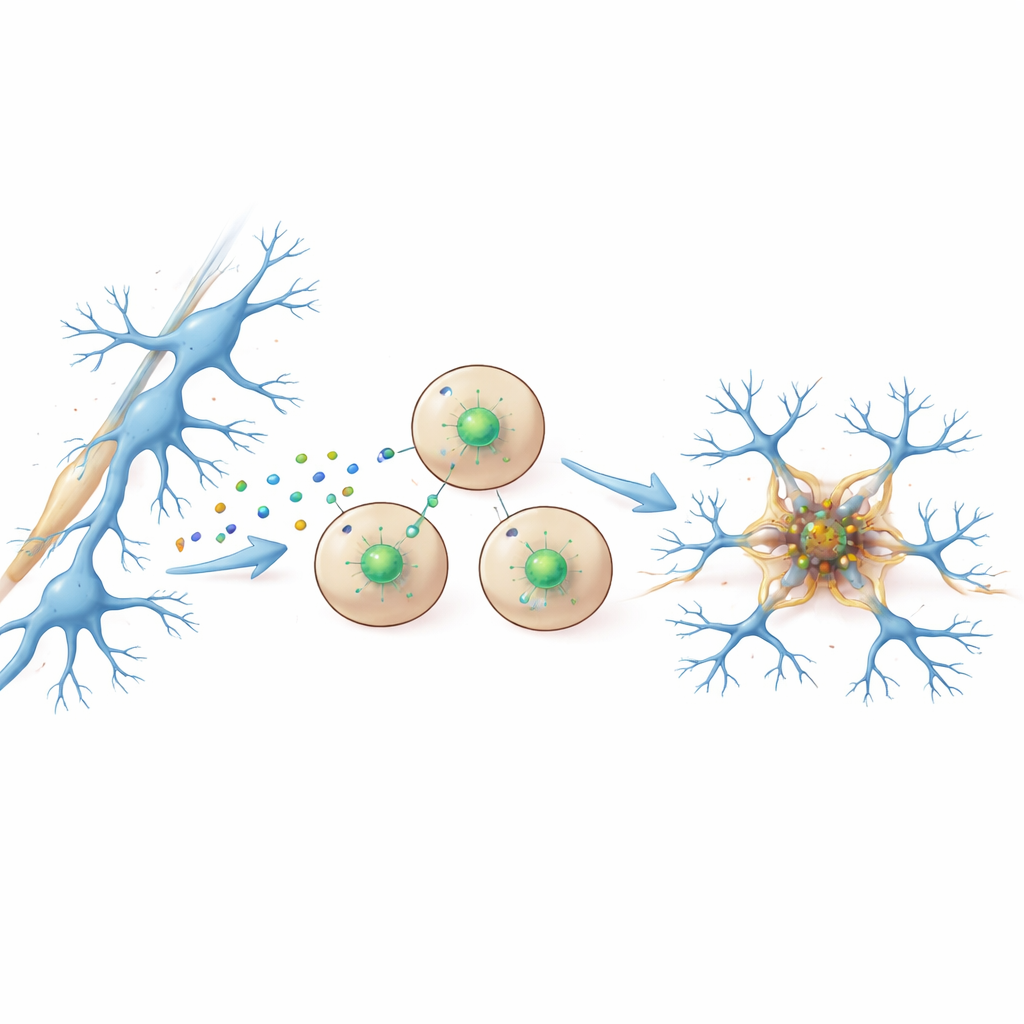
The authors then zoomed in on how BMP4 changes microglia. In human-like and mouse microglial cultures, adding BMP4 turned on the SMAD1/5/8 pathway, boosted Trem2, and increased microglia’s ability to move toward and engulf amyloid. Blocking BMP receptors erased these benefits. Further experiments showed that the SMAD proteins directly bind to the Trem2 gene’s control region, acting like a finger flipping the “on” switch. When microglia lacking BMPR1A were transplanted into mouse brains, they failed to adopt the protective state, did not form tight barriers around plaques, and left plaques looser and more harmful. Together, these results reveal a step-by-step chain: COPs sense amyloid, secrete BMP4, BMP4 activates BMPR1A–SMAD1/5/8 in microglia, and this in turn boosts Trem2 and other genes that equip microglia to surround, compact, and clear plaques.
Reawakening the Brain’s Early Defenses
Because COPs are short-lived, the researchers asked whether topping up BMP4 could prolong or restore this protective window. When they transplanted extra BMP4-producing COPs into Alzheimer’s mice, or delivered a gene therapy virus that drove BMP4 production specifically in COP-like cells, microglia became more activated around plaques, Trem2 levels rose, amyloid deposits shrank and became more compact, and signs of nerve and synapse damage decreased. Treated mice performed better on memory tests, and longer-term treatment also reduced later myelin loss. These findings suggest that enhancing BMP4 signaling from COPs to microglia could be a way to bolster the brain’s own early defense system against Alzheimer’s pathology, potentially delaying the point at which damage overwhelms repair.
Citation: Baek, S., Jang, J., Yeo, S. et al. Oligodendrocyte precursor cells–microglia crosstalk via BMP4 drives microglial neuroprotective response and mitigates Alzheimer’s disease. Sig Transduct Target Ther 11, 109 (2026). https://doi.org/10.1038/s41392-026-02620-9
Keywords: Alzheimer’s disease, microglia, oligodendrocyte precursor cells, BMP4 signaling, neuroinflammation