Clear Sky Science · en
Ubiquitin-mediated stabilization of KDM5B drives chemoresistance via repression of dual-specificity phosphatase 4 in ovarian cancer
Why some ovarian cancers stop responding to chemotherapy
Many women with ovarian cancer initially respond well to platinum-based drugs like cisplatin, only to face the devastating return of tumors that no longer react to treatment. This study reveals a hidden molecular circuit inside cancer cells that helps them become drug resistant. By uncovering how a specific “epigenetic switch” is turned on and off, the researchers point to new ways to predict which tumors will resist therapy and how to re-sensitize them to existing drugs.
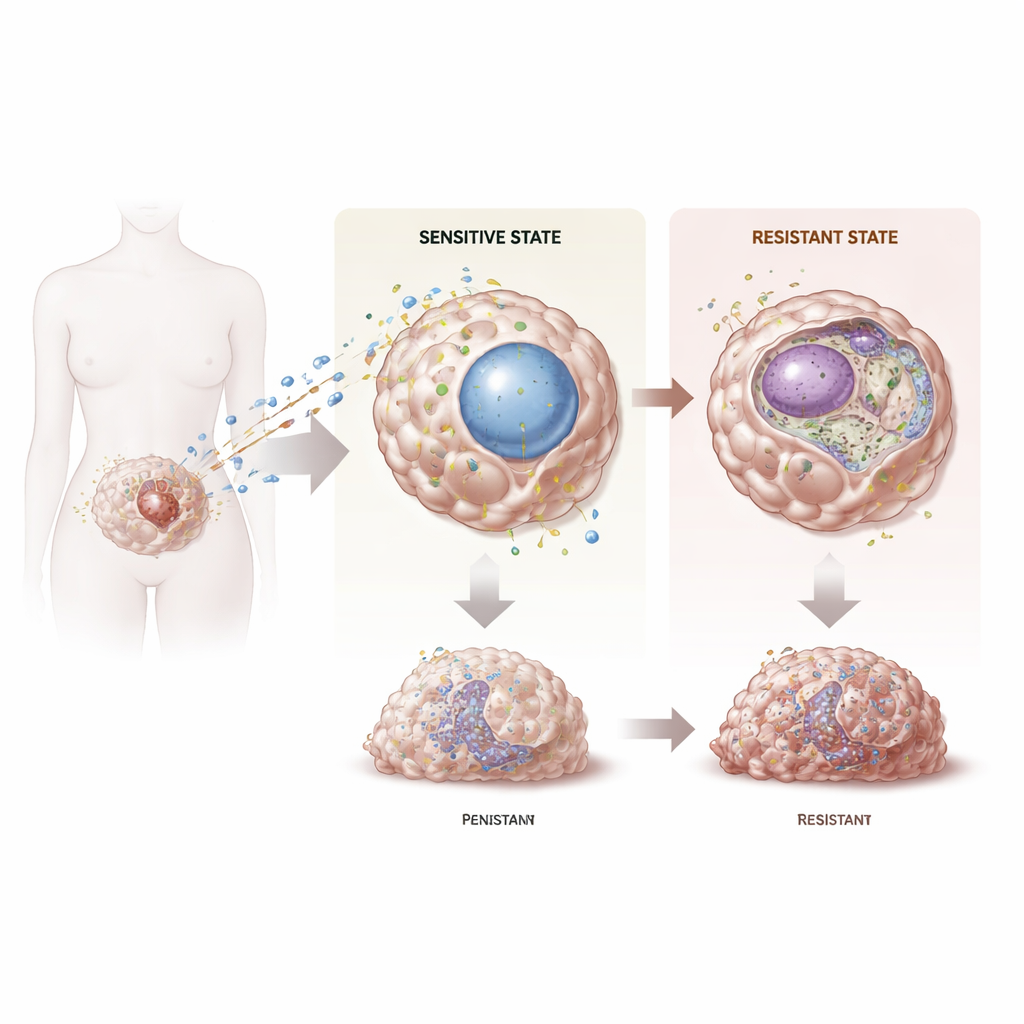
A deadly cancer’s stubborn comeback
Ovarian cancer is one of the most lethal gynecologic cancers in part because it is usually found late and because resistance to chemotherapy is common. Although up to 80% of patients initially benefit from platinum-based chemotherapy, most relapse with tumors that no longer respond, leaving few good options and poor survival. Recent work has shown that changes in how DNA is packaged and read—epigenetic changes—can help cancer cells adapt to treatment. The authors focused on a family of enzymes called KDM5, which fine‑tune gene activity by removing chemical marks from histone proteins that organize DNA. They asked whether particular members of this family might be key to platinum resistance in ovarian cancer.
One enzyme tips the balance toward resistance
By mining large cancer genomics databases and then testing multiple ovarian cancer cell lines, the team discovered that one KDM5 member, KDM5B, stands out in resistant tumors. Its levels are higher in recurrent ovarian cancers, metastatic lesions, and cell lines that no longer respond to cisplatin, whereas its close relative KDM5A does not show the same pattern. When the researchers selectively removed KDM5B from resistant cells, those cells once again became vulnerable to cisplatin and underwent more programmed cell death. Adding extra KDM5B to originally sensitive cells had the opposite effect, making them harder to kill with chemotherapy. These results held across several independent cell models and in mice bearing human ovarian tumors, firmly implicating KDM5B as a driver of chemoresistance.
A silenced brake on growth signals
Diving deeper, the authors asked which genes KDM5B was shutting down to help tumor cells survive. Using RNA sequencing and chromatin mapping, they found that KDM5B directly represses a gene called DUSP4, which normally acts as a brake on a major growth and stress-response route known as the MAPK pathway. KDM5B binds to the DUSP4 promoter and erases “on” marks, reducing DUSP4 levels and effectively releasing the brake on MAPK signaling. When DUSP4 is low, MAPK activity rises, promoting cell growth and helping cells withstand DNA damage from cisplatin. Restoring DUSP4 reverses this resistance, while deleting DUSP4 cancels out the benefits of removing KDM5B, both in dishes of cells and in mouse tumors. Patient data echo these findings: tumors with high KDM5B and low DUSP4 are associated with worse survival.
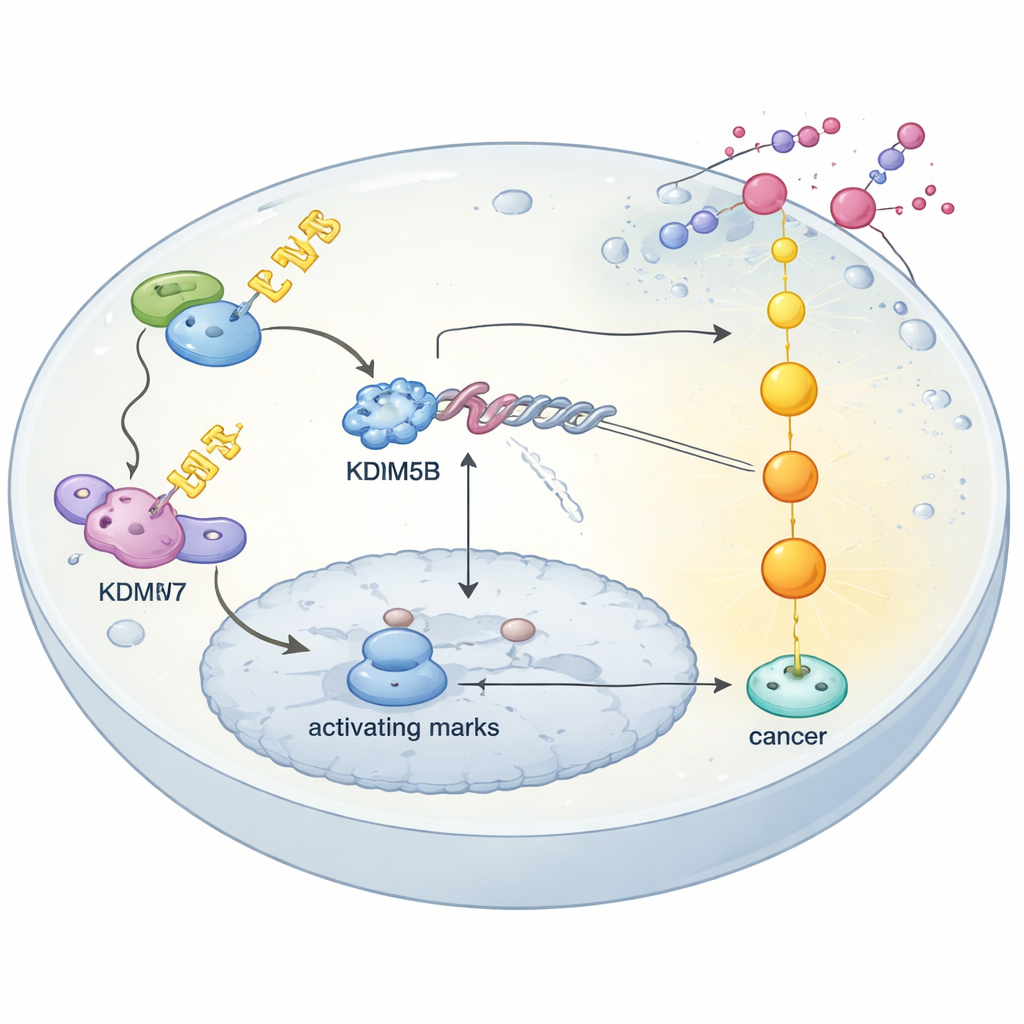
Protein quality control shapes drug response
The study also reveals how cancer cells stabilize KDM5B in the first place. Inside cells, many proteins are continually tagged for destruction or spared by a quality-control system based on ubiquitin chains. The researchers show that an enzyme called USP7 protects KDM5B by removing these tags, preventing its degradation. When USP7 is blocked genetically or with a small-molecule inhibitor, KDM5B levels fall and resistant ovarian cancer cells regain sensitivity to cisplatin. In contrast, an E3 ligase complex built around a protein called FBXW7 recognizes KDM5B only after another enzyme, HIPK1, phosphorylates it at a specific site, marking it for destruction. Disrupting this FBXW7–HIPK1 route makes KDM5B more stable. Overall, resistance emerges when USP7’s protective role outweighs FBXW7’s disposal role, allowing KDM5B to accumulate and keep DUSP4 turned off.
New ways to outmaneuver stubborn tumors
By mapping this USP7–KDM5B–DUSP4–MAPK axis, the authors provide a cohesive explanation for how ovarian cancer cells evolve resistance to cisplatin. For non‑specialists, the key message is that the problem is not simply more mutations, but also rewiring of gene control and protein turnover. The work suggests several testable strategies: using KDM5B, USP7, and DUSP4 levels as biomarkers to predict who will respond poorly to platinum therapy, and combining cisplatin with drugs that inhibit KDM5B or USP7, or that enhance KDM5B breakdown, to restore drug sensitivity. While these approaches still need clinical validation, they offer a hopeful blueprint for turning some resistant ovarian cancers back into treatable ones.
Citation: Yoo, J., Kim, G.W., Jeon, Y.H. et al. Ubiquitin-mediated stabilization of KDM5B drives chemoresistance via repression of dual-specificity phosphatase 4 in ovarian cancer. Sig Transduct Target Ther 11, 89 (2026). https://doi.org/10.1038/s41392-026-02601-y
Keywords: ovarian cancer, cisplatin resistance, epigenetic regulation, KDM5B, MAPK signaling