Clear Sky Science · en
IFFO1 inhibits breast cancer by coordinating mitochondrial fission and fatty acid synthesis via the LaminA/C-PGC1α axis
Why this research matters
Breast cancer remains one of the leading causes of cancer death in women, largely because some tumors keep growing, spreading, and outsmarting current treatments. This study uncovers a previously underappreciated cellular “brake” called IFFO1 that slows breast cancer by taming two core engines of tumor growth: the cell’s energy factories, mitochondria, and its ability to make and store fats. Understanding this brake offers a fresh angle for therapies that could work across multiple breast cancer subtypes.
A hidden guardian inside breast cells
The researchers began by examining samples from 30 women with breast cancer, as well as large public cancer databases. They found that levels of the protein IFFO1 were consistently lower in tumor tissue than in nearby normal breast tissue. The more advanced the cancer stage, the less IFFO1 was present, and patients whose tumors had higher IFFO1 tended to live longer. In cultured breast cancer cells, forcing the cells to make extra IFFO1 sharply reduced their ability to grow, divide, and migrate—behaviors needed for tumors to expand and spread. IFFO1 also dampened a cellular program known as epithelial–mesenchymal transition, which helps cancer cells detach and invade other tissues.
Calming overactive energy factories
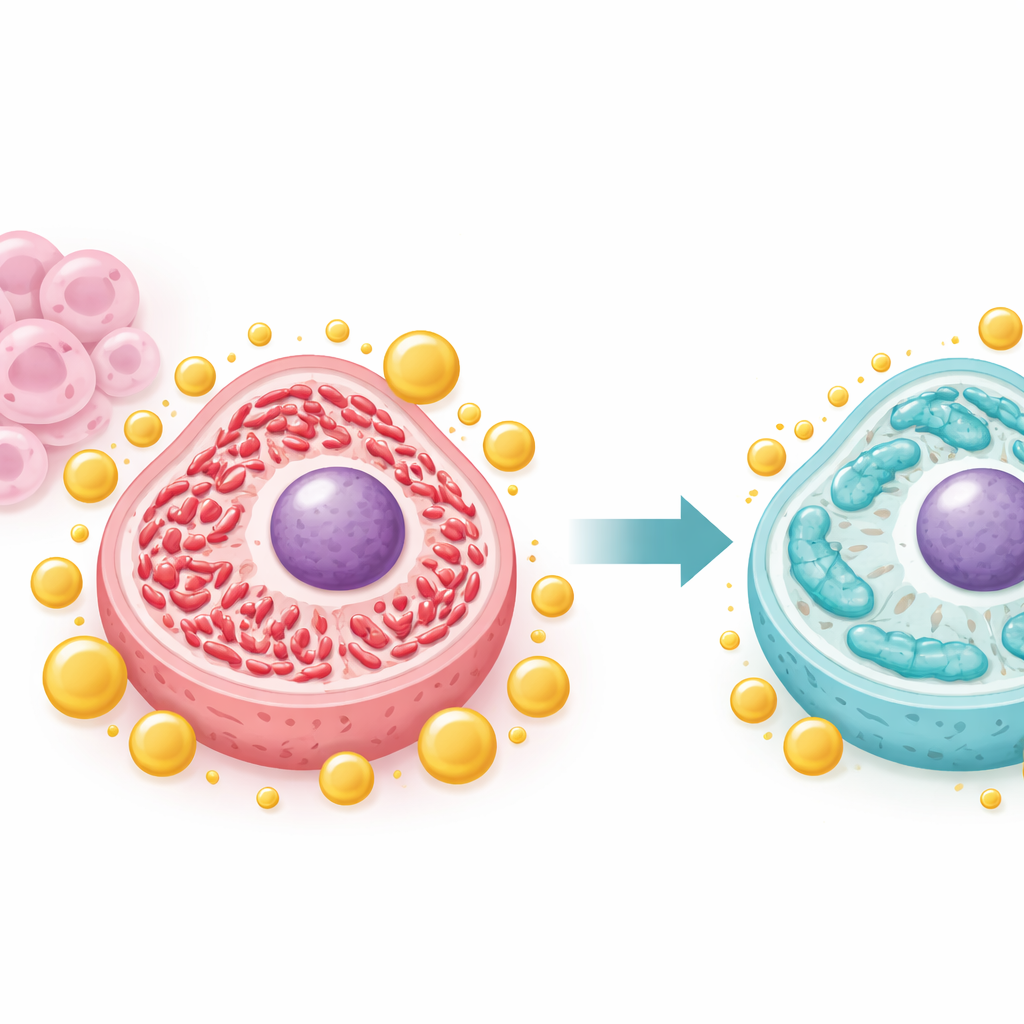
Cancer cells often reshape their mitochondria, the tiny power plants inside cells, to fuel rapid growth. The team showed that IFFO1 shifts this balance away from a highly chopped-up, “fission” state toward a more elongated, “fusion” state that is generally associated with healthier, more stable mitochondria. When IFFO1 was abundant, key fission proteins such as Drp1 and Fis1 decreased, while fusion proteins rose. Microscopy revealed that mitochondria became longer and less fragmented, and measures of mitochondrial DNA and energy output dropped from the abnormally high levels seen in aggressive cells. These changes suggest that IFFO1 prevents mitochondria from entering a hyperactive configuration that supports uncontrolled tumor growth.
Cutting off the fat supply line
Fast-growing tumors do not just need energy; they also need a steady supply of fats to build new membranes and signaling molecules. The study found that IFFO1 also presses down on this metabolic accelerator. In cells with extra IFFO1, core fat-building proteins—including FASN, SREBP‑1, SCD1, and others—were reduced. Enzymatic tests confirmed lower fat-synthesizing activity, and chemical assays showed drops in free fatty acids, triglycerides, and cholesterol. Imaging dyes that highlight fat stores revealed fewer lipid droplets and less overall neutral fat inside the cancer cells. Conversely, ramping up the fission protein Drp1 had the opposite effect, boosting fat production, while silencing Drp1 curbed it—supporting a direct link between mitochondrial shape and fat supply in cancer.
A signaling chain from the nucleus to mitochondria
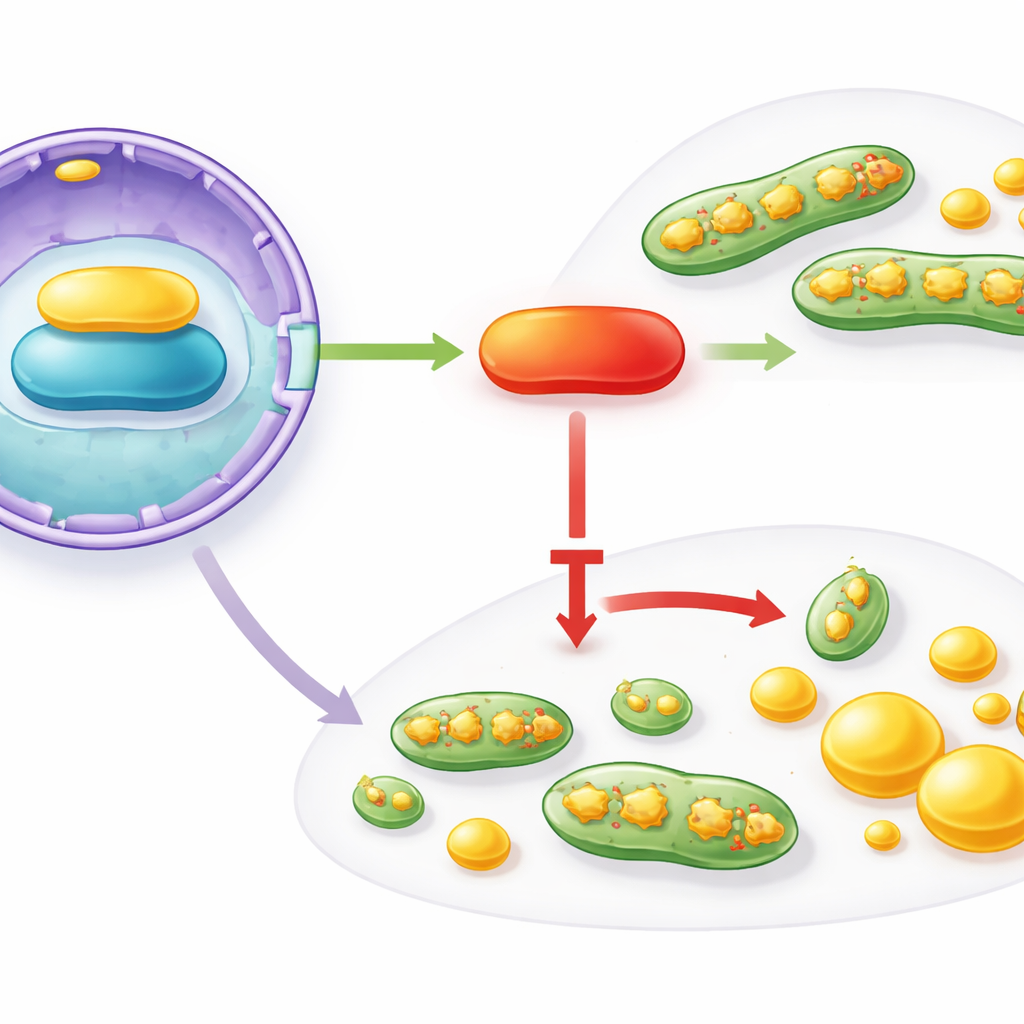
How does IFFO1 orchestrate these broad changes? The authors traced a chain of interactions that starts at the cell’s nucleus and ends at the mitochondria and fat-making machinery. IFFO1 physically binds to a structural protein of the nuclear envelope called Lamin A/C, and increases its levels. Lamin A/C, in turn, supports the activity of PGC1α, a master regulator that oversees mitochondrial health and metabolism. In breast cancer tissues and cells, both Lamin A/C and PGC1α were found to be reduced, mirroring the loss of IFFO1. When the scientists artificially boosted IFFO1, Lamin A/C and PGC1α rose, mitochondrial fission decreased, and fat synthesis waned. Knocking down Lamin A/C erased these benefits, but restoring PGC1α brought them back, pinpointing a functional IFFO1 → Lamin A/C → PGC1α axis that restrains tumor-promoting mitochondrial and lipid changes.
Testing the brake in living animals
To see whether these cellular effects translate into real tumors, the team implanted human breast cancer cells with or without extra IFFO1 into mice. Tumors with boosted IFFO1 grew more slowly, weighed less at the experimental endpoint, and showed fewer signs of fat buildup. In a separate model where cancer cells were injected into the bloodstream to seed lung metastases, cells overproducing IFFO1 formed markedly fewer lung tumor nodules. Tissue analyses from these mice echoed the cell culture findings: higher Lamin A/C and PGC1α, less mitochondrial fission, and lower fat synthesis.
What this means for future treatments
Taken together, the work presents IFFO1 as a multi-layered tumor suppressor that connects the cell’s structural scaffold, its energy factories, and its fat-making machinery. By stabilizing Lamin A/C and boosting PGC1α, IFFO1 keeps mitochondria from fragmenting excessively and cuts off the overproduction of fats that cancer cells depend on. For non-specialists, the key message is that this protein acts like an internal brake on both the power and the building blocks that fuel breast cancer growth and spread. Drugs that raise IFFO1 levels or mimic its effects on the Lamin A/C–PGC1α pathway could one day offer new options, especially for aggressive or treatment-resistant forms of breast cancer.
Citation: Cai, H., He, J. IFFO1 inhibits breast cancer by coordinating mitochondrial fission and fatty acid synthesis via the LaminA/C-PGC1α axis. Oncogenesis 15, 16 (2026). https://doi.org/10.1038/s41389-026-00609-1
Keywords: breast cancer, mitochondrial dynamics, fatty acid synthesis, tumor metabolism, PGC1α pathway