Clear Sky Science · en
Rab37-mediated OPN secretion enriches SPP1+ macrophages through autocrine–paracrine signaling to drive lung tumor progression
How Immune Cells Can Secretly Help Lung Tumors Grow
Lung cancer doesn’t develop in isolation. It grows within a bustling neighborhood of immune cells and connective tissue, sometimes turning supposed defenders into allies. This study reveals how a tiny trafficking protein inside immune cells, called Rab37, helps certain macrophages secrete a molecule named osteopontin (OPN), creating a tumor-friendly environment that makes lung cancer more aggressive and harder to treat.
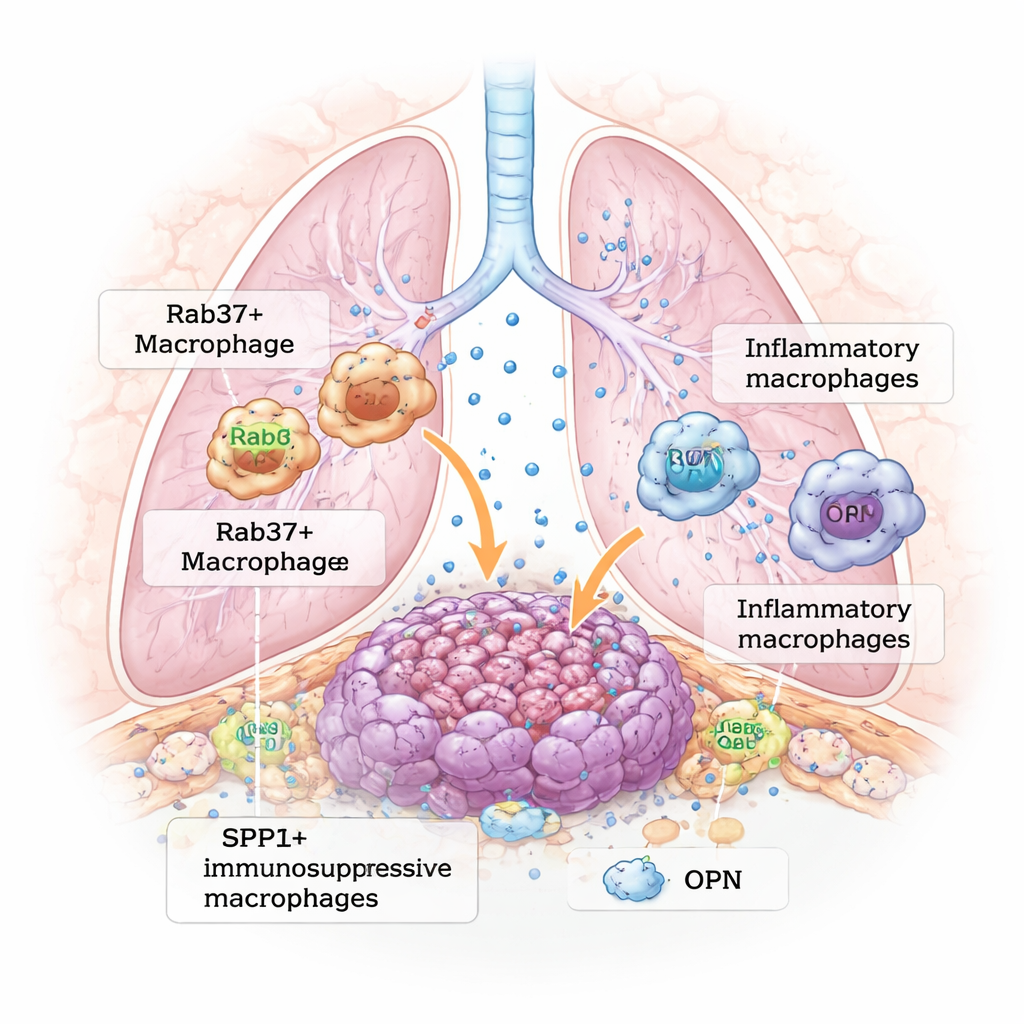
A Busy Neighborhood Inside a Lung Tumor
Modern cancer research shows that tumors are more like complex ecosystems than simple clumps of rogue cells. Around lung tumors, immune cells, blood vessels, and support cells constantly send chemical messages to one another. Among these, macrophages—immune cells that normally clear infections and debris—often settle inside tumors as “tumor-associated macrophages.” Instead of attacking cancer, many of these cells shift into a nurturing role, calming immune attacks and helping tumors grow and spread. The big question this paper tackles is: what pushes macrophages into this harmful, tumor-promoting state?
Two Types of Macrophages: Helpers and Hinderers
The researchers used single-cell RNA sequencing, a technology that reads the activity of thousands of genes in individual cells, to map immune cells inside mouse lung tumors. They compared normal mice with mice lacking Rab37. In tumors from normal mice, they found many macrophages rich in a gene called SPP1, which makes the protein osteopontin (OPN). These SPP1+ macrophages formed an immunosuppressive, tumor-helping group. In contrast, tumors from Rab37 knockout mice had fewer SPP1+ macrophages and more macrophages expressing a different gene, THBS1, linked to a more inflammatory, potentially tumor-restraining response. In human lung cancer samples, patients whose tumors contained many macrophages positive for CD163, Rab37, and OPN were more likely to have their cancer come back and had worse survival, suggesting that this specific macrophage type is clinically dangerous.
The Secret-Shipping Protein That Supercharges OPN
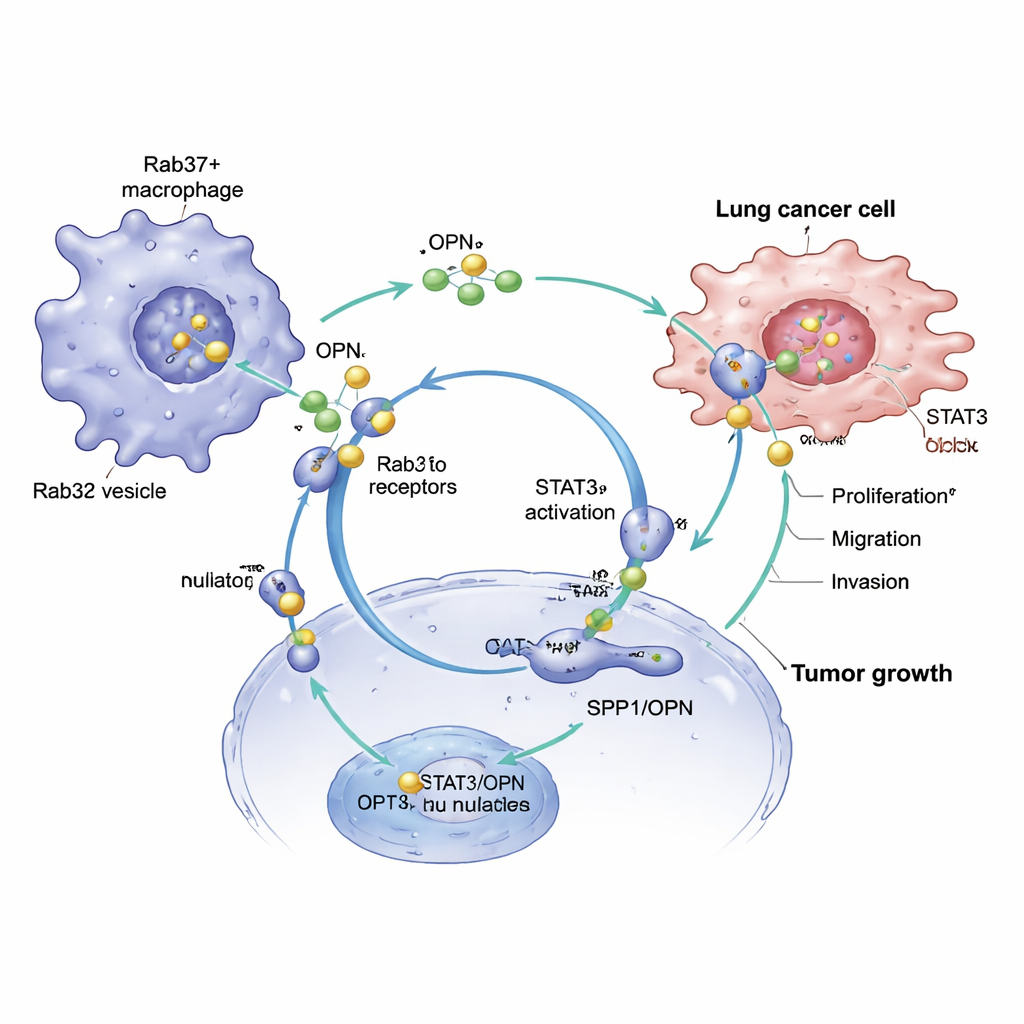
Rab37 belongs to a family of proteins that control how cells package and release molecules. The team showed that Rab37 loads OPN into small vesicles inside macrophages and drives its release to the outside. When macrophages had working Rab37, they secreted much more OPN, especially when exposed to signals from lung cancer cells. When Rab37 was removed or its activity blocked, OPN release dropped sharply. The study also uncovered a feedback loop: secreted OPN turns on a signaling protein called STAT3 in macrophages, which then boosts SPP1 gene activity and pushes macrophages further toward an M2-like, tumor-promoting state. This loop keeps the cells locked in a pro-tumor identity, steadily pumping out more OPN.
From Immune Signals to Faster-Growing Tumors
OPN does not only act on macrophages—it also communicates directly with cancer cells. When lung cancer cells were bathed in liquid taken from Rab37-positive macrophages, they grew faster and became more mobile and invasive. Blocking OPN in this liquid reduced these effects, while adding back purified OPN restored them. The same Rab37–OPN–STAT3 circuit that reprograms macrophages also activates growth and survival pathways inside lung cancer cells, encouraging proliferation, movement, and invasion into surrounding tissue. In this way, a single secreted molecule helps both reshape immune behavior and accelerate tumor progression.
Turning a Discovery into a Therapeutic Opportunity
For non-specialists, the main message is that some immune cells inside lung tumors become “double agents,” and Rab37 is a key coordinator of their betrayal. By helping macrophages secrete OPN and maintain an OPN-driven feedback loop, Rab37 fosters a quiet, tolerant environment where tumors can thrive and spread. Patients whose tumors are packed with Rab37+/OPN+ macrophages fare worse, meaning this cell type could serve as a warning sign and a treatment target. Therapies that block OPN, interfere with STAT3, or disrupt Rab37’s trafficking function may help flip macrophages back toward an anti-tumor role, making lung cancer more vulnerable to existing treatments, including immunotherapy.
Citation: Yang, YE., Lin, YA., Ling, LL. et al. Rab37-mediated OPN secretion enriches SPP1+ macrophages through autocrine–paracrine signaling to drive lung tumor progression. Oncogenesis 15, 4 (2026). https://doi.org/10.1038/s41389-026-00596-3
Keywords: lung cancer, tumor microenvironment, macrophages, osteopontin, STAT3 signaling