Clear Sky Science · en
Network-based analysis of differential white matter connectivity in major depressive disorder with and without comorbid anxiety
Why brain wiring matters for mood and worry
Depression and anxiety are among the leading causes of disability worldwide, and they often appear together in the same person. This study asks a deceptively simple question with big implications: does the brain’s wiring look different in people with depression alone compared with those who also suffer from anxiety? By examining how different brain regions are structurally connected, the researchers challenge a long‑standing view of depression as mainly a disorder of weakened connections, revealing a more nuanced picture when anxiety enters the mix. 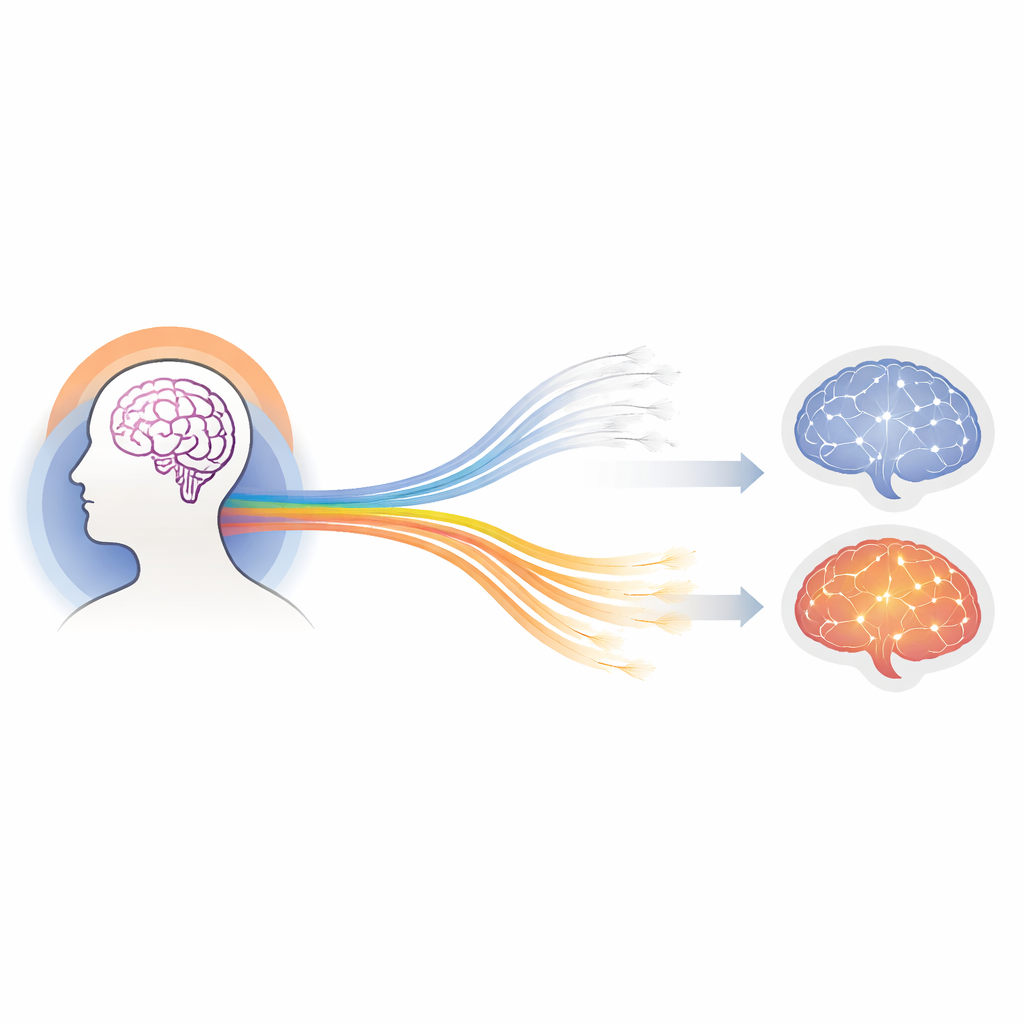
Looking at the brain as a wiring map
Instead of focusing on single brain areas, the team treated the brain like a network of cities linked by highways. They used MRI scans from more than 1,700 adults: healthy volunteers, people with major depression, and people with depression plus at least one anxiety disorder. In these scans, white matter fiber tracts act like the brain’s communication cables, and their number can be used as a rough measure of how strongly two regions are connected. Using a statistical approach designed for networks, the researchers searched for patterns of altered connections across the entire brain, while carefully controlling for age, sex, and scanning site.
Depression alone shows quieter connections
For people with depression but no diagnosed anxiety disorder, the results matched earlier work: their brain networks showed a subtle but widespread weakening of structural connections compared with healthy people. This “hypoconnectivity” was not confined to one spot but appeared across many regions, especially within and between frontal and parietal areas involved in thinking, emotion control, and self‑reflection. In other words, the brain’s communication highways in depression tend to be slightly less robust overall, fitting the idea that depression can be seen as a “disconnection” condition where information does not flow quite as smoothly as it should.
Adding anxiety flips the pattern
Surprisingly, when depression co‑occurred with anxiety disorders, the pattern changed direction. Instead of weaker connections, these individuals showed stronger and more numerous white matter links in many of the same pathways. This “hyperconnectivity” was especially pronounced in long‑range routes connecting frontal and occipital regions and involved hubs such as the insula and temporal areas, which are tied to bodily awareness, emotional salience, and the processing of sights and sounds. The same network of connections consistently showed reduced strength in depression alone and boosted strength when anxiety was present, suggesting that anxiety fundamentally reshapes how the depressed brain is wired. 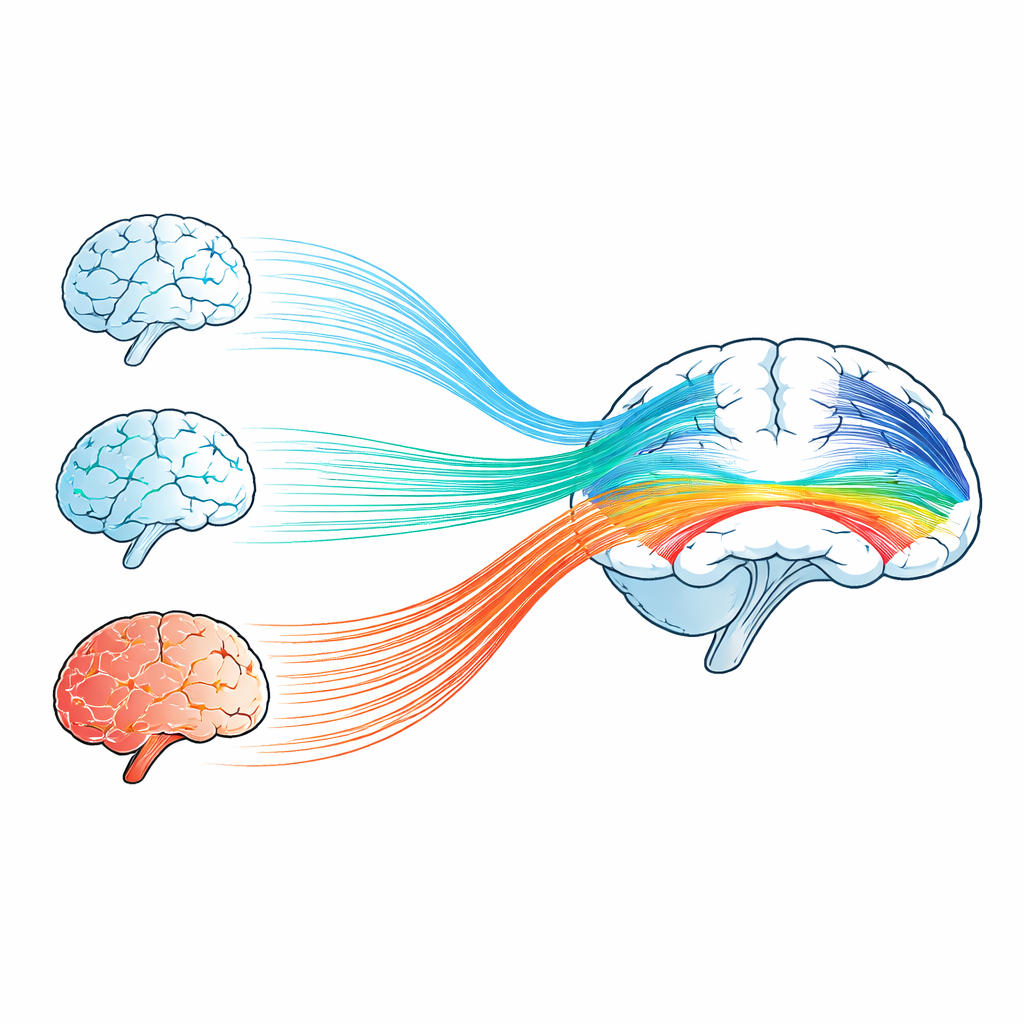
Anxiety level tracks with stronger wiring
To move beyond diagnostic labels, the researchers also examined people’s self‑reported anxiety scores, regardless of whether they were healthy, depressed, or had both depression and anxiety. Across the full sample, higher current anxiety—both as a temporary state and as a general tendency—was linked to stronger structural connectivity in specific subnetworks. These associations were modest but widespread and again highlighted long‑distance connections. One possible interpretation is that chronic worry and heightened vigilance may drive or reflect more intensely used pathways, which over time become structurally reinforced, much like a frequently traveled road becoming wider.
What this means for understanding and treating distress
The main takeaway for non‑specialists is that there is no single “depressed brain” wiring pattern. Depression without anxiety tends to be associated with slightly weaker connections, whereas depression with anxiety shows the opposite trend of stronger connections in overlapping networks. This finding challenges the idea that more severe symptoms always mean more disconnection. Instead, it suggests that the mix of symptoms—especially the presence and degree of anxiety—matters greatly for how brain circuits are altered. The authors argue that future research and, ultimately, treatments should focus less on broad diagnoses and more on specific symptom profiles, such as persistent anxiety or heightened threat sensitivity, to better match interventions to the underlying brain network changes.
Citation: Gruber, M., Schulte, J., Mauritz, M. et al. Network-based analysis of differential white matter connectivity in major depressive disorder with and without comorbid anxiety. Neuropsychopharmacol. 51, 916–925 (2026). https://doi.org/10.1038/s41386-025-02312-y
Keywords: major depressive disorder, anxiety, white matter connectivity, brain networks, neuroimaging