Clear Sky Science · en
Tunable flexible capacitive sensor for dynamic pressure monitoring
Feeling Forces in a Flexible World
From smart watches that track our pulse to wind farms that brace against violent gusts, more and more technologies rely on tiny sensors that can feel pressure. Yet most of today’s flexible pressure sensors work best only in gentle conditions and struggle when loads become large or unpredictable. This paper introduces a new kind of flexible pressure sensor that behaves almost like a smart spring: it stays calm and modestly sensitive under light touch, but automatically becomes far more responsive when forces ramp up, making it attractive for real‑world tasks such as monitoring wind loads on structures or forces on the human body.
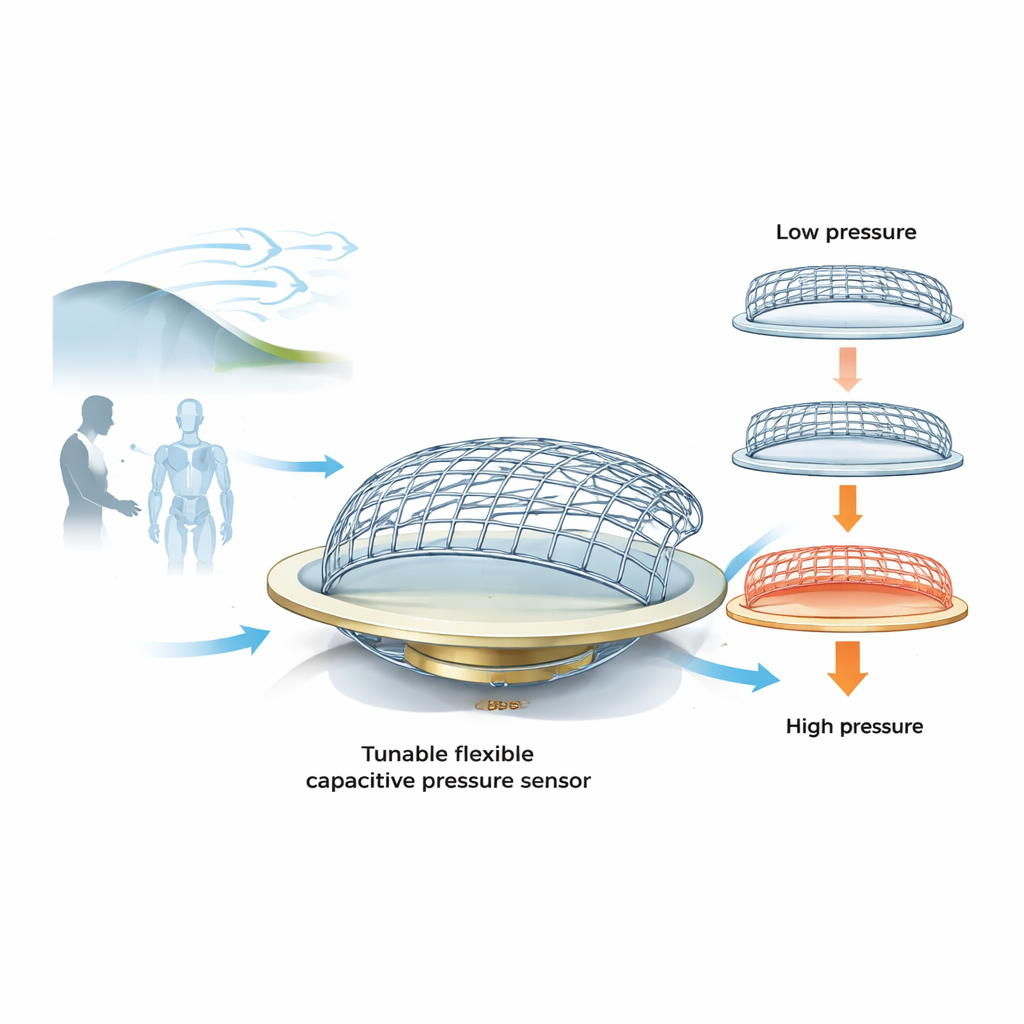
A Tiny Cage That Senses Pressure
At the heart of the device is an unusual three‑dimensional “cage” perched above a flat metal disk. Together, these two pieces act like the plates of a capacitor, an electrical component whose ability to store charge depends on how close its plates are and what fills the space between them. The researchers start with a flat, layered sheet of a flexible plastic and copper patterned into a ring and several curved strips. They glue this flat pattern onto a stretchy silicone sheet that has been pulled tight, then slowly release the stretch. As the silicone relaxes, the pattern buckles up into a neat cage‑like dome, creating a controlled gap between the top structure and the bottom electrode. Pressing on the dome squeezes this gap, changing the capacitance in a way that can be measured as an electrical signal.
Built‑In Smart Behavior Under Load
Unlike many earlier flexible capacitive sensors that are most sensitive only at very low pressures, this cage design is intentionally “tuned” to become more sensitive as pressure increases. Under gentle loads, the dome compresses only slightly, so the electrical signal changes slowly and avoids saturating from minor noise. As pressure grows, the mechanical response becomes more nonlinear: the dome moves closer to the base much more quickly, and the top plate also rotates, increasing the overlapping area between the two electrodes. Together, these geometric changes cause the capacitance to climb steeply at higher loads. Tests show that the sensor can detect extremely light touches—down to the weight of thin paper—while boosting its sensitivity by more than fivefold at higher pressures, all with quick response and recovery times and minimal lag between loading and unloading.
Dialing In Performance After Fabrication
A key advantage of this design is that it can be adjusted even after it has been built. By gently stretching the silicone substrate sideways, the team can raise or lower the “resting” height of the cage and thus the initial gap between the plates. This effectively shifts the pressure range over which the sensor operates best, trading off range for sensitivity or vice versa without changing materials or rebuilding the device. The authors also show that reshaping the metal electrodes—for example into semicircles or crescent forms—can exploit the natural rotation of the top plate under compression. As the plate twists, these shapes sweep past each other, increasing the overlapping area and providing another lever to boost sensitivity or sculpt how the signal grows with pressure.

Ready for Harsh and Curved Environments
To survive real‑world environments, the researchers encapsulate the cage sensor beneath a soft silicone dome filled with glycerol, a non‑evaporating liquid. This protective layer shields the device from dust, moisture, and mechanical damage while also raising its baseline capacitance, which helps drown out tiny electrical fluctuations. Importantly, the soft cover still allows the cage underneath to deform freely. In wind tunnel experiments, sensors mounted on both flat and curved surfaces produced stable, repeatable signals as wind speed increased, especially when the airflow struck the sensor head‑on. The device endured thousands of loading cycles with little drift, showing that the delicate‑looking cage is mechanically robust.
Why This Matters for Everyday Technology
In simple terms, the study demonstrates a flexible pressure sensor that can be “pre‑programmed” by design and then further tuned on demand, without complicated electronics or fragile materials. By using clever geometry and controlled buckling instead of exotic substances, the sensor offers low power use, long‑term stability, and the ability to feel both a feather‑light touch and a strong gust of wind. This tunable cage‑like architecture could underpin future smart skins for infrastructure, robots, and wearable devices that must operate reliably in changing, sometimes harsh environments while still sensing the most important forces with high precision.
Citation: Fu, H., Zhao, Z., Jiang, J. et al. Tunable flexible capacitive sensor for dynamic pressure monitoring. Microsyst Nanoeng 12, 110 (2026). https://doi.org/10.1038/s41378-026-01252-x
Keywords: flexible pressure sensor, capacitive sensing, buckling-guided 3D structures, tunable sensitivity, wind load monitoring