Clear Sky Science · en
A Monolithic CMOS-MEMS SoC with 1.8 mm/s and 2 mK Resolution for Flow and Temperature Sensing via a Microcantilever Array
Smaller Chips, Smarter Sensing
Keeping track of temperature, airflow, and even tiny changes in light is vital for everything from monitoring pollution to watching a patient’s breathing. Today, this usually takes several separate sensors, each with its own electronics and wiring. This paper describes a single fingernail‑sized chip that can sense flow, temperature, and light with extraordinary precision, using microscopic vibrating beams and built‑in electronics. Such highly sensitive, all‑in‑one sensors could help shrink environmental monitors, medical devices, and wearables into simple, low‑power patches or plugs.

Tiny Beams That Feel Their Surroundings
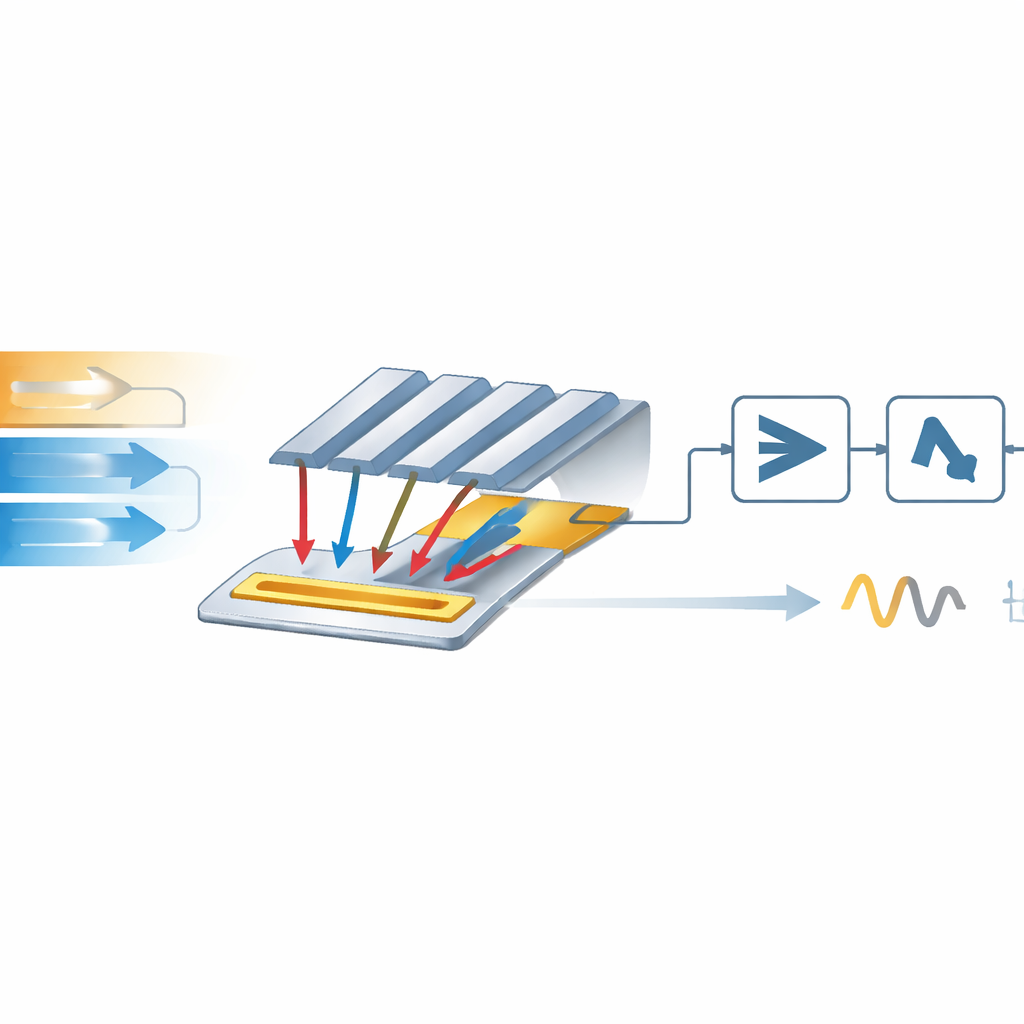
At the heart of the chip is a row of microcantilevers—slender beams, thinner than a human hair, anchored at one end and free at the other. These beams are made from two layers of materials that expand differently when heated. When the temperature rises or when light warms the surface, the mismatch in expansion gently bends each beam. Likewise, when a stream of gas flows across the chip, pressure from the moving gas nudges the beams downward. The researchers turn this bending into an electrical signal by forming a small capacitor: as the gap between the bent beam and an electrode underneath shrinks, the electrical capacitance increases, and this change can be measured.
Electronics That Listen in Frequency, Not Voltage
Instead of measuring tiny voltage changes directly, the chip’s electronics translate the changing capacitance into a change in oscillation frequency—a sort of electronic heartbeat whose rate speeds up or slows down. A chain of simple logic elements forms a ring oscillator whose pace depends on the total capacitance from the beam array. A matching “reference” capacitor made of fixed beams helps cancel out unwanted shifts from the circuitry itself. An additional circuit compares the sensing and reference signals, then a phase‑locked loop multiplies the resulting frequency difference so that it is easy to count and read digitally. Because the information is carried in frequency rather than absolute voltage, the system is naturally robust against noise and drift.
High Precision for Heat, Airflow, and Light
By carefully choosing the beams’ length and width, and by simulating how they bend under heat and pressure, the team tuned the structure for both sensitivity and durability. They then fabricated the design using a standard semiconductor process and a few added micromachining steps to release the movable beams. Tests showed that the output frequency changes almost perfectly linearly with temperature from room temperature up to 100 °C, corresponding to a temperature resolution of about 2.3 thousandths of a degree Celsius—fine enough to detect minute thermal shifts. In airflow tests using nitrogen gas, the output frequency followed a predictable curve with the square of flow speed, enabling detection of changes as small as a few millimeters per second and maintaining sensitivity up to very high flows of 130 meters per second. Additional experiments with a microscope light source showed clear frequency shifts even for relatively weak illumination, confirming that photothermal bending also provides a usable signal.
From Lab Bench to Real‑World Uses
Compared with earlier integrated flow and temperature sensors, this new chip packs more functions into a smaller area, while consuming only a few milliwatts of power. Its microcantilever design and low electronic noise give it better resolution than many existing devices of similar type, and the same basic structure can respond to multiple kinds of inputs—heat, flow, and light—without needing separate sensors. The authors argue that, with added on‑chip calibration and smarter signal processing, similar chips could be adapted to track breathing, blood flow pulses through soft packaging, or subtle environmental changes, all in a compact, manufacturable system.
Why This Matters
In plain terms, the researchers have built an ultra‑sensitive “electronic feeler” that can pick up tiny changes in air movement, temperature, and light, all on a single microchip that standard factories can mass‑produce. By converting mechanical bending of microscopic beams into crisp frequency shifts, the device offers both high precision and simple digital readout. This combination of sensitivity, size, and versatility makes the technology a strong candidate for future environmental sensors and medical monitors that are smaller, cheaper, and easier to embed almost anywhere.
Citation: Wang, F., Ouyang, X., Hong, L. et al. A Monolithic CMOS-MEMS SoC with 1.8 mm/s and 2 mK Resolution for Flow and Temperature Sensing via a Microcantilever Array. Microsyst Nanoeng 12, 103 (2026). https://doi.org/10.1038/s41378-026-01220-5
Keywords: microcantilever sensor, CMOS-MEMS, flow sensing, temperature sensing, multiparameter sensing