Clear Sky Science · en
Hydrogel-based electrodes for high-fidelity sEMG acquisition and robotic hand control
Listening to Muscles to Move Machines
Imagine controlling a robotic hand simply by tensing your own muscles. For people who have lost hand function, or for workers who need precise robotic assistance, this kind of effortless link between body and machine could be life-changing. But today’s stick-on metal electrodes are stiff, can irritate the skin, and often produce noisy electrical readings. This paper presents a soft, skin-friendly "jelly-like" electrode that hugs the body, listens to tiny muscle signals more clearly, and uses them to steer a lifelike robotic hand.
A Soft Patch That Feels Like Skin
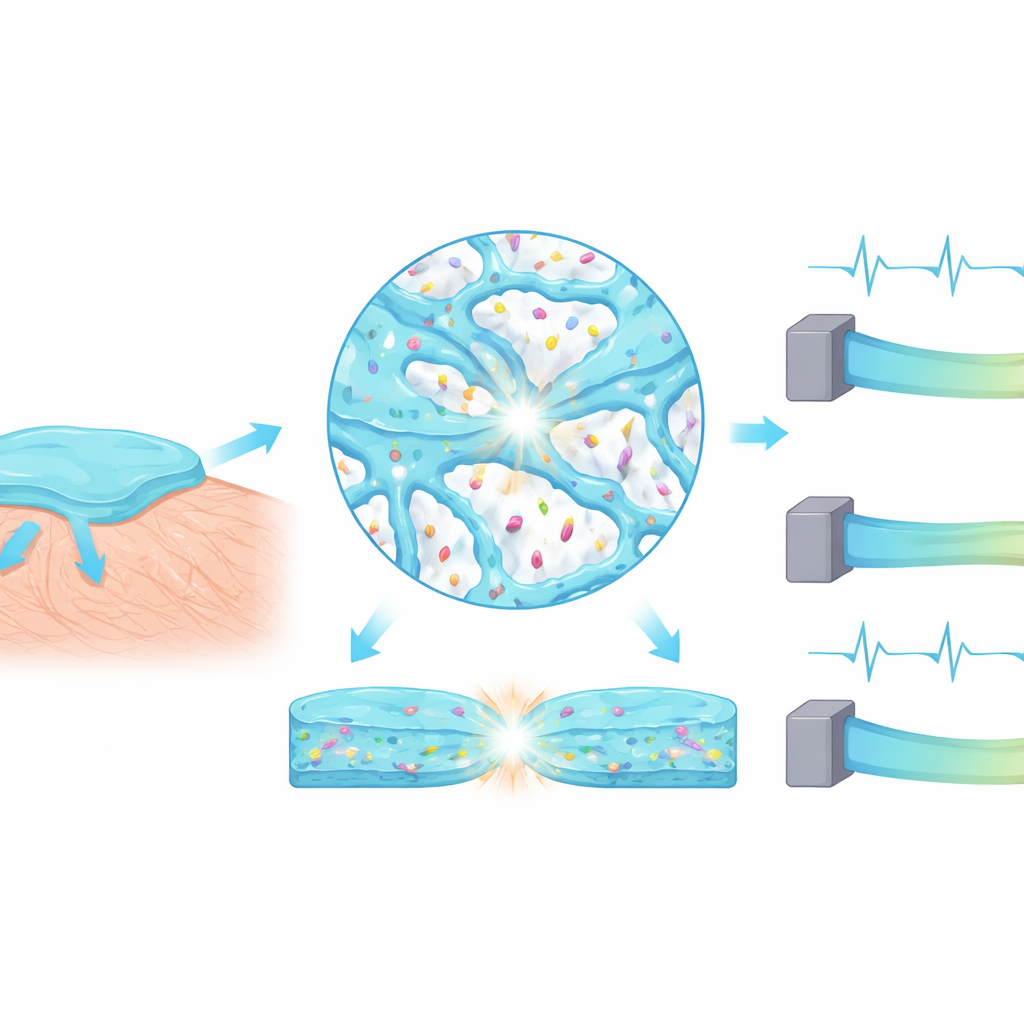
The researchers designed a new hydrogel—an elastic, water-rich material similar to contact lenses—to act as an electrode on the skin. They combined common building blocks used in plastics with natural additives such as chitosan (derived from shellfish) and tannic acid (found in plants), plus glycerol and simple salts. Together, these ingredients create a stretchy, ion-conducting network that can carry electrical charges while remaining soft and moist against the skin. By fine-tuning how much of each component they added, the team produced a version that can stretch more than twelve times its original length without breaking and still maintain reliable electrical performance.
Strong, Sticky, and Able to Heal Itself
To work well on a moving arm or hand, an electrode must stay put, survive bending and pulling, and keep working even after minor damage. The new hydrogel excels in all three areas. Under the microscope, it shows a dense, sponge-like structure formed by many weak bonds between its molecules. Those bonds act like shock absorbers, letting the material stretch, twist, and compress while springing back into shape. They also allow cut pieces of gel to reconnect over time; when the team sliced a sample in half and pressed the pieces together, it gradually healed and recovered nearly all of its original electrical conductivity. Meanwhile, chemical groups in tannic acid give the gel strong adhesion to many surfaces, from plastics and metals to real pigskin and human skin, and this stickiness remains useful even after dozens of attach–peel cycles.
Cleaner Signals from Working Muscles
The next step was to see how well the soft gel could pick up surface electromyography (sEMG) signals—the faint voltages produced by muscles just under the skin. The researchers attached hydrogel electrodes to the forearms of volunteers and compared them with commercial silver/silver-chloride pads of the same size. During simple tasks like clenching and relaxing a fist, both electrode types recorded clear waveforms, but the hydrogel delivered a noticeably higher signal-to-noise ratio. In practical terms, this means the desired muscle signals stood out more sharply from background electrical chatter, and the readings stayed more stable as the electrodes were moved or reused. Even after repeated reattachment or deliberate cutting and self-healing, the hydrogel patches continued to capture high-quality signals, outperforming the rigid metal-based pads.
Teaching a Robotic Hand to Read Gestures
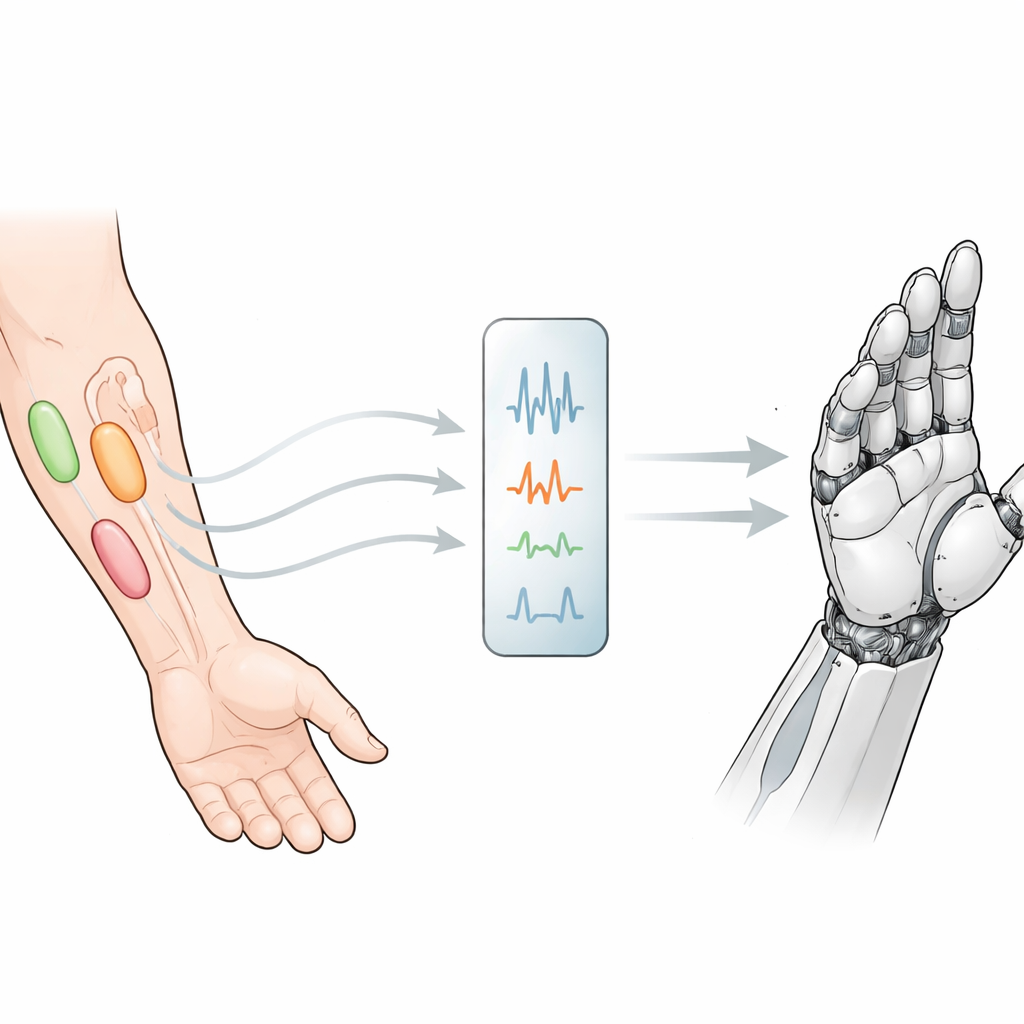
With cleaner muscle signals in hand, the team built a complete system that turns those signals into distinct hand gestures. They mounted integrated hydrogel electrodes over the flexor and extensor muscles of the forearm and recorded electrical patterns while volunteers performed five common gestures, such as an "OK" sign, thumbs-up, open hand, pointing, and a clenched fist. From these recordings, the researchers extracted simple statistical features—how strong, how steady, and how rapidly changing the signals were—and fed them into a computer model. They used an algorithm that combines a fast-learning neural network with an optimization method inspired by swarming birds. This pairing allowed the system to quickly learn which muscle patterns correspond to which gesture with high accuracy.
From Thought-Like Commands to Real Motion
Finally, the team linked their recognition software to a biomimetic robotic hand. When a volunteer formed one of the trained gestures, the hydrogel electrodes captured the sEMG signals, the algorithm identified the intended gesture, and the robotic hand mirrored the movement in real time. Across many trials, the system correctly classified gestures more than 94% of the time, even though it relied only on a small set of simple signal features. For a layperson, the takeaway is straightforward: a soft, self-healing, and sticky gel patch can listen to muscle activity through the skin more comfortably and more clearly than conventional metal pads, enabling reliable control of assistive robots. This approach could underpin future prosthetic hands, rehabilitation tools, and wearables that respond naturally to the body’s own electrical language.
Citation: Yu, Z., Gu, Y., Ren, Y. et al. Hydrogel-based electrodes for high-fidelity sEMG acquisition and robotic hand control. Microsyst Nanoeng 12, 107 (2026). https://doi.org/10.1038/s41378-026-01219-y
Keywords: hydrogel electrodes, surface electromyography, wearable sensors, gesture recognition, robotic hand control