Clear Sky Science · en
Precise detection of single particles and bio-sensing applications on quartz crystal microbalance using non-linear resonance behavior
Weighing the Almost Weightless
Modern science and medicine increasingly depend on tracking vanishingly small amounts of material: a few virus particles in a blood sample, traces of pollutants in air, or rare protein markers of disease. Today’s tiny mechanical sensors can, in principle, feel these minuscule masses, but they often demand delicate fabrication and careful handling. This paper introduces a surprisingly simple twist on a well-known device—the quartz crystal microbalance—that lets it detect masses down to about one hundred femtograms, roughly a billionth of a billionth of a gram, without exotic materials or complex redesign.
A Familiar Crystal with a New Trick
A quartz crystal microbalance (QCM) is essentially a thin slice of quartz sandwiched between metal electrodes. When an alternating voltage is applied, the crystal vibrates at a precise tone, much like a finely tuned bell. If extra mass sticks to its surface, that tone shifts slightly, and electronics can translate the shift into a measured mass. QCMs are popular because they are robust, cheap, and easy to scale up, but conventional operation usually detects only nanogram-level changes. To go far smaller, researchers often coat the surface with special layers or shrink the resonator to the nanoscale, both of which can hurt reliability and make devices harder to manufacture and use.

Leaning into Nonlinear Vibrations
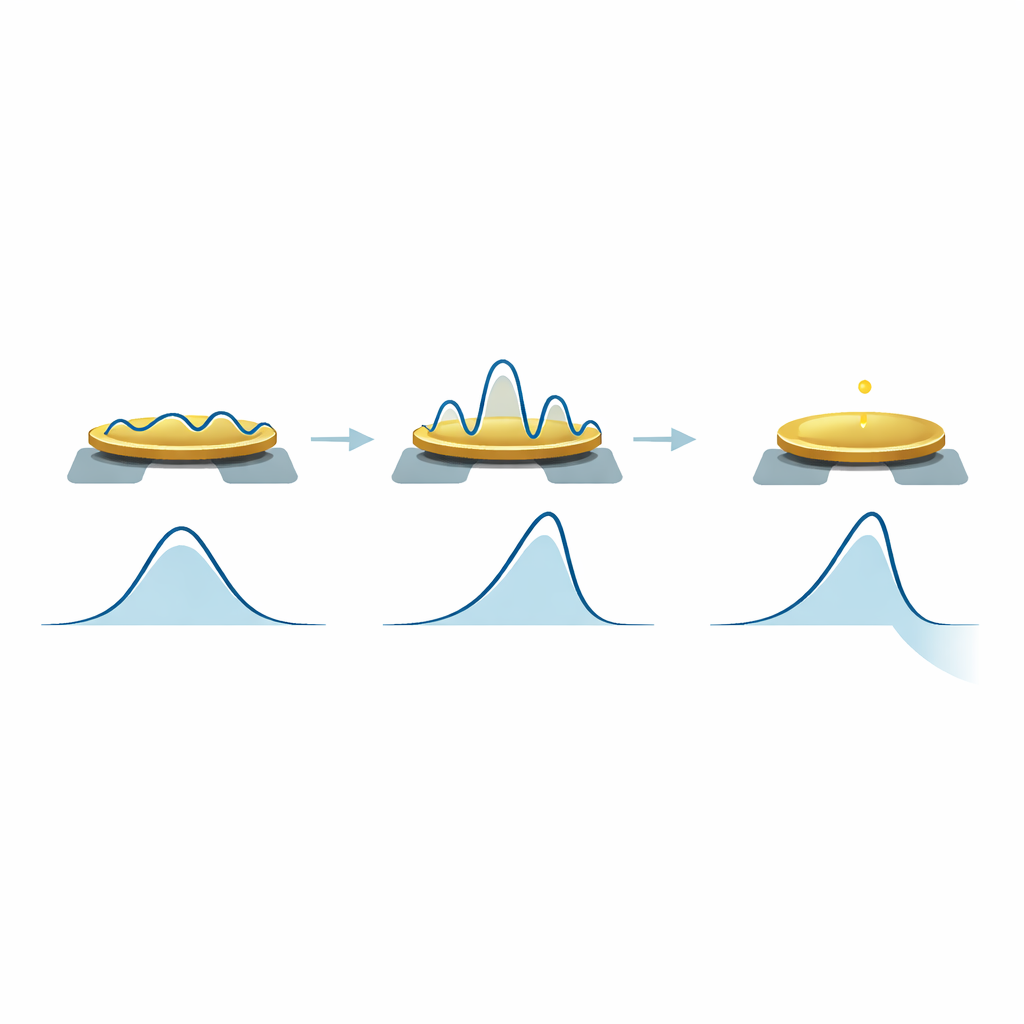
The authors take a different approach: instead of redesigning the device, they change how it is driven. By turning up the electrical drive that makes the crystal vibrate, they push the QCM out of its comfortable, linear regime and into nonlinear behavior, where the response of the crystal is no longer proportional to the drive. In this nonlinear state, the vibration pattern develops an abrupt “cliff”: as the drive frequency is swept, the vibration amplitude suddenly drops at a particular point. The team focuses on this special point, which they call the amplitude-drop frequency. When any extra mass lands on the crystal, it nudges the resonance slightly, shifting where that cliff appears. Because the drop is so abrupt, even a tiny shift—caused by a very small added mass—produces a clear, easily detectable change in the vibration signal.
Putting Tiny Particles and Proteins on the Scale
To show that this effect is more than a mathematical curiosity, the researchers built a simple setup with a commercial 6 megahertz QCM, a standard function generator, and a lock-in amplifier to read out vibration amplitude. They first verified that the crystal could be driven steadily into the nonlinear regime, settling on a drive voltage where the amplitude drop was strong, sharp, and reproducible from sweep to sweep. Then they deposited controlled amounts of silica micro- and nanoparticles, as well as the common protein bovine serum albumin (BSA), directly onto the QCM surface. In ordinary, low-drive operation, it was hard to resolve mass changes below about ten picograms. In the nonlinear regime, however, they could clearly see distinct shifts in the amplitude-drop point corresponding to single microparticles and protein masses down to roughly 100 femtograms.
Feeling Single Molecules Bind
Beyond particles and bulk protein, the team probed a biologically more relevant task: detecting the binding of an antibody to its target protein. They allowed BSA molecules to adsorb onto the gold surface of the QCM, then introduced a matching anti-BSA antibody solution. After giving the antibodies time to bind and rinsing away unbound material, they again measured the nonlinear response. The additional binding step produced an extra shift in the amplitude-drop frequency corresponding to about 100 femtograms of antibody. Importantly, the same QCM could be reused multiple times, and repeated single-particle measurements consistently produced the same signal change, indicating that the nonlinear operation mode is stable and robust under normal laboratory conditions and even, with some performance loss, in water.
Why This Matters for Real-World Sensing
The core message of this work is that a standard, off-the-shelf quartz crystal can act as an ultrasensitive mass sensor simply by being driven into a carefully chosen nonlinear vibration state. Instead of chasing ever smaller or more elaborate devices, the authors use the crystal’s own dynamics as an internal amplifier: small added masses tip the system over a built-in cliff, turning subtle effects into large, easily read signal jumps. This approach bypasses the need for special surface coatings and complex fabrication while remaining compatible with future microfluidic chips and real-time detection schemes. In practical terms, it could open the door to compact, reusable sensors that weigh individual particles and extremely small amounts of biomolecules, with potential applications ranging from monitoring nanoplastics and fine dust in the environment to spotting early disease markers in a drop of blood.
Citation: Kim, J., Je, Y., Kim, S.H. et al. Precise detection of single particles and bio-sensing applications on quartz crystal microbalance using non-linear resonance behavior. Microsyst Nanoeng 12, 98 (2026). https://doi.org/10.1038/s41378-026-01217-0
Keywords: quartz crystal microbalance, nonlinear resonance, ultrasensitive mass detection, single-particle sensing, biosensing