Clear Sky Science · en
Exploring the synergic effect of thermal tuning and mode-coupling for frequency stabilization in micromechanical resonators
Keeping Tiny Timekeepers on Track
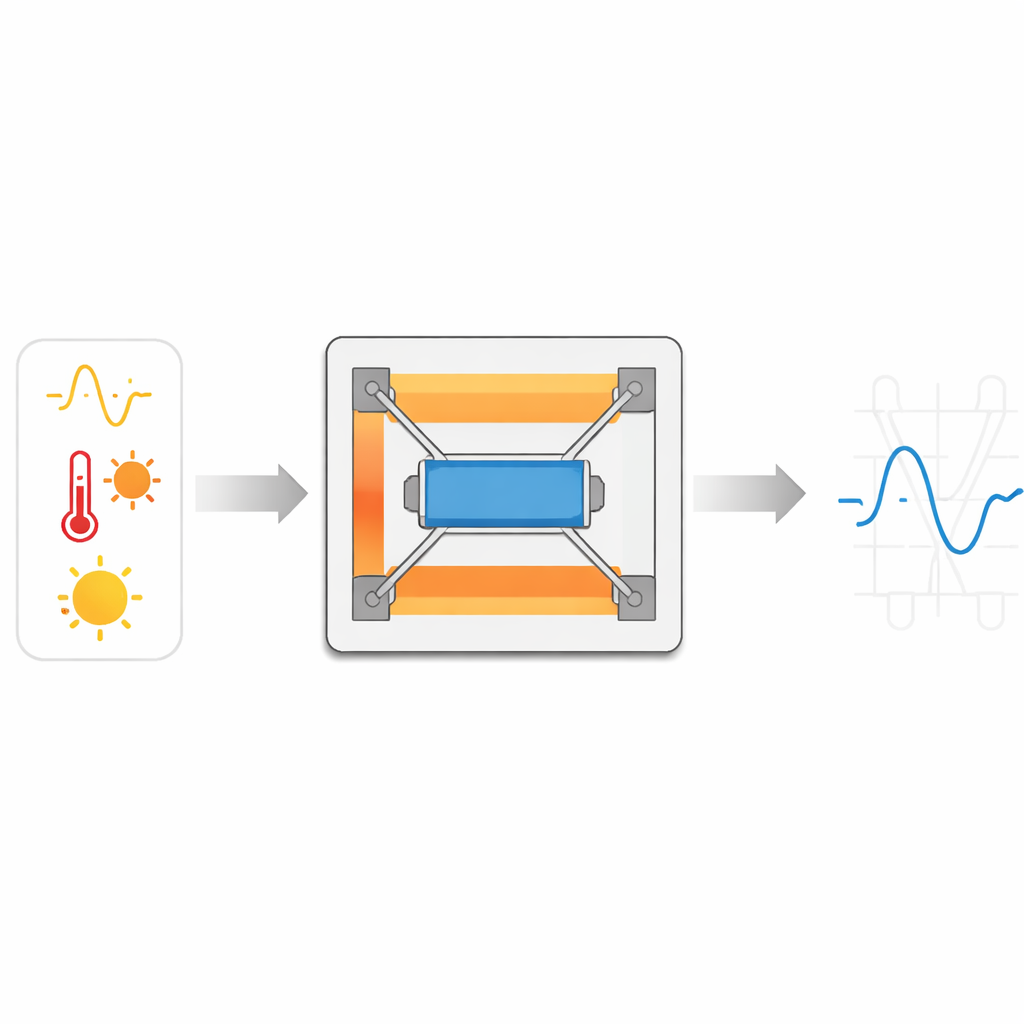
From smartphones and GPS receivers to autonomous cars and scientific instruments, modern technology quietly relies on tiny vibrating structures called resonators to keep precise time and measure motion. But like musical instruments that drift out of tune when they warm up, these micrometer-scale "timekeepers" are easily disturbed by temperature changes and internal interactions between their vibration patterns. This paper shows how carefully controlled heating inside the chip itself can counteract those disturbances, helping miniature resonators stay locked to a steady beat for more reliable electronics.
Why Small Vibrations Matter
Micromechanical resonators are microscopic versions of tuning forks etched into silicon. They vibrate millions of times per second and serve as clock sources, filters for wireless signals, and sensitive detectors in countless devices. Many of today’s resonators are designed to support two different vibration patterns, or modes, at once. This dual-mode operation allows the same chip to sense multiple quantities, process complex signals, or improve frequency stability. However, when both modes are active, energy can leak between them in subtle ways, shifting their vibration frequencies and undermining the device’s precision.
When Modes Talk and Heat Builds Up
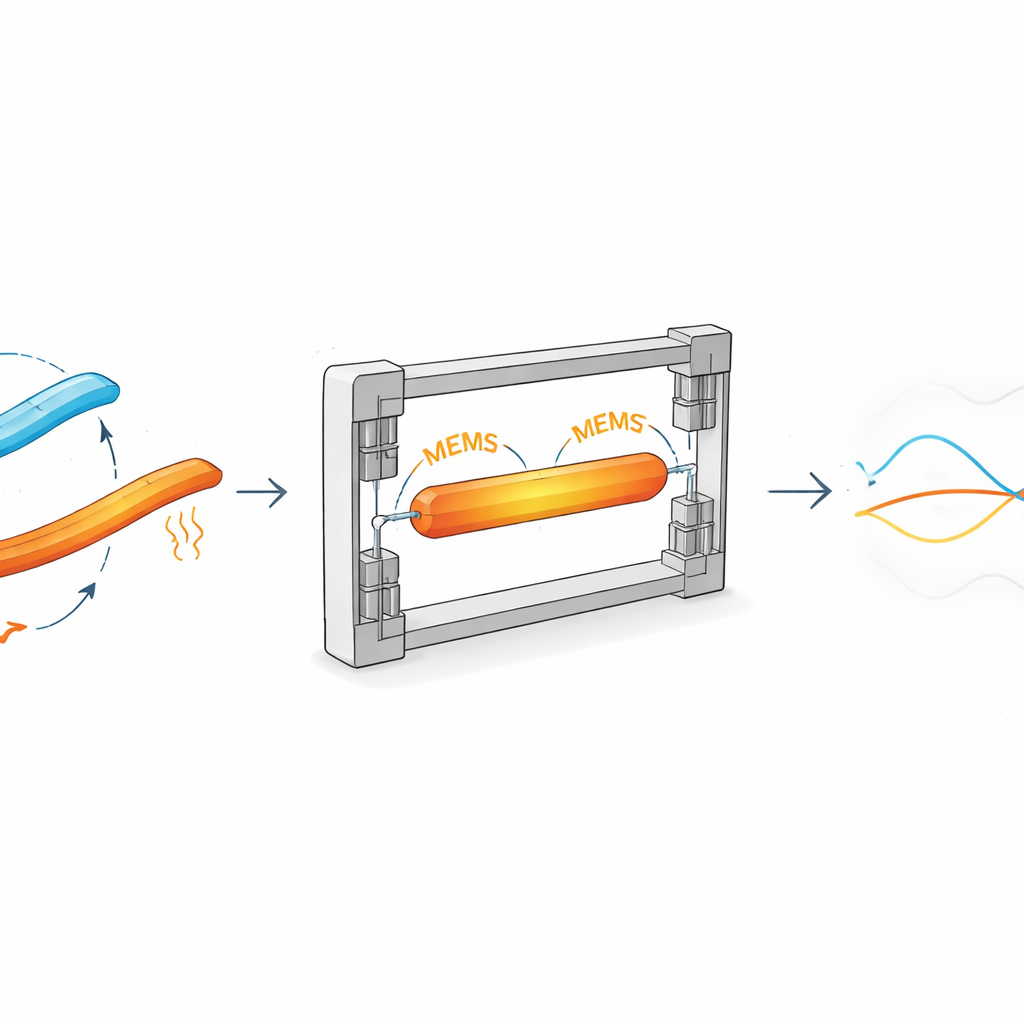
In the dual-mode device studied here, one vibration mode bends slightly out of the plane of the chip while the other stretches it in-plane. When one mode vibrates strongly, its motion slightly changes the stiffness felt by the other, nudging that second mode’s natural frequency up or down. At the same time, the electrical drive that powers the motion causes tiny but significant heating inside the resonator body. Because the stiffness of silicon changes with temperature, this self-heating also shifts the vibration frequency. The key insight of this work is that these two effects—mode interaction and self-heating—can be made to oppose each other, so that one cancels the other instead of adding up.
A Built-In Tiny Oven with a Smart Sweet Spot
To achieve this balance, the researchers built a special resonator on a thin film of piezoelectric material atop heavily doped single-crystal silicon, then suspended it on slender folded beams that act as thermal bottlenecks. Around the resonator they integrated a miniature heater—a “micro-oven”—that can gently warm the structure with a small direct current. Because of the way the silicon is doped and oriented, each vibration mode responds differently to temperature: one mode’s frequency increases at first and then decreases beyond a particular “turnover” temperature, while the other decreases more steadily. By adjusting the micro-oven’s heating power, the team can park the in-plane mode exactly where its frequency is either insensitive to temperature or turns in the opposite direction needed to offset mode-induced shifts.
Watching the Balance in Action
Using precision electronics to drive and read out the resonator, the authors systematically varied the vibration strength of one mode while monitoring how the other mode’s frequency responded under different heating levels. Without special tuning, ramping up one mode pulls the other’s frequency noticeably away from its starting value. As the micro-oven raises the overall temperature, self-heating during motion becomes more pronounced and can either worsen this drift or, at a carefully chosen operating point, almost completely cancel it. In their experiments, when the device was biased near this sweet spot, the frequency of the in-plane mode remained nearly constant—even as the companion mode’s vibration amplitude changed significantly—improving short-term frequency stability by more than an order of magnitude.
What This Means for Everyday Devices
This work shows that heat, often seen as a nuisance in electronics, can be turned into a helpful tool. By intentionally warming a dual-mode resonator to a carefully selected temperature, the natural frequency shifts caused by internal mode interaction can be neutralized by equal-and-opposite shifts from self-heating. The result is a tiny on-chip oscillator whose tone stays steady despite strong internal vibrations, without needing complex external reference signals. As this approach is extended to other designs and sensing schemes, it could lead to more robust timing chips and sensors that hold their accuracy in demanding environments, quietly improving the reliability of the technologies we use every day.
Citation: Xiao, Y., Sun, C., Liu, S. et al. Exploring the synergic effect of thermal tuning and mode-coupling for frequency stabilization in micromechanical resonators. Microsyst Nanoeng 12, 93 (2026). https://doi.org/10.1038/s41378-026-01210-7
Keywords: MEMS resonator, frequency stabilization, thermal tuning, mode coupling, micro-oven