Clear Sky Science · en
Localized thermal tuning in fused silica inductive vibrating ring gyroscopes
Gyroscopes Built for Rough Real-World Use
Many of the devices that keep airplanes on course, stabilize satellites, or guide drilling equipment deep underground rely on tiny motion sensors called MEMS gyroscopes. But in especially harsh environments, traditional designs can be too fragile or too inaccurate over time. This research introduces a new way to fine-tune a particularly rugged kind of gyroscope, making it much more precise without sacrificing its ability to survive extreme shocks and temperatures.
A Tougher Kind of Motion Sensor
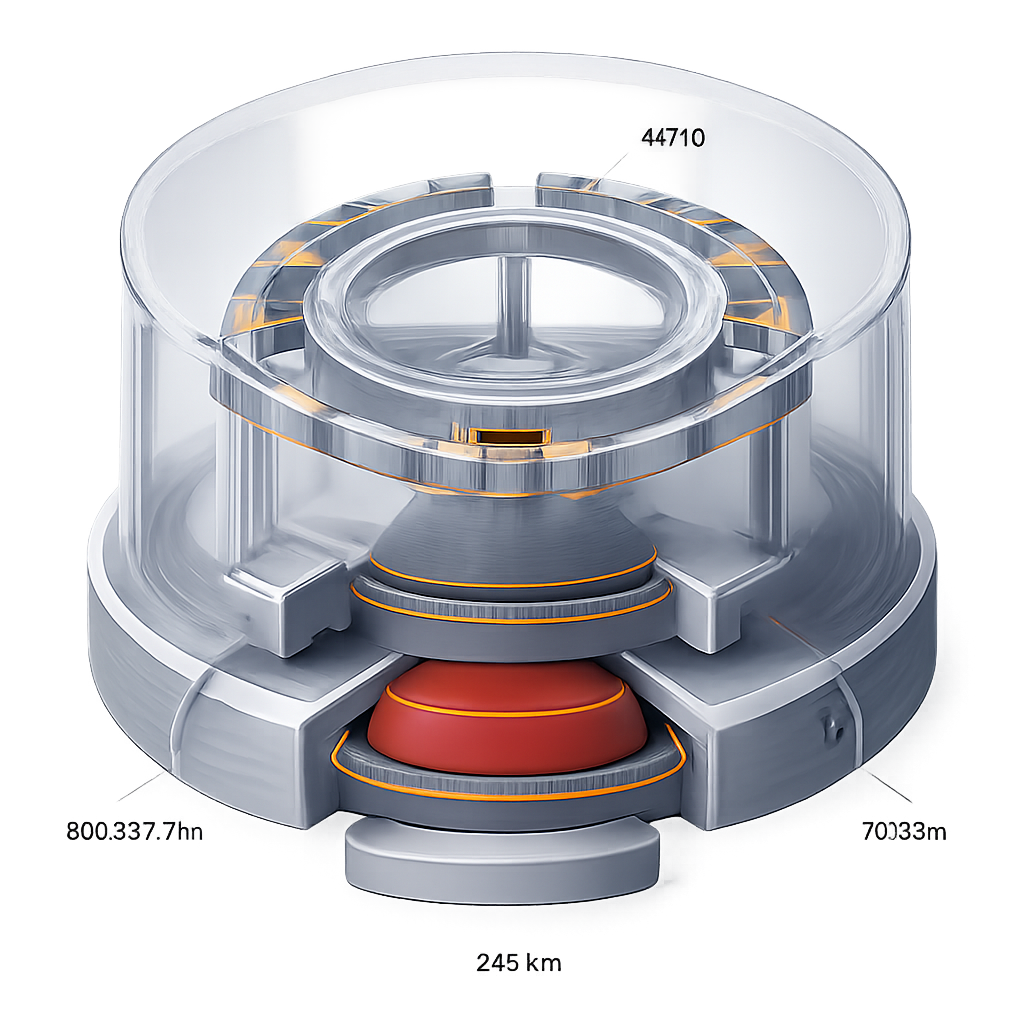
Most commercial micro-gyroscopes today are “capacitive” devices that sense motion by monitoring tiny changes in electric charge across very narrow gaps. These narrow gaps make them sensitive, but also vulnerable: a strong shock can slam moving parts into fixed electrodes, potentially damaging the device. The gyroscope studied here belongs to a different family, called an inductive vibrating ring gyroscope, built from a glass-like material known as fused silica. Instead of relying on delicate gaps, it uses a magnetic field and electric current in surface wires to push a ring-shaped structure into vibration and to read out its motion. This layout allows much larger safe movements and excellent shock resistance, making it attractive for demanding applications.
Why Tiny Frequency Differences Cause Big Errors
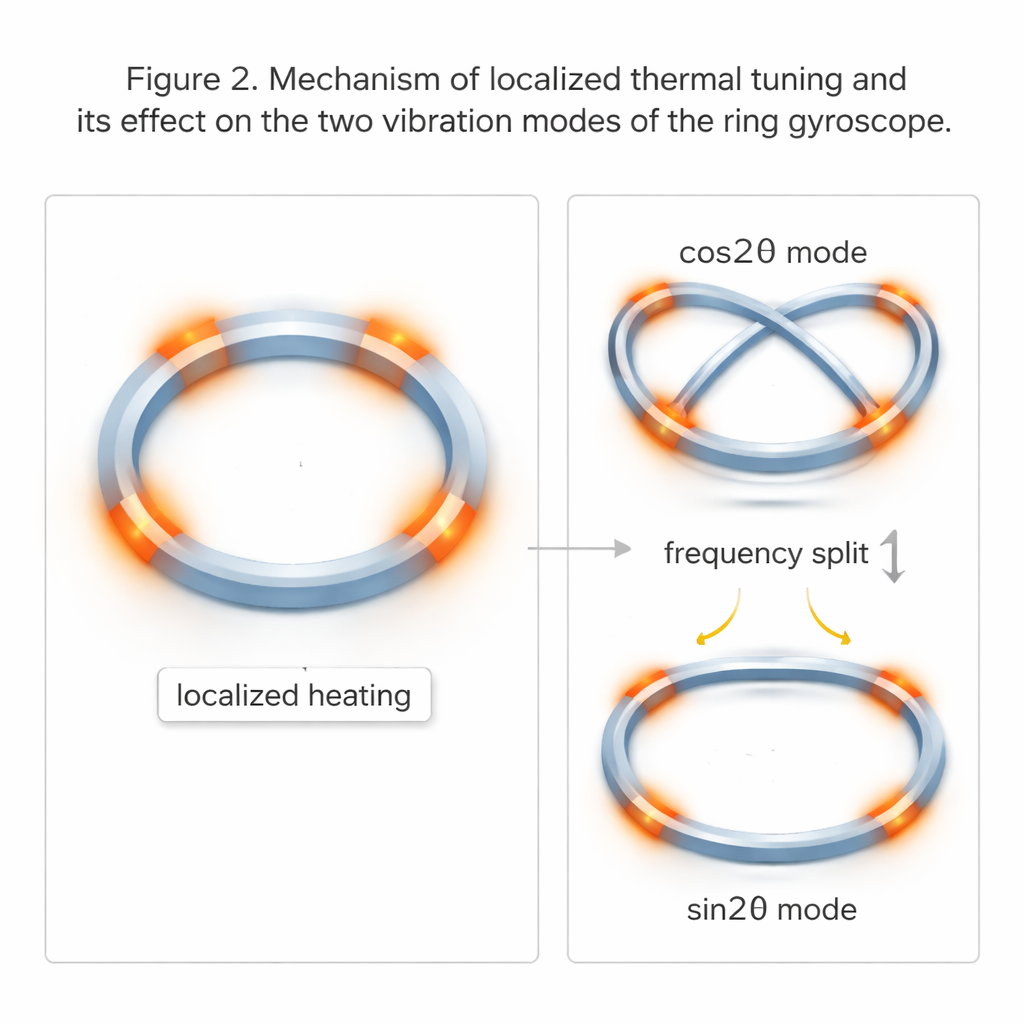
In this ring design, two vibration patterns—imagine the ring flexing into slightly different ellipses—should ideally resonate at exactly the same frequency. In reality, tiny imperfections in shape, stiffness, or damping make these two “degenerate” modes slightly different, a mismatch called frequency split. That small difference might sound harmless, but when the device operates in a high-precision “whole-angle” mode that tracks how the vibration pattern rotates, it becomes a major source of error. Frequency split creates angle-dependent bias (a rate offset that varies with orientation), distorts the relationship between input rotation and output signal, and increases long-term drift. Existing tuning approaches, like laser trimming or electrostatic adjustment, either are permanent, cannot be used after packaging, or do not work well with magnetically driven devices like this one.
Heating Very Precisely, Instead of Rebuilding the Device
To solve this, the authors propose a clever alternative: instead of cutting or pulling on the structure, they gently and locally heat it. When electrical current passes through carefully patterned thin gold electrodes on the ring, it produces Joule heat. Fused silica behaves unusually: its stiffness (Young’s modulus) increases with temperature. That means warming a small part of the ring makes that section stiffer and nudges the vibration frequency up. By placing “hot spots” at specific angles—aligned with the peaks of a chosen vibration pattern—the researchers can raise the frequency of one mode much more than the other, shrinking the frequency split in real time and in a fully reversible way.
Designing Tiny Heaters That Don’t Disturb the Wrong Mode
Simply heating the whole ring would shift both modes together and barely change their mismatch. The key is localization: the hot region must be small enough to affect mainly one pattern, yet large enough to noticeably shift its overall stiffness. The team analyzes how temperature spreads around the ring and introduces a “thermal coupling” factor that measures how much the unwanted mode is affected. Using mathematical models and computer simulations, they show there is an optimal angular size for the heated region—too broad and both modes are pushed together, too narrow and the tuning effect is weak. They then redesign the electrodes so that resistance, and thus heating, is concentrated near small mass blocks placed at the vibration peaks. Different layouts are tested in simulation, and one design in particular strikes the best balance between strong tuning and low cross-coupling.
Turning Theory into a Working High-Precision Gyroscope
The researchers fabricate several prototypes using a laser-based etching method to sculpt the fused-silica rings and conventional thin-film processing to pattern the metal electrodes. In tests under high vacuum, they superimpose a steady tuning voltage on top of the normal drive signal, letting the same electrodes both excite and thermally tune the vibration. As the tuning power increases, the two mode frequencies are observed to converge until they nearly coincide. With the best electrode design, the initial difference in frequencies can be reduced to as little as 14 millihertz—more than sufficient for whole-angle operation—while the quality factor, a measure of how cleanly the structure rings, is barely affected.
Sharper Measurements Across a Wide Temperature Range
Once the frequency split is minimized and small phase errors in the electronics are corrected, the overall sensor performance improves dramatically. The angular bias that depends on the vibration pattern’s orientation shrinks by more than a factor of six, the nonlinearity in the scale factor drops by about seventyfold, and long-term bias instability is reduced from several degrees per hour to well below one degree per hour. Random noise is also cut significantly. Importantly, these gains hold over a broad temperature window from −40 °C to 60 °C, with only modest changes in tuning needed as the environment shifts.
What This Means for Future Navigation Systems
For a non-specialist, the core message is that this work shows how to finely “retune” a tough, magnetically driven micro-gyroscope on the fly using patterned nanoscale heaters, rather than by permanently altering its structure. By harnessing an unusual property of fused silica and carefully shaping how heat flows around a vibrating ring, the authors turn a robust but imperfect device into a much more accurate and stable sensor. That combination of durability and precision is crucial for navigation and control systems that must perform reliably in shock-filled, temperature-changing, and hard-to-access environments.
Citation: Wu, K., Wang, X., Li, Q. et al. Localized thermal tuning in fused silica inductive vibrating ring gyroscopes. Microsyst Nanoeng 12, 77 (2026). https://doi.org/10.1038/s41378-026-01203-6
Keywords: MEMS gyroscope, inductive ring gyroscope, thermal tuning, fused silica resonator, inertial navigation