Clear Sky Science · en
A laminated magnetic flux concentrator with low coercivity and high relative permeability for efficient flux modulation in MEMS magnetoresistive sensors
Listening to Extremely Faint Magnetic Signals
From mapping the human brain to guiding spacecraft, many modern technologies rely on detecting incredibly weak magnetic fields. Magnetic tunnel junction (MTJ) sensors are already among the most promising tools for this job, but a type of low-frequency "hiss" known as 1/f noise limits how faint a signal they can hear. This paper reports a new way to tame that noise by pairing MTJs with carefully engineered magnetic add-ons that concentrate and modulate magnetic fields, potentially opening the door to compact, ultra-sensitive detectors operating at room temperature.
Why Weak Magnetic Fields Matter
Magnetic sensors show up in surprising places: they help navigate aircraft and satellites, measure traffic flow, and even monitor tiny magnetic signals from the heart or brain. To push into more demanding applications—such as observing minute fluctuations in space or inside the human body—sensors must pick out signals millions of times weaker than Earth’s magnetic field. MTJ sensors are attractive because they are tiny, energy-efficient, and intrinsically sensitive. However, at low frequencies, their performance is crippled by 1/f noise, a background fluctuation that grows stronger as the signal slows down. Existing tricks to dodge this noise often require bulky shielding, added coils that introduce their own disturbances, or cryogenic cooling, all of which limit practical deployment.
Concentrating and Shifting the Magnetic Signal
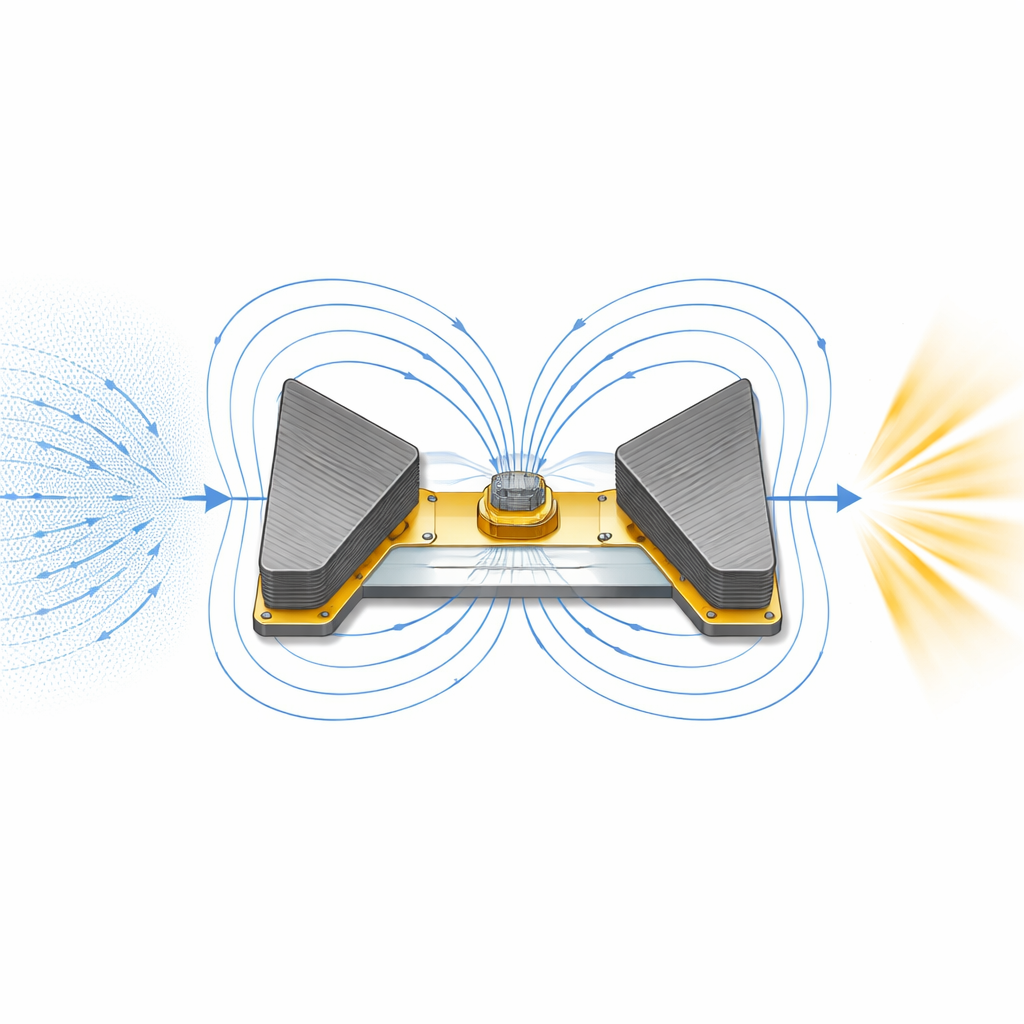
The authors focus on a strategy that uses magnetic flux concentrators—miniature pieces of soft magnetic material placed beside the MTJ—to gather and intensify incoming magnetic field lines. In their design, these concentrators are mounted on a moving micro-electromechanical (MEMS) structure along with the MTJ. As the parts vibrate in a coordinated pattern called two-dimensional synchronous motion modulation (TDSMM), a steady or slowly varying external field is converted into a high-frequency oscillating signal at the sensor. This shift into a higher frequency band helps sidestep 1/f noise, while the concentrators themselves boost the effective field at the MTJ by more than a factor of two. Simulations show that, with properly chosen dimensions and spacing, the device can maintain both strong field gain and a clean, nearly sinusoidal modulated signal.
Designing a Better Magnetic “Lens”
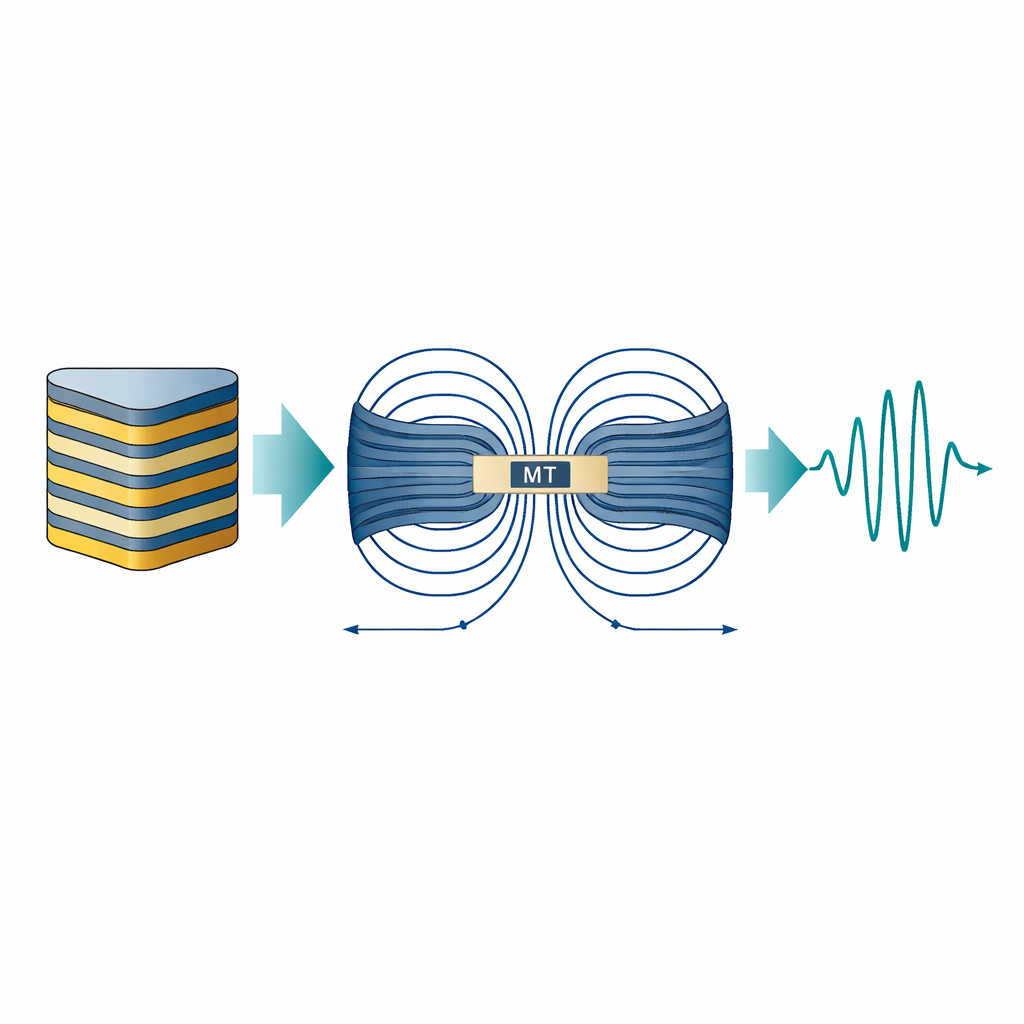
Achieving this performance hinges on the properties of the concentrator material. To work well, it must guide magnetic fields easily (high relative permeability) while responding with minimal internal friction (low coercivity). The team developed a laminated film made of alternating layers of a soft alloy (Ni77Fe14Cu5Mo4) and thin tantalum spacers. By carefully choosing the thickness of each magnetic layer and the number of repetitions, they suppressed stripe-like magnetic domains that normally make the material sluggish and lossy. Measurements revealed that stacking six such bilayers slashed the coercivity by more than an order of magnitude compared with a single layer, while maintaining excellent magnetic softness. The researchers also tuned the sputtering power used to deposit the films, balancing internal stress and surface smoothness to reach a very high relative permeability of about 3200 along the preferred direction.
From Thin Films to Working Sensors
With the material optimized, the team fabricated 400-nanometer-thick flux concentrators integrated directly beside an MTJ on a silicon-on-insulator chip. Because thick films can crack or peel during processing, they built up the concentrators in two 200-nanometer steps using a lift-off method, ensuring good adhesion and pattern fidelity. When these concentrators were positioned just 12 micrometers from the MTJ, the sensor’s response to a small magnetic field—its sensitivity—rose by a factor of 2.2. Noise measurements inside a magnetic shield showed that, at low frequencies around 1 hertz, the device could detect fields of about 10 nanotesla per square-root hertz. At a higher frequency tied to the planned MEMS vibration (around 11.6 kilohertz), the noise power dropped by a factor of 686 compared with the low-frequency range, highlighting how moving the signal into this band dramatically cleans up the measurement.
Toward Compact Ultra-Sensitive Magnetic Ears
In simple terms, this work shows how to build a tiny magnetic "lens" that both amplifies and reshapes weak magnetic signals so MTJ sensors can hear them more clearly. By engineering a laminated soft-magnetic material with extremely low coercivity and very high permeability, then integrating it with an MTJ at micrometer-scale distances, the authors achieve strong field gain and a simulated modulation efficiency of about 65%, outperforming similar hybrid designs. When this improved concentrator is combined with the planned MEMS motion scheme, calculations suggest that the sensor’s noise floor could be pushed down to just tens of picotesla—small enough to compete with much larger and more complex instruments. That prospect makes MTJ-based hybrids promising candidates for future portable devices that quietly listen to some of the faintest magnetic whispers in nature.
Citation: Jiao, Q., Peng, G., Jin, Z. et al. A laminated magnetic flux concentrator with low coercivity and high relative permeability for efficient flux modulation in MEMS magnetoresistive sensors. Microsyst Nanoeng 12, 88 (2026). https://doi.org/10.1038/s41378-026-01202-7
Keywords: magnetic tunnel junction sensors, magnetic flux concentrator, MEMS modulation, low-frequency noise reduction, ultra-weak magnetic field detection