Clear Sky Science · en
Signal-to-noise ratio enhancement for MEMS resonant sensors with potential barrier adjustable stochastic resonance
When Noise Becomes a Useful Tool
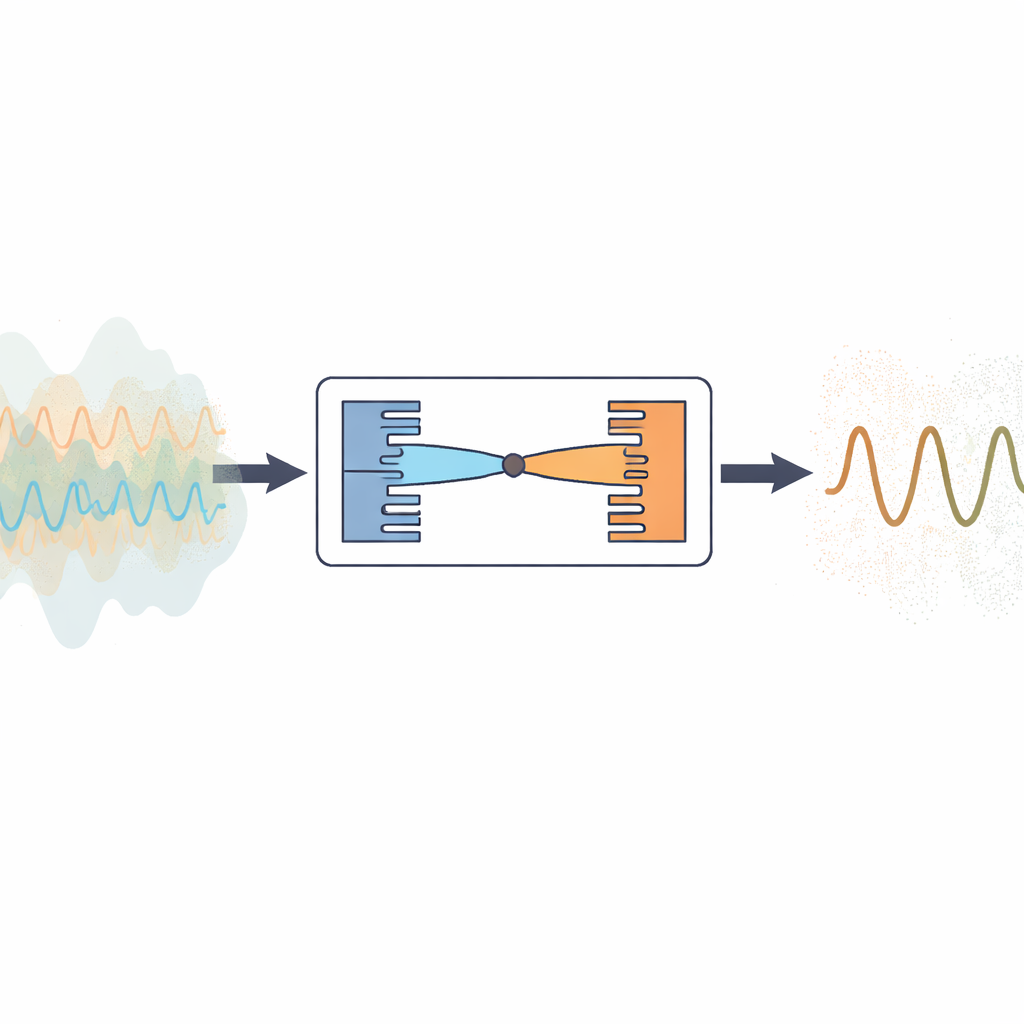
Modern sensors often struggle to pick out faint signals hiding inside a roar of background noise—much like trying to hear a whisper in a crowded room. This paper explores an unusual twist: under the right conditions, adding or reshaping noise can actually make tiny signals easier to detect. The authors build a micro-scale mechanical device that turns this counterintuitive idea into a practical technology, showing how it can reveal forces so small they are measured in nanonewtons.
Turning Randomness into an Ally
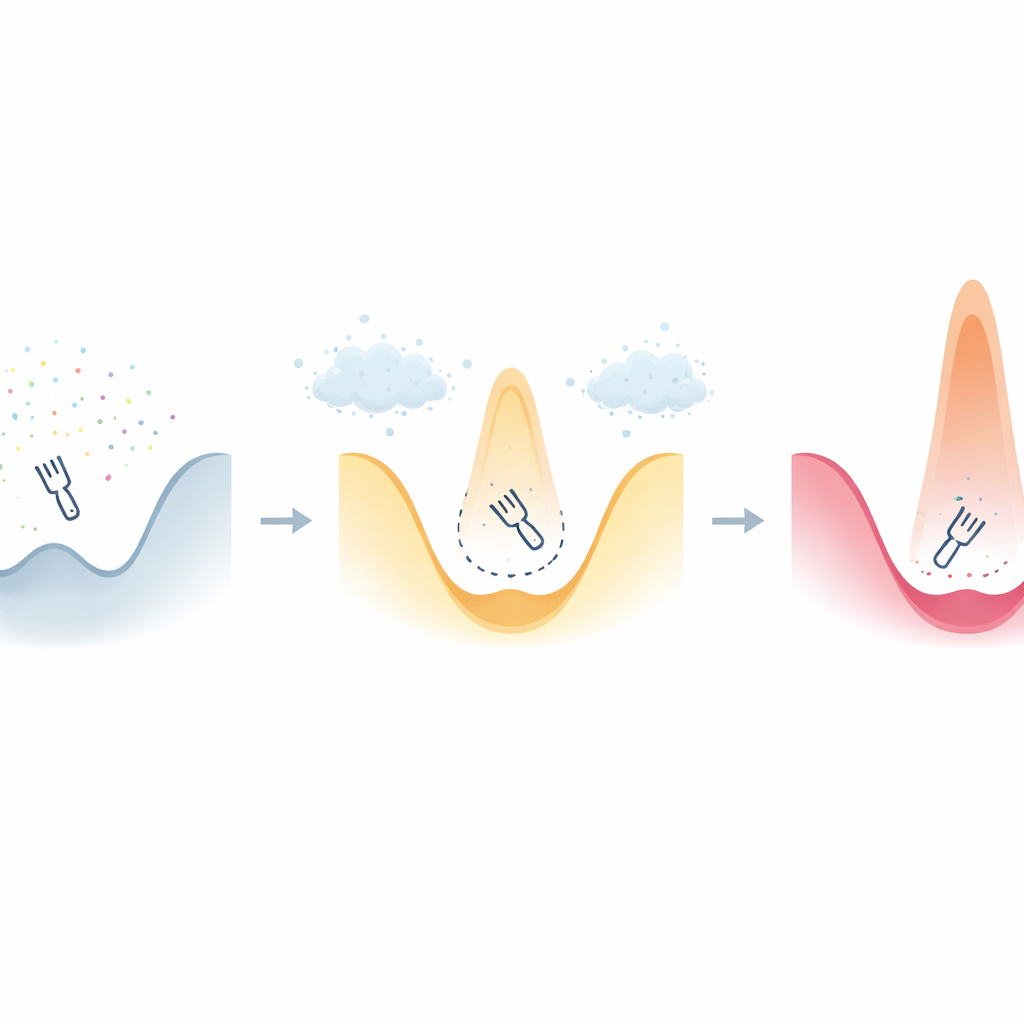
The work builds on a phenomenon called stochastic resonance, where a system with two preferred states can use random jostling to hop back and forth in step with a weak repeating signal. Imagine a ball in a landscape with two valleys separated by a hill. A periodic push alone is too weak to move the ball over the hill, but if the landscape is also shaken by just the right amount of noise, the ball starts crossing back and forth in rhythm with the signal. The result is that the weak input becomes much easier to spot in the system’s output. Traditionally, this effect is controlled by carefully adjusting how much noise is added.
Why Conventional Methods Fail in Loud Environments
In real-world settings, background noise is often not under our control. The authors show experimentally that when the ambient noise around a sensor is already high, adding more noise no longer helps. Using their microelectromechanical (MEMS) resonator, they first recreate the usual approach: a weak periodic voltage signal is combined with controllable extra noise. At low starting noise levels, increasing this added noise boosts the signal-to-noise ratio, up to an optimal point. Beyond that point, however, the signal once again drowns in randomness. When the surrounding noise is already strong, the system never reaches the sweet spot—any extra noise only makes things worse. This limitation blocks conventional stochastic resonance methods from working in many practical, noisy environments.
Shaping the Energy Landscape Instead of the Noise
To break this barrier, the researchers redesign the problem. Rather than trying to dial the noise up or down, they reshape the “hill and valley” landscape itself inside the MEMS device. Their resonator has a tiny movable shuttle held by springs and flanked by comb-like electrodes. By applying specially chosen voltages to a second set of combs that do not drive motion directly, they can deepen or shallow the two valleys and raise or lower the hill between them. This tunable landscape creates two stable positions for the shuttle and lets the team control how much energy is needed for it to hop from one side to the other. Measurements and simulations show that by increasing the applied voltages, they can smoothly raise the barrier height and move the stable positions farther apart, all while keeping the system symmetric.
Making Sense of Tiny Forces
With this adjustable landscape in place, the team tests a new strategy: they keep the environmental noise fixed—sometimes at levels that previously ruined performance—and instead tune the barrier height. They find that for each noise level, there is an optimal barrier: too low, and the shuttle jumps randomly with no clear pattern; too high, and it rarely crosses at all. At the right setting, the hopping becomes locked to the weak driving signal, and the signal-to-noise ratio climbs sharply, even when the surrounding noise is very strong. Finally, they apply this method to detect periodic forces as small as about 2.7 nanonewtons, with different wave shapes and frequencies. When they reshape the potential, the device clearly reveals the driving frequency, boosting the usable signal by more than 10 decibels across a broad band of low frequencies.
What This Means for Future Sensors
To a lay observer, the main message is that the authors have turned a classic drawback—excess noise—into something that can be tamed by redesigning the sensor’s internal landscape rather than its surroundings. Their MEMS resonator can be “retuned” on the fly to restore the delicate balance needed for stochastic resonance, letting it hear extremely faint, repetitive signals even in a very noisy setting. This approach could pave the way for a new generation of ultra-sensitive, miniaturized sensors that work reliably in the messy, unpredictable conditions of the real world.
Citation: Wu, J., Zhou, G. Signal-to-noise ratio enhancement for MEMS resonant sensors with potential barrier adjustable stochastic resonance. Microsyst Nanoeng 12, 84 (2026). https://doi.org/10.1038/s41378-026-01201-8
Keywords: stochastic resonance, MEMS resonator, signal-to-noise ratio, bistable sensors, noise-assisted detection