Clear Sky Science · en
High sensitivity SAW hydrogen gas sensor based on thermal conductivity effect
Why keeping track of hydrogen really matters
Hydrogen is a promising clean fuel, but it is also invisible, odorless, and can ignite with only a tiny spark. In places like refueling stations, factories, and spacecraft, a small leak can quickly turn into a dangerous situation. Engineers urgently need sensors that can spot both faint traces of hydrogen and very high concentrations before an accident happens. This paper presents a new kind of miniature hydrogen sensor that is fast, highly sensitive, and able to track gas levels over an unusually wide range, offering a safer path for the growing hydrogen economy.
A tiny chip that listens to sound waves
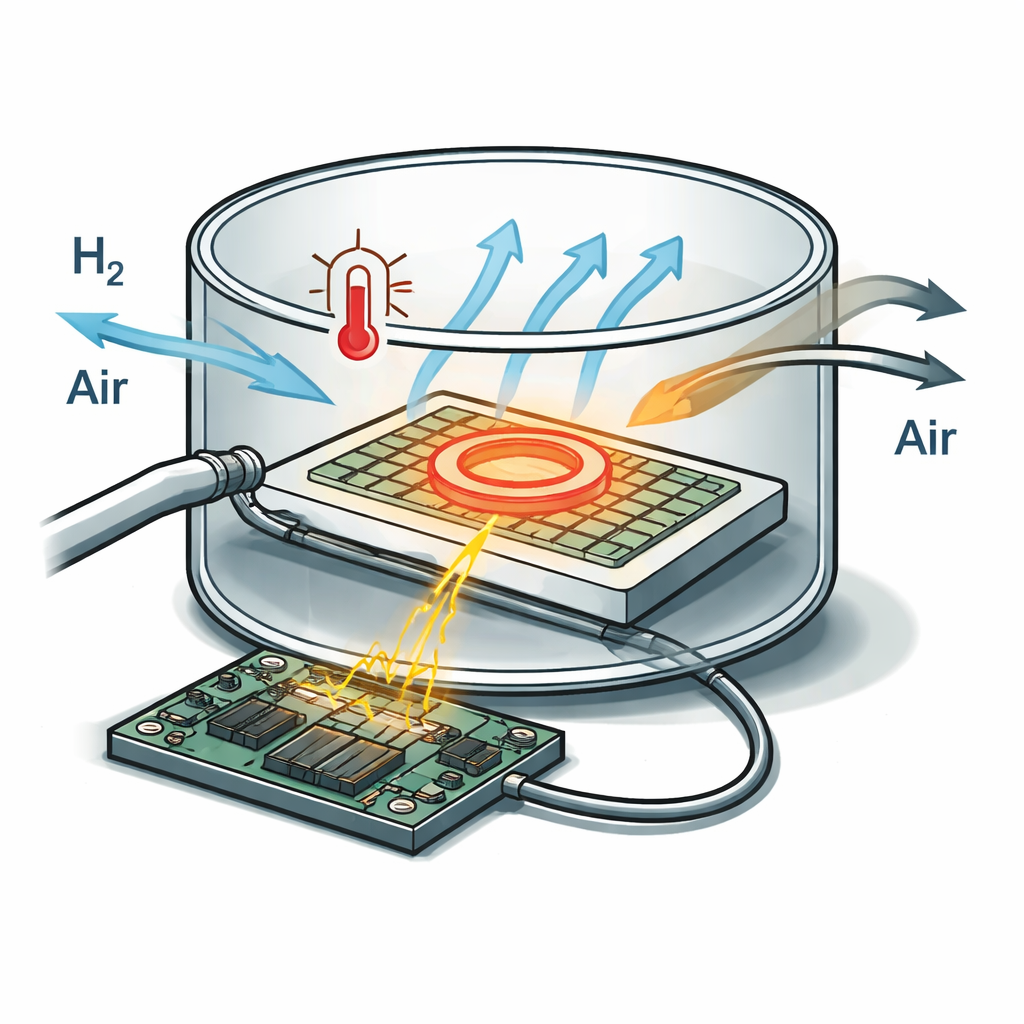
The sensor at the heart of this work is built on a surface acoustic wave (SAW) device. Instead of relying on a chemical coating that reacts with hydrogen, it uses ripples of sound travelling along the surface of a crystal. Metal combs called interdigital transducers launch and receive these surface waves. The researchers added a ring-shaped micro-heater around the active region of the chip so that the device runs at a controlled elevated temperature. As gas flows over the warm crystal, any change in the gas mixture affects how quickly heat is carried away, which in turn changes the temperature and the speed of the sound waves. By watching subtle shifts in the electrical phase of those waves, the system can infer how much hydrogen is present.
How heat flow reveals hidden gas leaks
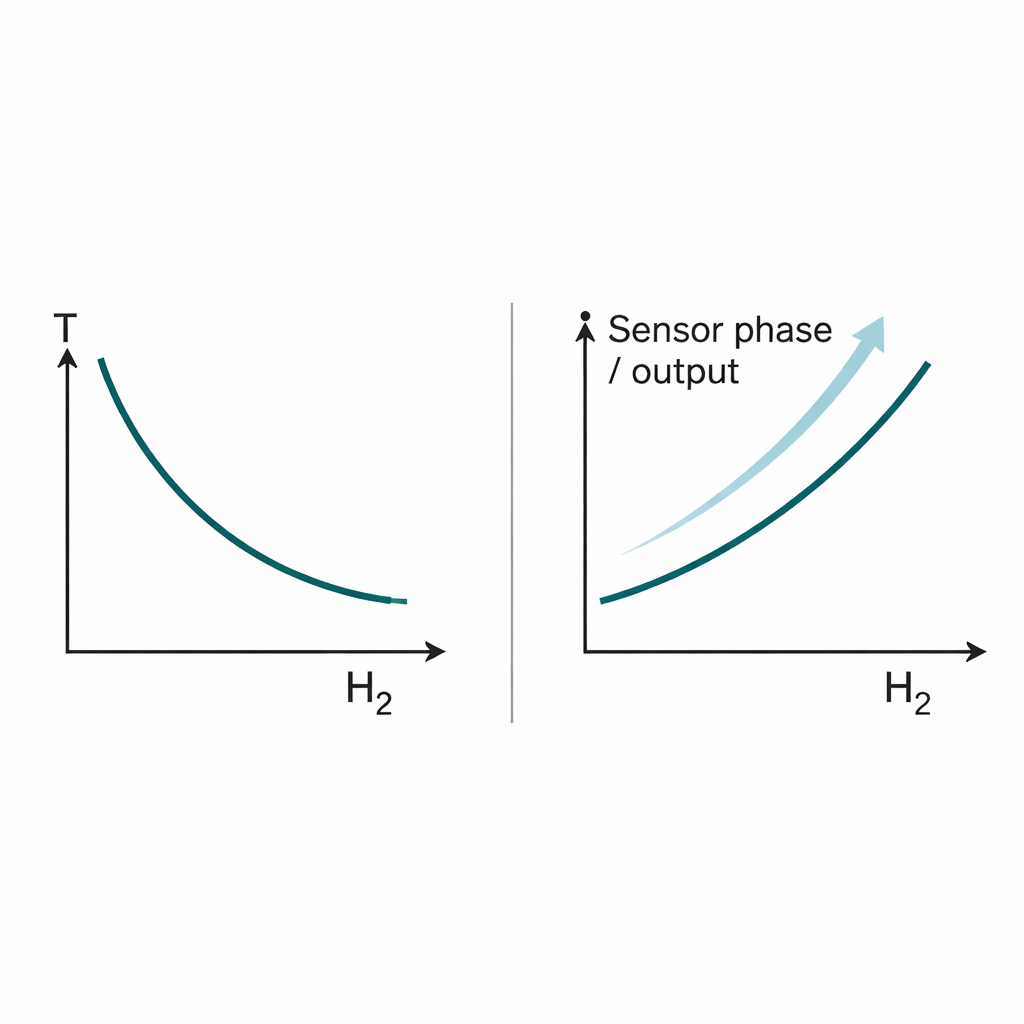
The key physical trick is the high thermal conductivity of hydrogen: it carries heat away much more effectively than air. The team built a detailed mathematical model that combines heat balance with acoustic wave theory to describe how gas composition, gas flow, chip size, and heater power work together. Their calculations show that as hydrogen concentration rises, the heated sensor cools noticeably, especially when it starts from a higher operating temperature. They also show that the speed of the surface waves drops in a very predictable way with temperature, allowing the device to translate small thermal changes into clear, linear shifts in signal. Longer acoustic paths and carefully chosen gas flow speeds further boost the response, but too strong a gas flow can make the signal noisy by stirring the temperature too violently.
Building and packaging the working sensor
Guided by this model, the authors fabricated a SAW chip on a lithium niobate crystal operating at 200 megahertz, with finely patterned aluminum electrodes and a matching aluminum micro-heater. They measured how the chip’s electrical phase changed with temperature and found excellent agreement with their calculations: a change of just 1 degree Celsius produced about 6 degrees of phase shift, a strong effect for sensing. The chip was then mounted inside a robust stainless-steel gas chamber, separated from a compact printed circuit board that generates radio-frequency signals and reads out the phase. This integrated system showed extremely low electrical noise, which is crucial for detecting tiny gas signals, and remained stable even when the sensor was heated to around 120 degrees Celsius during operation.
From parts per million to pure hydrogen
Tests with controlled mixtures of hydrogen and air demonstrated that the sensor can reliably measure hydrogen from a few parts per million all the way up to 100 percent hydrogen. Across this vast range, the device responded quickly, with typical response and recovery times of about 15 seconds. At low concentrations, the smallest reliably detectable level was about 6 parts per million, thanks to the combination of strong temperature sensitivity and low baseline noise. The sensor’s readings were highly repeatable over many cycles and remained stable over months of use. Trials with other gases showed that hydrogen produced the strongest signal, reflecting its much higher thermal conductivity compared with common industrial gases such as carbon monoxide, methane, carbon dioxide, and oxygen. Higher humidity did reduce sensitivity somewhat, but the sensor continued to respond clearly to hydrogen.
What this means for everyday safety
To a non-specialist, the bottom line is that this work turns tiny sound waves on a chip into an exceptionally sharp thermal stethoscope for hydrogen. By carefully modeling how heat and sound interact on a microscale device, the researchers were able to design a sensor that can catch both faint leaks and large spills, react within seconds, and operate for long periods without wearing out. Such sensors could be built into hydrogen refueling stations, fuel-cell vehicles, chemical plants, or power systems to provide continuous, reliable monitoring. As hydrogen becomes a more common energy carrier, technologies like this offer a practical way to keep that future both clean and safe.
Citation: Cui, B., Cheng, L., Xue, X. et al. High sensitivity SAW hydrogen gas sensor based on thermal conductivity effect. Microsyst Nanoeng 12, 68 (2026). https://doi.org/10.1038/s41378-026-01199-z
Keywords: hydrogen sensor, surface acoustic wave, thermal conductivity, gas leak detection, hydrogen safety