Clear Sky Science · en
Electrohydrodynamic printing technology: mechanisms, control, and applications
Printing Tiny Structures with Electric Fields
Imagine being able to "draw" ultra-fine wires, sensors, and medical scaffolds directly onto almost any surface, from flexible plastic to curved glass, using nothing but tiny jets of liquid and an electric field. This is the promise of electrohydrodynamic (EHD) printing, a micro- and nanoscale 3D printing method that could reshape how we make electronics, medical implants, optical components, and energy devices. This review article explains how EHD printing works, how engineers are learning to control it, and what it could mean for future technologies that are smaller, smarter, and more adaptable than today’s devices.
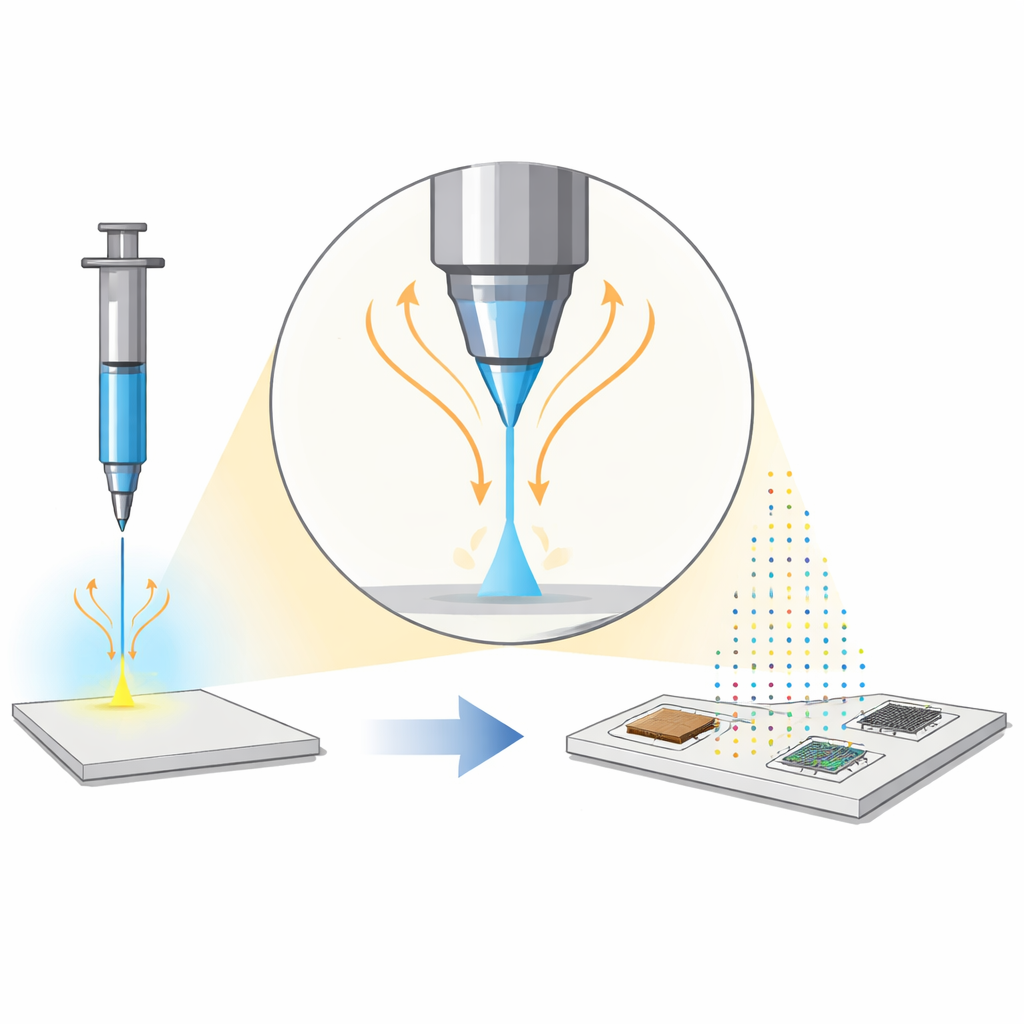
How Electricity Pulls Ink into Tiny Jets
At the heart of EHD printing is a simple idea: use a strong electric field to pull a liquid into a sharp cone and then into an ultra-thin jet. A syringe feeds a functional “ink” to a tiny nozzle positioned above a surface. When high voltage is applied between the nozzle and the substrate, charges in the liquid migrate to the surface, stretching the droplet into a pointed shape called a Taylor cone. If the electric pull overcomes surface tension and viscosity, a jet shoots out that is far thinner than the nozzle opening. Depending on the strength of the field and the ink properties, this jet can form individual droplets, continuous fibers, or sprays of nanoparticles, enabling patterns that range from isolated dots to webs of nanofibers and uniform thin films.
Taming Instabilities and Keeping the Jet in Line
Turning this delicate phenomenon into a reliable manufacturing tool is challenging. The jet is governed by a tangle of interacting forces: surface tension, viscosity, gravity, and electric stresses in the liquid and surrounding air. Small changes in voltage, flow rate, or environment can cause the jet to wobble, break up into unwanted “satellite” droplets, or whip around in spirals, ruining pattern fidelity. Researchers have built physical and mathematical models to map out different operating modes and predict when the jet will remain stable. They analyze how satellite droplets form along thinning liquid threads, how whipping instabilities emerge from uneven surface charge, and how residual oscillations of the liquid at the nozzle can blur rapid, repeated printing. New simulations in full 3D and refined scaling laws are helping define safe “windows” where the process is both precise and repeatable.
Smarter Control, Smarter Inks, Smarter Hardware
Because so many factors are coupled, EHD printing is moving from trial-and-error toward data-driven control. Closed-loop systems use cameras and electrical sensors to watch the jet in real time and automatically adjust the voltage waveform or flow rate to keep the cone and jet in a desired state. Machine learning models learn the relationship between process settings and printed features, enabling fast prediction of droplet size or line width and even on-the-fly optimization. At the same time, ink design has become a major lever: by tuning viscosity, surface tension, conductivity, polymer elasticity, nanoparticles, and solvent mixtures, researchers can suppress coffee-ring drying, avoid nozzle clogging, and maintain fine features. Hardware is evolving too, with multi-nozzle arrays for higher throughput, auxiliary electrodes that focus the electric field, and coaxial nozzles that print core–shell fibers or droplets.
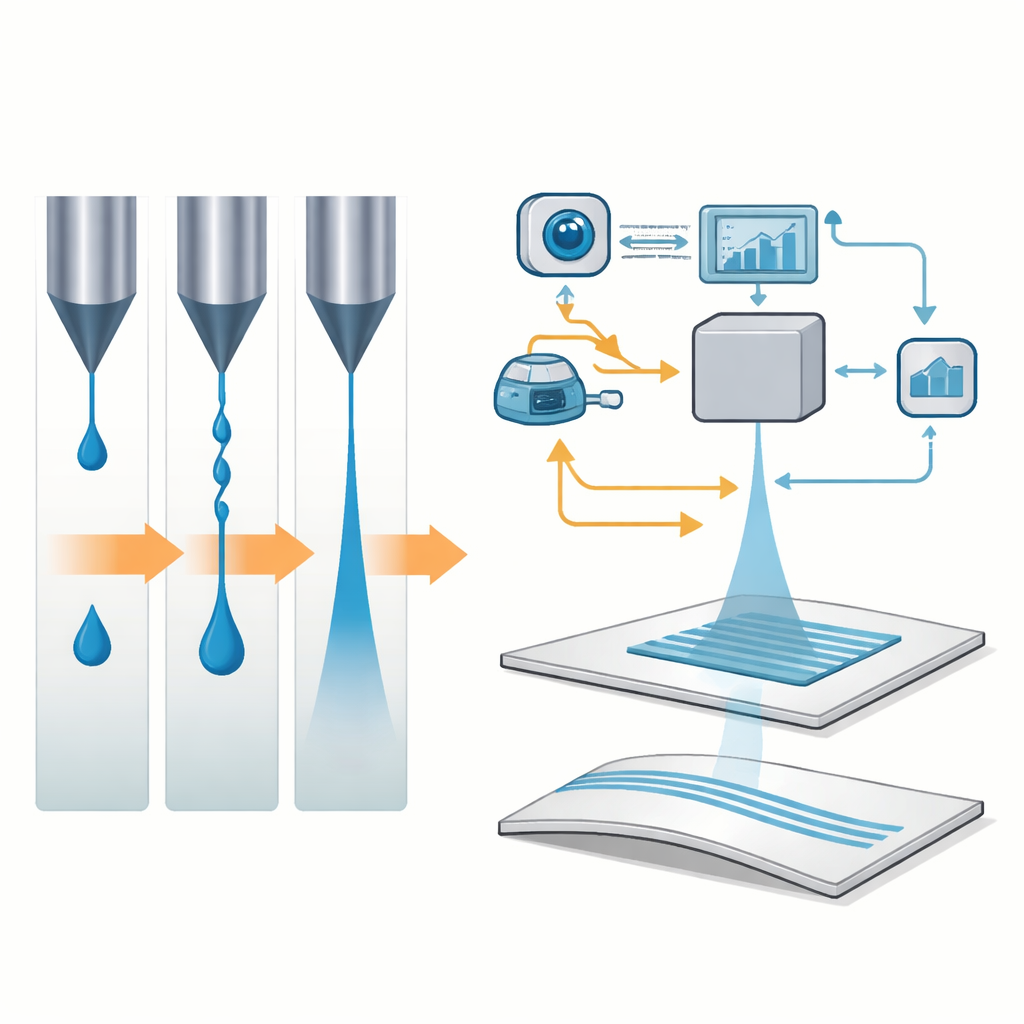
From Flexible Electronics to Living Tissues and Light
These advances are starting to pay off in real devices. In electronics, EHD printing can write metal lines and semiconductor channels tens of nanometers wide, enabling flexible transistors, vertical interconnects, and ultra-high-resolution displays like quantum dot LEDs and micro-OLED panels with pixel densities suitable for virtual and augmented reality. In biomedicine, EHD-printed fiber scaffolds guide cell growth for repairing tendons, nerves, bone, and heart tissue, and coaxially printed particles and fibers act as long-lasting drug depots. In optics and energy, the same technique creates microlens arrays, optical resonators, micro-supercapacitors, and triboelectric nanogenerators that harvest motion or light, often on curved or stretchy substrates that conventional fabrication cannot handle.
Where This Tiny Printing Technology Is Headed
The article concludes that EHD printing is emerging as a versatile platform for building complex micro- and nanoscale systems, but several hurdles still stand between laboratory demonstrations and industrial production. Controlling a fast, nonlinear fluid process in real time, formulating inks that are both easy to print and high performing, ensuring strong interfaces between multiple materials, and scaling to dense multi-nozzle arrays without electrical crosstalk are all open problems. The authors argue that combining better physical understanding with machine learning, advanced ink chemistry, and precision motion systems will be key. If these challenges are met, EHD printing could become a mainstream way to manufacture next-generation electronics, medical devices, energy harvesters, and optical components directly where they are needed.
Citation: Tian, Y., Zhou, J., Zhu, H. et al. Electrohydrodynamic printing technology: mechanisms, control, and applications. Microsyst Nanoeng 12, 83 (2026). https://doi.org/10.1038/s41378-026-01195-3
Keywords: electrohydrodynamic printing, micro-nanofabrication, flexible electronics, biofabrication, high-resolution additive manufacturing