Clear Sky Science · en
Fast multi-resolution 3D printing of microfluidics: enabling 2 μm channels and ultra-compact mixers
Why Shrinking Tiny Plumbing Matters
Inside many modern medical and chemical devices, liquids are shuffled, mixed, and tested in channels thinner than a human hair. These “labs on a chip” can speed up diagnostics, cut costs, and shrink bulky instruments to pocket size. But building such intricate plumbing has been slow and limited by today’s 3D printers. This paper describes a new way to 3D-print microfluidic chips that combines speed and ultra-fine detail, opening the door to smaller, faster, and more capable mini-labs.
Two Projectors, One Tiny Factory
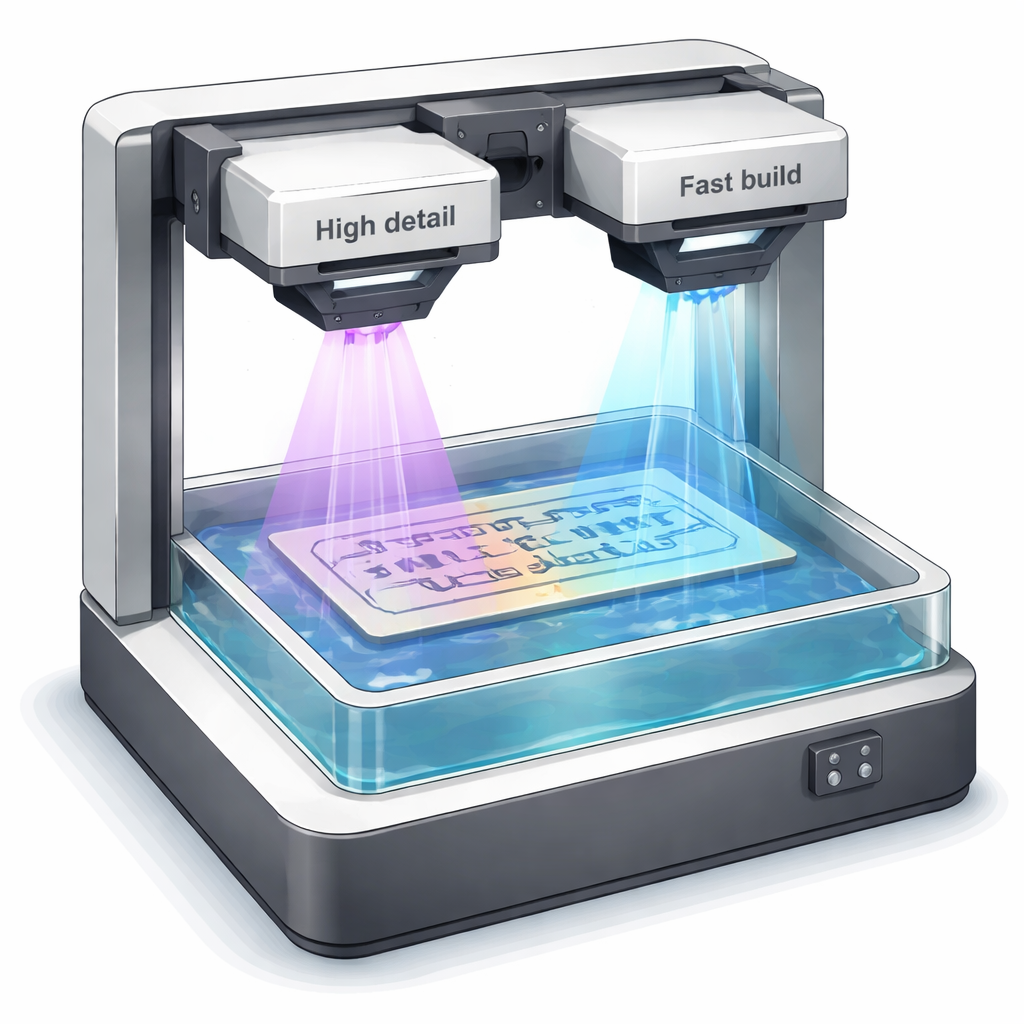
Conventional 3D printers must choose between printing quickly over a large area or printing very fine details in a tiny space. The authors solve this long-standing trade-off by using two optical “engines” in the same machine. One projector, the Main Optical Engine, lays down the bulk of each device quickly at moderate resolution. The other, called the Very High Resolution Optical Engine, is reserved for the smallest, most demanding features. Both project patterns of ultraviolet light into a liquid resin, curing it layer by layer. By moving the print head and carefully coordinating exposures, the system can embed islands of extremely detailed structures inside a much larger, coarser body—all in a single automated print.
Controlling Depth as Well as Detail
Getting crisp features in three dimensions requires more than tiny pixels in the horizontal plane. The printer must also control how deeply light penetrates into the resin, which sets the thickness of each solidified layer. Here the team designed a custom resin that contains two different light-absorbing molecules. Because the two projectors use different wavelengths of UV light, each interacts with the resin in its own way. One beam is absorbed strongly and solidifies only a very thin slice; the other penetrates more deeply, curing thicker layers. This “dual absorber” chemistry lets the printer switch between ultra-thin and thicker layers on demand, achieving true multi-resolution printing in all three dimensions.
World-Record Channels and Intricate 3D Lattices
To show what the system can do, the researchers printed fully enclosed channels just 1.9 by 2.0 micrometers in cross-section—roughly 50 times narrower than a human hair, and about 100 times smaller in area than what their earlier printer achieved. They also fabricated delicate “biocage” structures and a triply periodic minimal surface, a sponge-like 3D lattice with 7 micrometer pores, embedded right inside a larger channel. These complex shapes offer enormous internal surface area in a tiny volume, which is valuable for tasks like separating closely related molecules. Crucially, many copies of such devices can be printed in parallel, so building several intricate structures at once takes little longer than printing one.
Pumps and Mixers on a Grain-of-Sand Scale
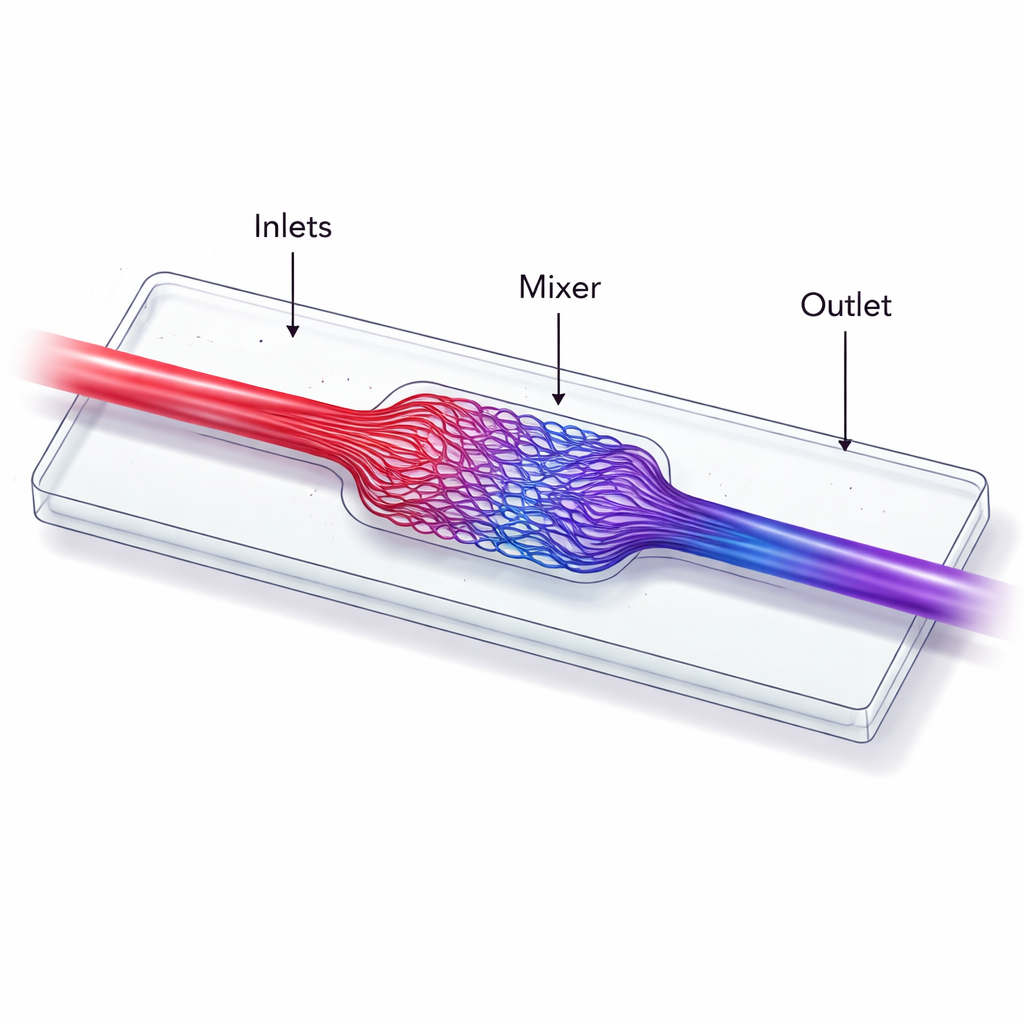
Beyond passive channels, working microfluidic chips need moving parts: valves that open and close, and pumps that push fluid along. Using the lower-resolution engine, the team printed flexible membrane valves and different pumping schemes, then tuned their timing to triple the flow rate compared with earlier designs. On top of this foundation, they used the high-resolution engine to create an ultra-compact mixer. Instead of relying on long winding channels, their mixer splits two incoming streams into many hair-thin threads that weave between each other before merging. Computer simulations and fluorescence measurements show that, even at low flow rates, the liquids become thoroughly mixed within a region under half a millimeter long and with a total printed volume of only 17 nanoliters—smaller than a speck of dust.
What This Means for Future Lab-on-a-Chip Devices
For non-specialists, the key outcome is that it is now possible to 3D-print microfluidic devices that are both extremely detailed and reasonably fast to produce. By selectively applying “high-detail” printing only where it is needed, and “fast-build” printing everywhere else, the system sidesteps the usual trade-off between speed and precision. The result is tiny pumps, mixers, and porous structures that fit into an exceptionally small footprint, yet can be manufactured as easily as printing a single part. This approach could accelerate the development of portable diagnostic tools, compact chemical reactors, and other lab-on-a-chip technologies that bring sophisticated testing from the lab bench to the clinic, factory floor, or even the home.
Citation: Miner, D.S., Viglione, M.S., Hooper, K. et al. Fast multi-resolution 3D printing of microfluidics: enabling 2 μm channels and ultra-compact mixers. Microsyst Nanoeng 12, 66 (2026). https://doi.org/10.1038/s41378-026-01194-4
Keywords: microfluidics, 3D printing, lab-on-a-chip, high-resolution fabrication, microfluidic mixer