Clear Sky Science · en
Q-optimised nanoelectromechanical diamond resonators
Listening to Tiny Diamond Guitars
Imagine a guitar string so small you could line thousands of them across the width of a human hair, yet each one could weigh a few atoms or test the limits of quantum physics. This study explores such miniature "strings" made of diamond, showing how a clever design trick can make them ring longer and cleaner—an important step for ultra-sensitive sensors, precise timing devices, and future quantum technologies.
Why Shrinking Machines Hit a Wall
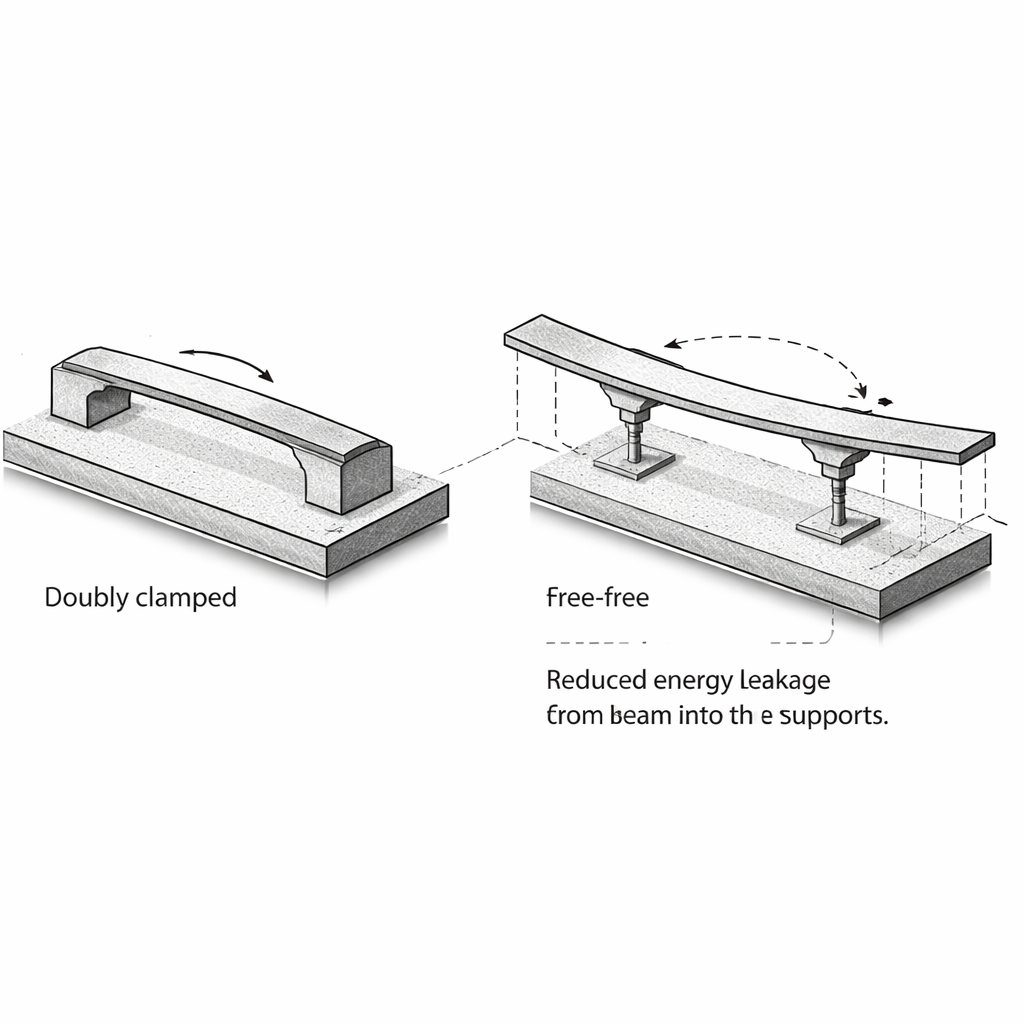
Engineers build micro- and nano-scale mechanical resonators—tiny vibrating beams—to do everything from weighing single molecules to probing quantum effects. To make them more sensitive, you want them to vibrate at very high frequencies while losing as little energy as possible, a property captured by a number called the quality factor, or Q. But as these devices are shrunk to reach higher frequencies, they usually start to leak energy into their supports, like a badly mounted tuning fork that quickly falls silent. This loss at the clamping points has been a major obstacle to pushing mechanical resonators deeper into the high-frequency regime.
Diamond as a High-Speed Building Material
Diamond is not just hard—it also carries sound extremely quickly, which makes it ideal for creating fast mechanical vibrations. Single-crystal diamond, however, is difficult to process with standard chip-making techniques. The authors instead work with nanocrystalline diamond, a thin film made of tiny diamond grains that can be grown directly on silicon wafers. Despite its grainy structure and naturally rough surface, this material keeps a very high stiffness, allowing beams only a few micrometers long and half a micrometer wide to vibrate in the 40–100 megahertz range—tens of millions of times per second.
A Smarter Way to Hold a Tiny Beam
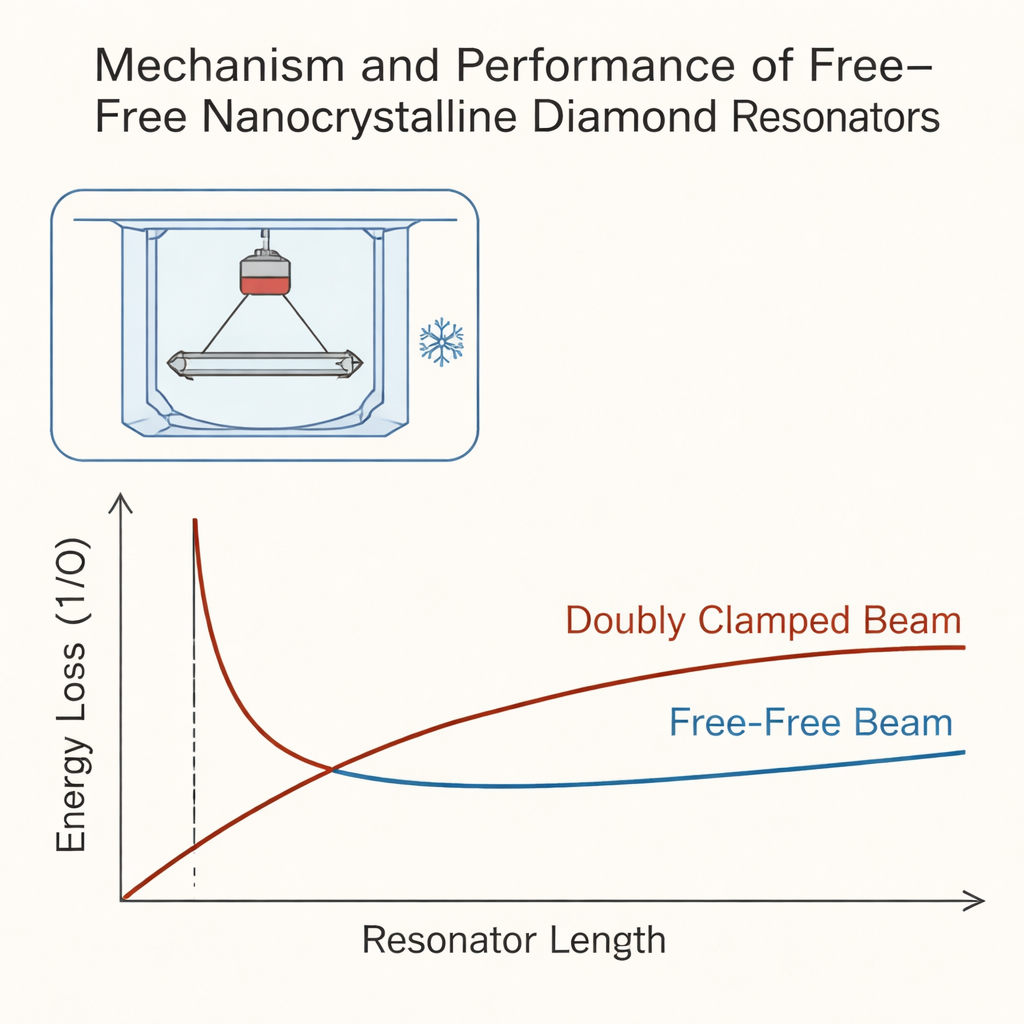
The team compared two ways of supporting these diamond beams. In the traditional "doubly clamped" design, each end of the beam is rigidly fixed to anchors. In the improved "free-free" design, the beam is instead held up by specially shaped side supports attached at points that hardly move during vibration—so-called nodes. These flexural supports are tuned to vibrate in step with the main beam. By anchoring the structure where motion is naturally minimal, the design blocks much of the vibrational energy from leaking into the substrate. Experiments at 12 kelvin—just a few degrees above absolute zero—showed clear, sharp resonance peaks, confirming that both designs were vibrating as intended.
Measuring How Long the Ring Lasts
To quantify energy loss, the researchers used a magnetic field to gently drive and read out the motion of the beams. They then mathematically removed extra damping from the measurement circuitry to uncover the beams’ intrinsic behaviour. For conventional beams, the energy loss increased strongly as the devices were made shorter, consistent with clamping loss dominating the performance. When the free-free supports were added, this length-dependent loss was dramatically reduced. For beams near 100 megahertz, the new design cut dissipation by almost a factor of nine, yielding Q values around ten thousand and frequency–Q products approaching 1012 hertz—figures competitive with or superior to many state-of-the-art silicon and gallium arsenide devices.
What Really Limits Performance
The researchers also asked whether the roughness of the diamond surface was a major source of loss. They fabricated devices from both as-grown, rough films and chemically polished, smoother films. Surprisingly, at 12 kelvin the baseline (length-independent) energy loss was similar in both cases, even though their top surfaces differed greatly. This suggests that, under these cold conditions, surface effects on the top side of the beam play a minor role. Instead, losses are likely dominated by how the beams are clamped, by imperfections inside the diamond grains, and by the buried, less-accessible surfaces formed early in the film’s growth.
What This Means for Future Tiny Machines
In everyday terms, the authors have shown that you can make diamond "strings" that vibrate very fast and stay ringing for a long time if you hold them at just the right spots. Their free-free design turns nanocrystalline diamond—a material that is easy to integrate onto ordinary chips—into a strong contender for next-generation sensors and quantum devices. By minimising how much vibrational energy disappears into the supports, and by working with a material whose surfaces are relatively benign, this work points toward compact, high-frequency mechanical elements that are both practical to manufacture and exceptionally quiet in operation.
Citation: Thomas, E.L.H., Mandal, S., Leigh, W.G.S. et al. Q-optimised nanoelectromechanical diamond resonators. Microsyst Nanoeng 12, 74 (2026). https://doi.org/10.1038/s41378-026-01189-1
Keywords: nanomechanical resonators, diamond NEMS, energy dissipation, high-Q devices, microelectromechanical systems