Clear Sky Science · en
A temperature self-calibrated MEMS gyroscope with 0.007°/h/K bias drift coefficient using real-time parametric quality factor control and mode matching
Why tiny motion sensors matter
From smartphones to drones and spacecraft, many modern devices rely on microscopic motion sensors called MEMS gyroscopes to know which way they are turning. These chips are small and cheap, but their readings can slowly drift as the temperature around them changes, which is a serious problem for navigation and guidance systems that must stay accurate for hours. This paper reports a new way for a MEMS gyroscope to quietly "teach itself" to stay stable as it warms up or cools down, cutting temperature-caused drift to record-low levels without adding bulky hardware or complicated factory calibration.

The problem of slow drift
In an ideal world, a gyroscope would report exactly zero rotation when it is standing still. In reality, internal imperfections in the tiny vibrating structures and in the surrounding electronics create a small false signal called zero-rate output, or bias. This bias is sensitive to temperature because material properties, microscopic clearances, and circuit behavior all shift as a device moves from winter cold to summer heat. Earlier designs tried to cancel some of these effects by making the mechanical structure very symmetric, by shaping the support springs carefully, or by adding electrical adjustments. While these steps help, they usually correct the bias only at the time of manufacture or under a narrow range of conditions, so bias still drifts when the temperature changes during actual use.
Breaking down where errors come from
The authors start by dissecting the different ways in which the gyroscope can produce a false signal. Some errors appear in a direction that is shifted relative to true rotation and can often be reduced by existing tuning methods. For the device studied here—a carefully balanced four-mass gyroscope—the most stubborn error comes from a mismatch in how quickly vibrations die out along two different directions. This property, known as the quality factor, describes how much energy the vibrating masses lose to their surroundings. When the two directions have slightly different loss rates that also vary with temperature, the overall vibration pattern tilts, and the sensor interprets this tilt as a slow, temperature-dependent rotation even when there is none.
Teaching the gyroscope to tune itself
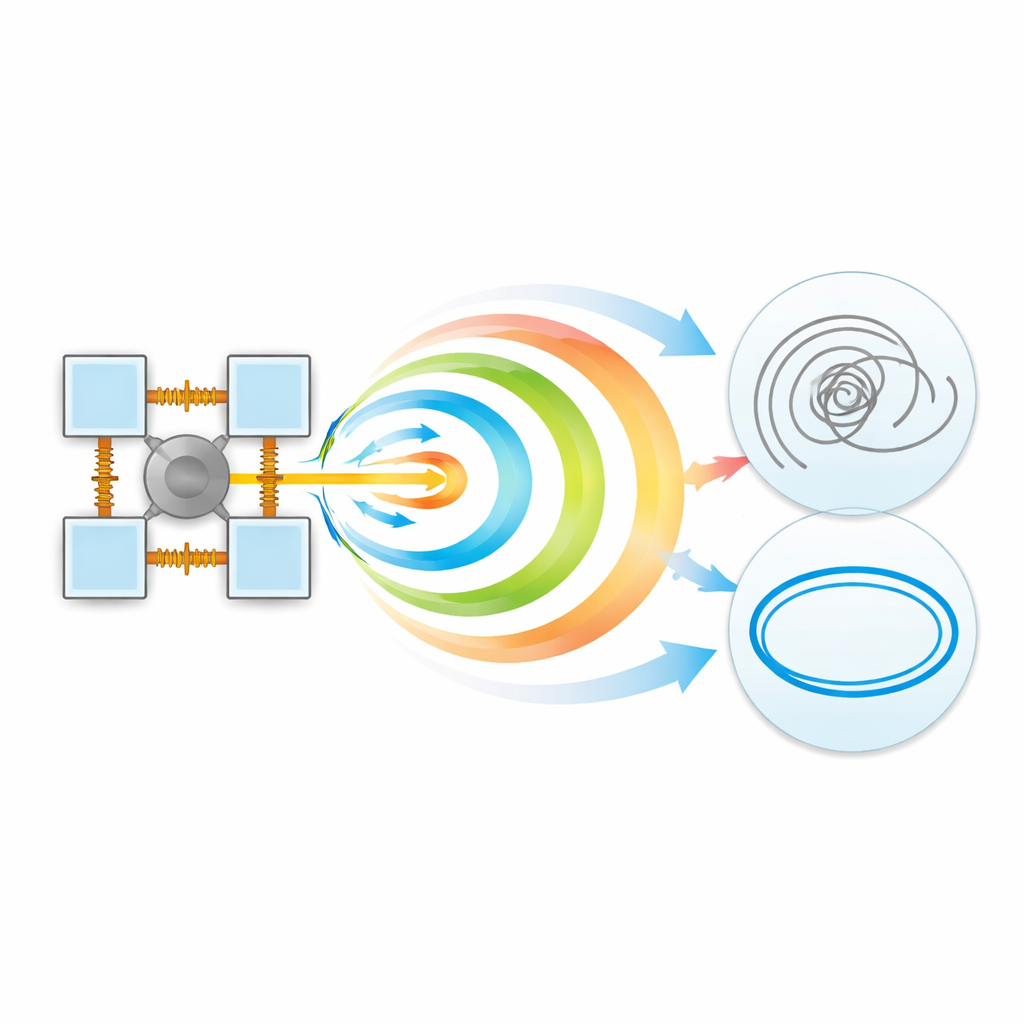
To attack this root cause, the team uses a clever approach called parametric excitation: instead of just pushing the masses back and forth, they also rhythmically adjust the stiffness of the supporting springs at twice the vibration frequency. This extra modulation changes the effective quality factor of one of the vibration directions, allowing it to be increased or decreased like a knob. A small test signal is injected into the sensor so that two faint side tones appear around the main vibration. By watching the phase of these tones in real time, the electronics can infer how the effective quality factor is changing with temperature. A control loop then automatically adjusts the strength of the spring modulation so that the quality factor stays locked at the value that produces zero bias, even as the environment heats up or cools down.
Putting the self-calibrating sensor to the test
The researchers built their scheme into a high-performance gyroscope chip and drove it with custom electronics on a laboratory turntable inside a temperature chamber. They compared three situations: no extra control, a fixed amount of spring modulation, and the full self-adjusting loop. Without the new method, the bias changed noticeably as the temperature swept from –20 °C to 50 °C. With a fixed modulation, some improvement was seen but the bias still drifted. When the real-time quality factor control was switched on, however, the sensor’s bias stayed very close to zero across the full temperature range, while the helpful quality factor was held almost constant by automatically changing the modulation strength in the background.
What the results mean for real devices
From a user’s perspective, the most striking outcome is how much more stable the sensor becomes. The sensitivity of bias to temperature was reduced by a factor of 122, down to just 0.007 degrees per hour per degree Celsius, which the authors note is the best reported value so far for this class of device. Measures of long-term noise and random wander also improved, and the method did not introduce extra noise. Importantly, all of this is achieved by smart control of signals that already exist inside the chip, avoiding the need for added damping elements or extensive temperature mapping in the factory. This makes the approach attractive for future guidance systems in cars, aircraft, and small satellites that need navigation-grade stability from tiny, low-power sensors.
Citation: Shen, Y., Zheng, X., Fang, C. et al. A temperature self-calibrated MEMS gyroscope with 0.007°/h/K bias drift coefficient using real-time parametric quality factor control and mode matching. Microsyst Nanoeng 12, 102 (2026). https://doi.org/10.1038/s41378-026-01181-9
Keywords: MEMS gyroscope, temperature drift, sensor calibration, quality factor control, inertial navigation