Clear Sky Science · en
Conformal bumped electrode web for chronic ECoG recordings in swine
Listening to the Brain More Gently
Doctors and engineers are working to build better "microphones" for the brain so they can treat conditions like epilepsy, paralysis, and vision loss without causing harm. This paper presents a new kind of soft, stretchable sensor sheet that sits on the brain’s surface and listens to its electrical activity for weeks at a time in pigs. By reshaping and softening the tiny metal contact points, the team shows they can follow the brain’s natural curves, reduce noise, and record clearer signals over a wider area for longer periods—an important step toward safer brain–computer interfaces and medical monitoring tools.
A Soft Web That Fits a Moving Brain
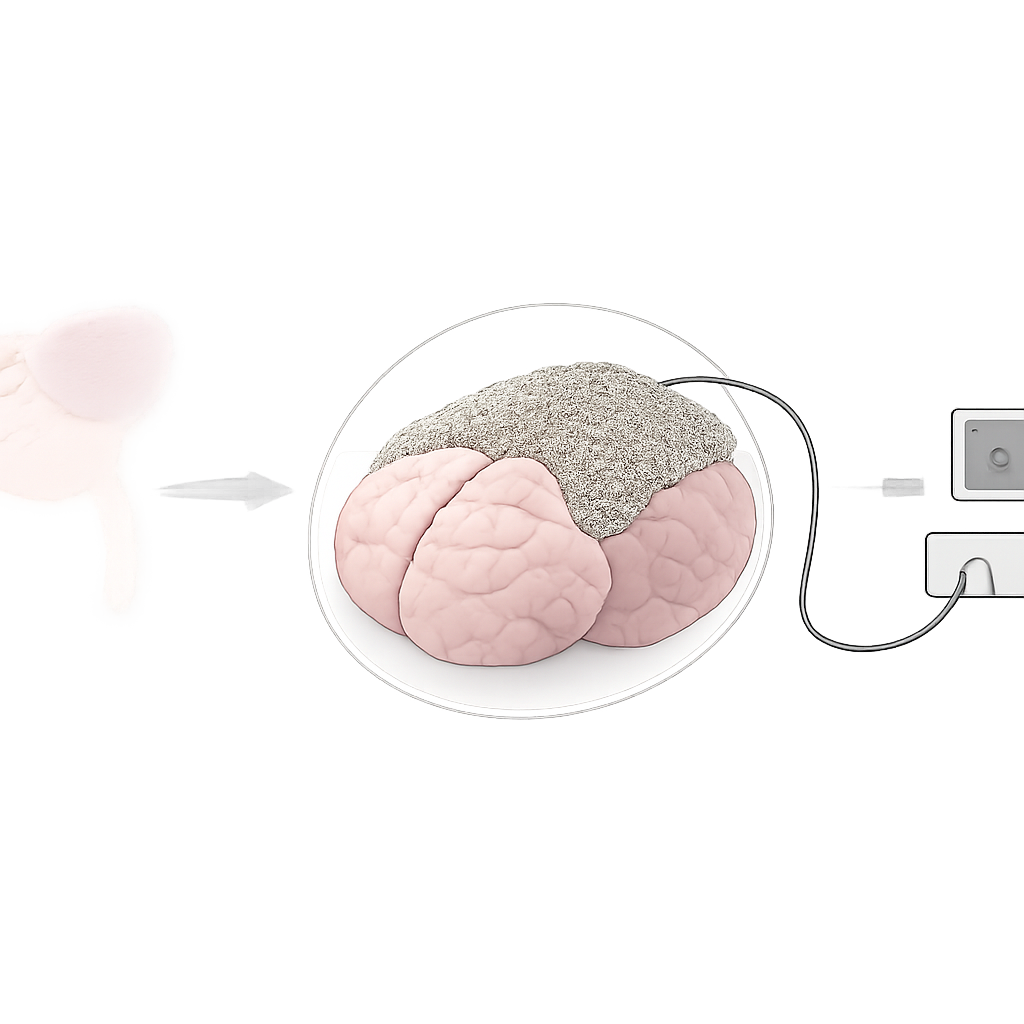
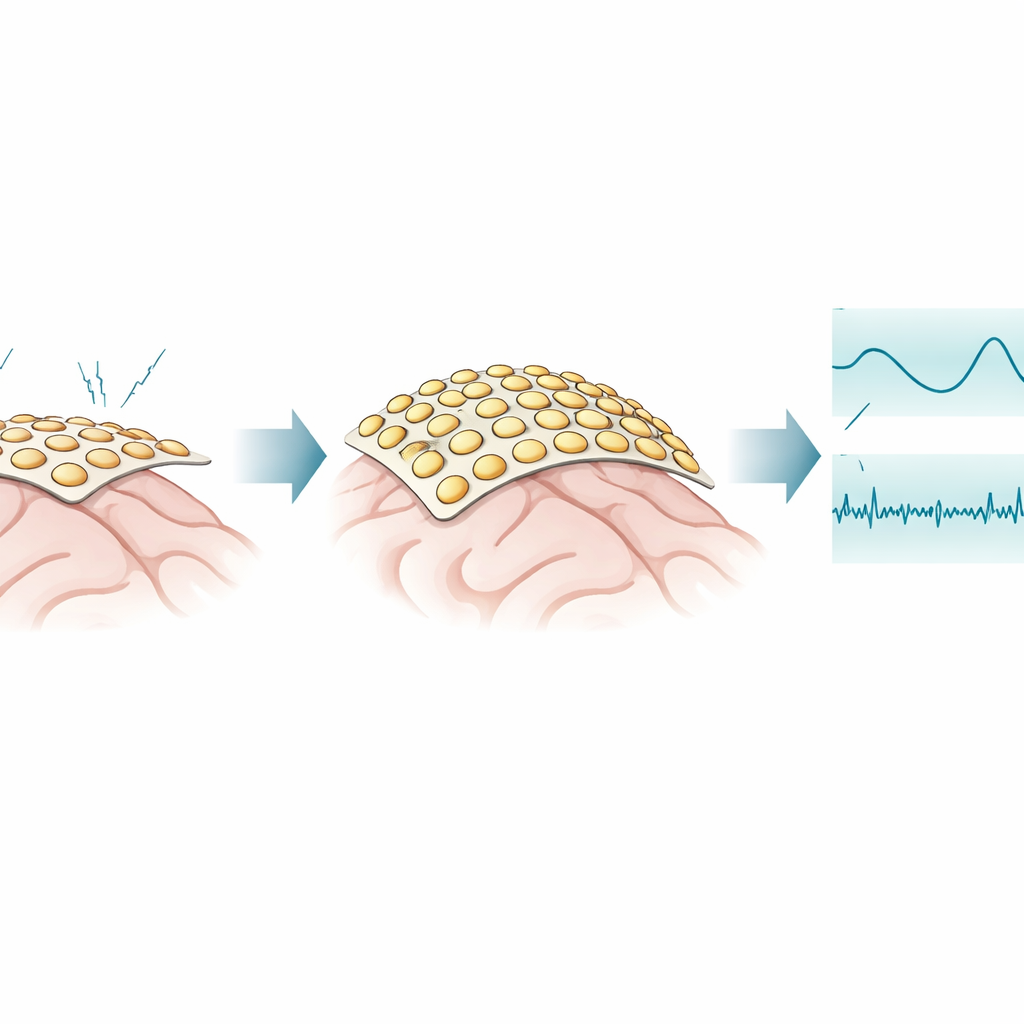
Traditional brain-surface sensors are flat and relatively stiff, more like a postage stamp than a cling wrap. That is a problem, because the brain is not only soft—it also pulses, shifts slightly, and is full of grooves and ridges. The authors designed a “web” of ultra-thin plastic film patterned into spring-like, serpentine traces that can gently stretch and bend with the brain. On this web sit dozens of raised, bump-shaped metal pads that press into the thin membrane covering the brain, improving contact without piercing into the tissue. Computer simulations showed that a simplified single connection under each bump allowed the sheet to flex and drape over a curved brain model with much lower internal stress than earlier, more rigid designs.
Tuning the Electrical Touch for Clearer Signals
Good mechanical contact is only half the challenge; the electrical handshake between metal and brain also matters. Bare metal tends to have relatively high electrical resistance, which adds noise and blurs the tiny voltage changes that carry neural information. The team coated the gold bumps with a conductive polymer called PEDOT:PSS, a sponge-like material that dramatically increases the effective surface area in contact with the salty fluid around the brain. Laboratory tests showed that this coating boosted the electrode’s charge storage capacity by nearly two orders of magnitude and cut its electrical resistance at key brain-signal frequencies by about a factor of seven, while remaining stable after thousands of voltage cycles and repeated stretching. Even after 2,500 rounds of 10% stretching—more than the brain would experience—the coating developed only nanoscale cracks at the edges and kept its performance almost unchanged.
Hugging the Brain, Reducing Noise
To see whether this design really clings better, the researchers compared their stretchable bumped sheet with a flat, non-stretchable one on a soft brain-shaped model. The new device wrapped smoothly around the model’s curves, while the flat sheet wrinkled and lifted at the edges. When they pulled sideways on each sheet, the bumped version needed much more force to slide, showing stronger adhesion. In a tabletop test that mimicked nerve signals using light-triggered pulses in salty gel, the modified bumped electrodes produced much higher signal-to-noise ratios than both bare metal and flat coated electrodes. In other words, the same artificial “spike” looked bigger and cleaner, while the random background hiss shrank—exactly what is needed for reliable decoding of brain activity.
Listening to Pig Brains for Weeks
The ultimate test was inside living animals. The team implanted their stretchable web over the motor and visual areas of mini pig brains, then protected the connector with a redesigned, sealed chamber fixed to the skull. Immediately after surgery and over several weeks, the electrodes recorded ongoing brain rhythms as well as clear responses to flashes of blue light that stimulated the pigs’ eyes, producing visual signals with recognizable peaks. Over five weeks of implantation across an area of about 22 × 22 square millimeters, the sheet continued to capture useful signals. Although the electrical resistance at the interface gradually rose and the signal-to-noise ratio dipped slightly over time—likely due to natural tissue reactions and motion—the bumped, stretchable design consistently outperformed flat versions in both signal strength and uniformity across channels.
What This Means for Future Brain Interfaces
Put simply, this work shows that a soft, stretchable grid with tiny raised pads can “hug” the brain better and listen more clearly, for longer. By combining a mechanically compliant web, three-dimensional contact bumps, and a carefully chosen conductive coating, the authors achieve stable, low-noise recordings in a large animal model over several weeks. While these bumps are not yet sharp enough to penetrate tissue or capture signals from deep layers, the approach already offers a promising route to safer, more comfortable brain–surface sensors. Such devices could one day help people with epilepsy, paralysis, or sensory loss by providing more reliable windows into brain activity while minimizing damage and discomfort.
Citation: Wang, M., Jiang, H., Ni, C. et al. Conformal bumped electrode web for chronic ECoG recordings in swine. Microsyst Nanoeng 12, 95 (2026). https://doi.org/10.1038/s41378-026-01180-w
Keywords: electrocorticography, brain–computer interface, flexible electronics, neural implants, biocompatible sensors