Clear Sky Science · en
Cryogenic performance evaluation of commercial SP4T microelectromechanical switch for quantum computing applications
Why shrinking the wiring matters for quantum computers
Building useful quantum computers will likely require millions of delicate quantum bits, or qubits, chilled to temperatures close to absolute zero. Today’s machines connect each qubit to bulky room‑temperature electronics with its own cable, a bit like trying to wire every lightbulb in a city directly to a power plant. This paper explores whether a tiny mechanical switch, already sold commercially for everyday radio‑frequency electronics, can work reliably at ultra‑cold temperatures and help solve this wiring bottleneck.
A traffic cop for quantum signals
Modern superconducting quantum computers place their qubit chips at about ten thousandths of a degree above absolute zero, inside specialized refrigerators. Control and readout signals travel down from room temperature through stacks of metal plates, filters, and amplifiers. As systems scale up, there simply isn’t enough space or cooling power to dedicate one cable per qubit. The authors focus on an alternative: placing “multiplexers” near the cold qubit chip. These devices act like traffic cops, steering signals between many qubits using far fewer cables from above. The study evaluates a commercial single‑pole four‑throw (SP4T) microelectromechanical (MEMS) switch—essentially a tiny moving metal beam that can connect one input line to one of four outputs—as a building block for such cryogenic multiplexers. 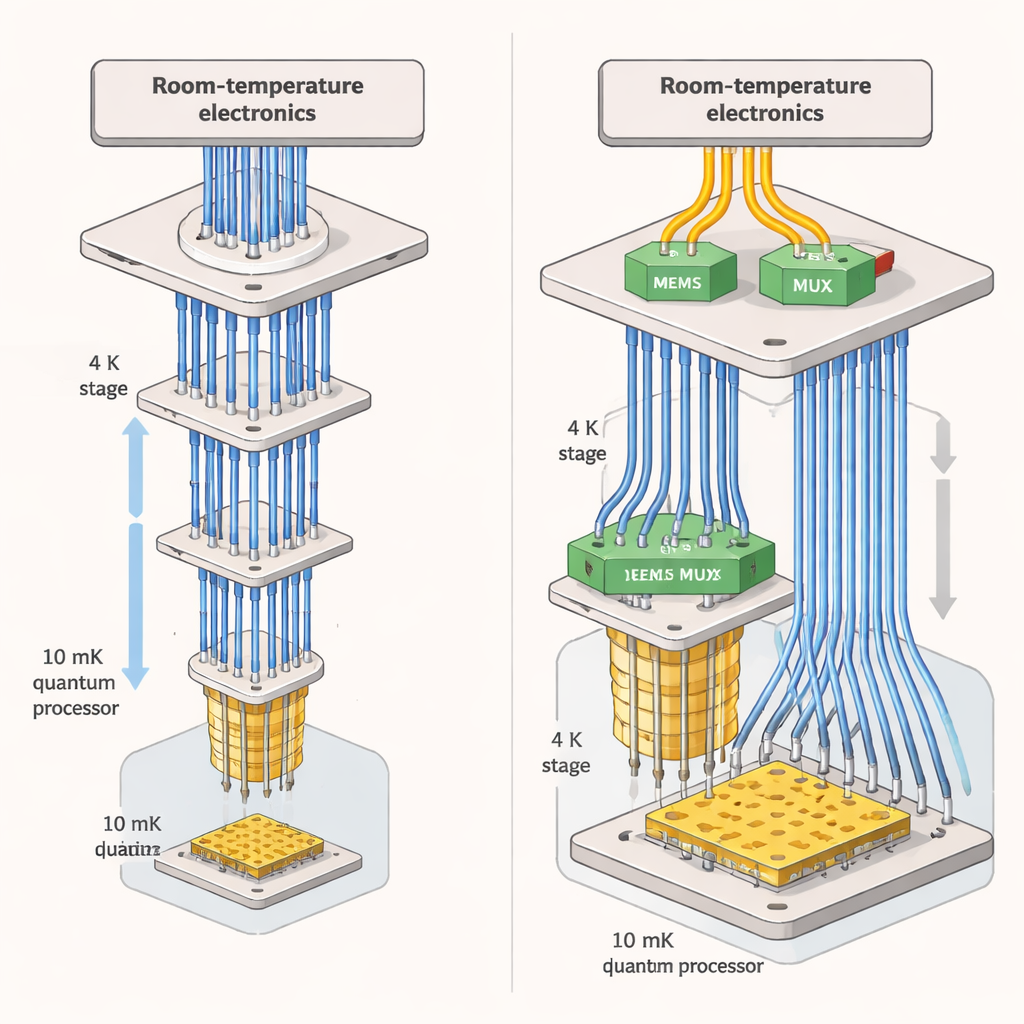
Tiny moving beams that like the cold
Unlike ordinary transistors, the MEMS switch works by physically bending a microscopic metal cantilever down to touch a contact when a voltage is applied. The team used computer simulations and experiments in a cryogenic probe station at about 5.8 kelvin to see how this motion and the electrical behavior change in the cold. They found that the gap the beam has to cross barely changes with temperature, so the voltage needed to pull it down drops only slightly—about three percent—rather than drifting wildly as in many older MEMS designs. Once closed, the contact resistance between the metal parts actually improves by more than 15 percent at low temperature because electrical resistance in metals falls as vibrations quiet down. Radio‑frequency tests up to tens of gigahertz showed that signal loss through the switch stays below half a decibel in the key 4–8 gigahertz band used by many superconducting qubits, while isolation between channels remains better than 35 decibels. In plain terms, the switch passes the desired signal cleanly while strongly blocking unwanted crosstalk, and it does even better in the cold than at room temperature.
Taming a cryogenic bouncing problem
Operating at such low temperatures, however, introduced an unexpected challenge: bouncing. The switch package is sealed with a small amount of gas inside. When cooled, that gas condenses and leaves a near‑vacuum, removing the air cushioning that normally damps the beam’s motion. As a result, when the beam strikes the contact it can ring like a tiny bell, opening and closing repeatedly for about 150 microseconds. This makes the electrical output oscillate and could disturb sensitive quantum signals. By carefully shaping the driving voltage pulse, the researchers found a way to slow the beam just before impact and reduce its rebound. Their engineered waveform briefly applies a higher voltage to start the motion, then drops to a lower voltage so the beam arrives at nearly zero speed, before switching back to a holding level. A similar sequence is used when releasing the beam. This strategy slightly lengthens the switching time to about 3.3 microseconds, but almost eliminates bouncing and still meets the needs of many time‑multiplexed readout schemes.
Proving longevity and simple logic at ultra‑low temperatures
With the improved drive waveform in place, the team repeatedly cycled the MEMS switch at low temperature and monitored its behavior. Even after more than one hundred million on‑off operations, the switching waveforms and on‑resistance remained stable, indicating excellent mechanical and electrical reliability in the cryogenic environment. They then exercised the full SP4T device—one input steered to four different outputs—showing that signals could be cleanly routed to any chosen output line by activating the matching gate electrode. Exploiting the way these switches can be wired in series or parallel with simple resistors, the authors also demonstrated basic digital building blocks, specifically NAND and NOR logic functions, at 5.8 kelvin. These experiments hint that such mechanical devices could not only serve as passive routing elements but might also support some on‑chip logic close to the qubits.
What this means for future quantum machines
For a general reader, the key takeaway is that an off‑the‑shelf mechanical radio switch can operate dependably at temperatures just a few degrees above absolute zero and even works better there in several respects. The device consumes essentially no power when idle, adds very little noise or signal loss, and can be cycled at least 100 million times without noticeable wear, all while steering signals among multiple paths and performing simple logic. Some hurdles remain—such as speeding it up further for the fastest control tasks and reducing a slow “charging” effect in the insulating layers—but the results strongly suggest that commercial MEMS switches are promising building blocks for the dense, low‑power wiring networks needed to connect millions of qubits in tomorrow’s large‑scale quantum computers. 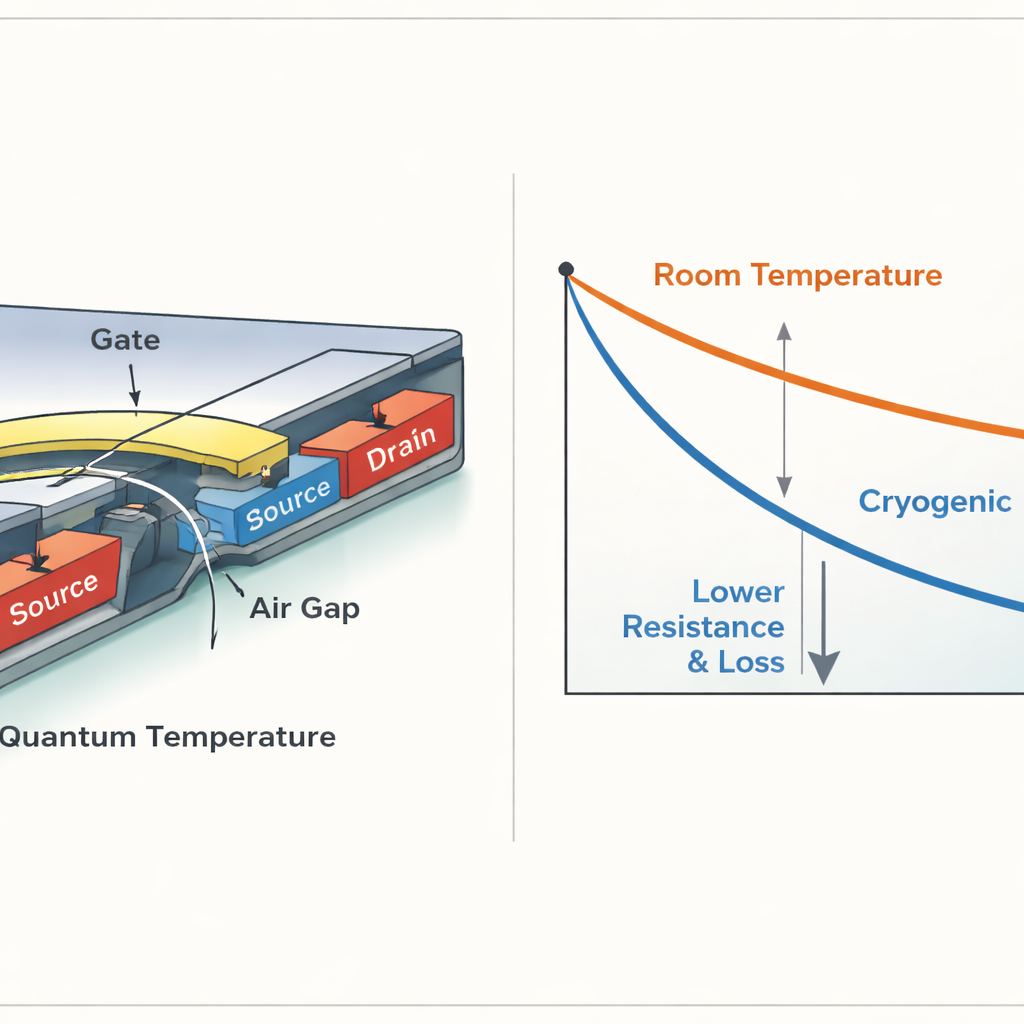
Citation: Lee, YB., Devitt, C., Zhu, X. et al. Cryogenic performance evaluation of commercial SP4T microelectromechanical switch for quantum computing applications. Microsyst Nanoeng 12, 72 (2026). https://doi.org/10.1038/s41378-026-01178-4
Keywords: quantum computing hardware, cryogenic electronics, MEMS switches, superconducting qubits, signal multiplexing