Clear Sky Science · en
Enhanced electromechanical coupling in piezoelectric MEMS vibration energy harvesters via strain-induced phase transition in Mn-doped bismuth ferrite epitaxial films
Power from Everyday Vibrations
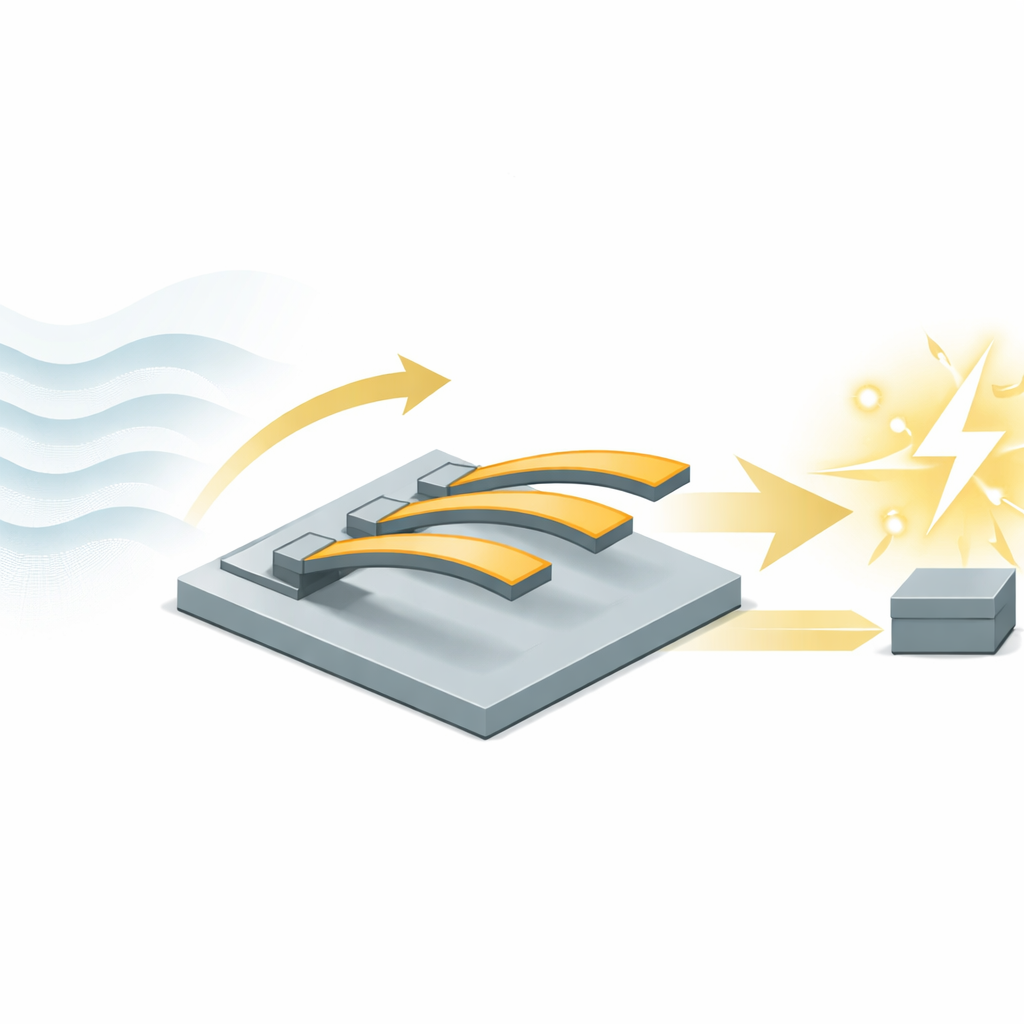
Our world quietly hums and shakes—from air-conditioning units and factory machines to the motion of our own bodies. Engineers are learning how to turn these tiny vibrations into usable electricity to power miniature sensors and devices without batteries. This paper reports a new way to boost the performance of such “vibration harvesters” by carefully engineering a special crystal film so that it changes its internal structure under strain, squeezing more electrical energy out of every mechanical jolt.
Why Tiny Generators Need Better Materials
Modern electronics are moving toward dense networks of small, smart sensors that monitor everything from industrial equipment to the human body. Powering these devices with cables or batteries quickly becomes impractical, so harvesting energy from the environment is an attractive alternative. Piezoelectric materials—substances that generate voltage when bent or stretched—are at the heart of many micro‑scale generators. The most widely used films today either contain lead and struggle to reach very high sensitivity in tiny devices, or have low electrical capacity and suffer from circuit losses. The material studied here, bismuth ferrite, has long been seen as a promising, lead‑free candidate but has not yet matched the best conventional options in real devices.
Tuning a Crystal Film with Heat and Composition
The researchers focused on a manganese‑doped version of bismuth ferrite, grown as an ultra‑thin, highly ordered film on standard silicon wafers—the same kind used in computer chips. Using a clever “combinatorial” sputtering method, they created a single wafer where composition and growth temperature change smoothly from place to place. This allowed them to map, in one experiment, how structure and electrical properties vary with processing conditions. Across the wafer, the film stayed dense, well‑aligned with the underlying silicon, and free of unwanted phases. By measuring its atomic‑scale spacing with X‑ray techniques, they discovered that the built‑in tension from heating and cooling on silicon gradually pushed the crystal from one internal arrangement to another, while still preserving its orderly growth.
Strain-Driven Shape-Shifting for Better Output
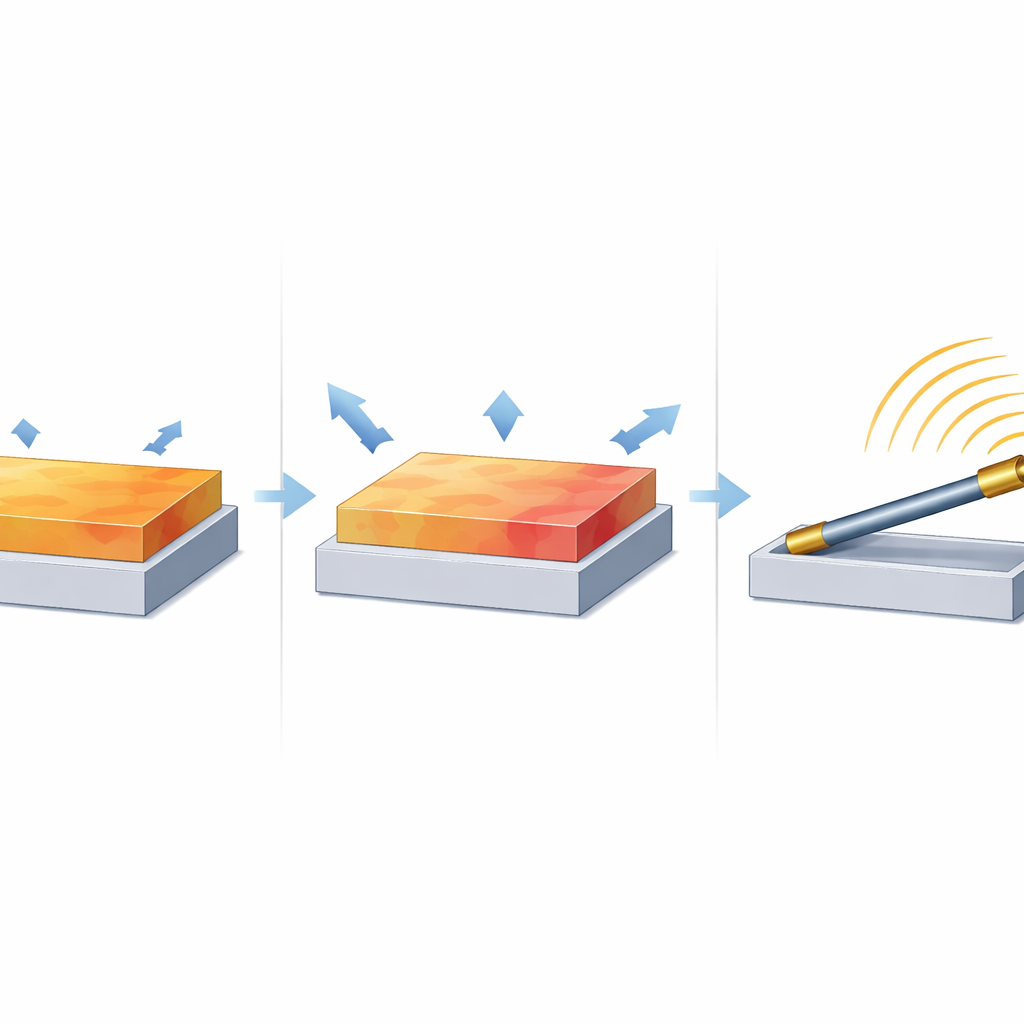
Inside the film, the crystal lattice can adopt slightly different shapes, and the switch between them turns out to be crucial. As the tensile strain increased, the material transitioned from its usual “rhombohedral‑like” configuration to a “monoclinic‑like” one. Around this boundary region between two structures, the film’s ability to convert bending into electrical charge was dramatically enhanced. The team found that in the best‑tuned areas, the transverse piezoelectric coefficient—a measure of generated charge per unit area—reached values higher than any previously reported for this family of materials. At the same time, the film maintained a modest dielectric constant and very low energy loss, both of which are vital for making sensitive, low‑noise micro‑generators.
Building and Testing the Micromachine
To prove that this crystal engineering pays off beyond the lab bench, the optimized films were built into micro‑electromechanical devices on silicon‑on‑insulator chips. Each device is a tiny cantilever beam with a small mass at its tip; when the base is shaken, the beam flexes and the piezoelectric film produces voltage. Under steady vibrations near its natural resonance, the new manganese‑doped devices showed an electromechanical coupling factor about five times higher than similar devices made from undoped bismuth ferrite, and a mechanical quality factor comparable to that of high‑performance lead‑based films. Overall, the product of these two figures—a key indicator of how efficiently mechanical energy becomes electrical energy—was high enough that the generator produced more than 90 percent of the maximum power predicted by theory.
Capturing Messy, Real-World Motion
Real environments rarely vibrate in a clean, single tone; instead, they deliver irregular bumps and jolts. The team therefore also tested the devices under short, impulsive pushes that contain a broad spread of frequencies. They compared the manganese‑doped film with both undoped bismuth ferrite and a standard lead‑based film. Although all three devices delivered similar total harvested energy per impulse, the manganese‑doped device combined a high peak voltage with faster damping of its vibrations. This rapid decay means it can be “reset” and ready to capture the next impulse more quickly, a clear advantage for schemes that convert slow, random motion into repeated bursts at the device’s resonance.
What This Means for Future Self-Powered Sensors
By deliberately using the strain that arises when a film cools on a silicon chip, and by tweaking the chemistry with a dash of manganese, the authors created a piezoelectric layer that changes its internal crystal shape in a way that boosts its electrical response. When built into micro‑scale vibration harvesters, this engineered film rivals or surpasses conventional lead‑based materials while remaining lead‑free and compatible with standard chip technology. For non‑specialists, the takeaway is that careful control of crystal structure at the nanoscale can make tiny generators significantly more efficient, nudging us closer to self‑powered sensor networks that draw their energy from the ambient shakes and rattles of everyday life.
Citation: Aphayvong, S., Takagi, M., Fujihara, K. et al. Enhanced electromechanical coupling in piezoelectric MEMS vibration energy harvesters via strain-induced phase transition in Mn-doped bismuth ferrite epitaxial films. Microsyst Nanoeng 12, 90 (2026). https://doi.org/10.1038/s41378-026-01177-5
Keywords: vibration energy harvesting, piezoelectric thin films, microelectromechanical systems, bismuth ferrite, strain engineered materials