Clear Sky Science · en
Design and testing of frequency-doubling microstrip antenna sensor for wireless monitoring of high temperatures
Why watching heat from afar matters
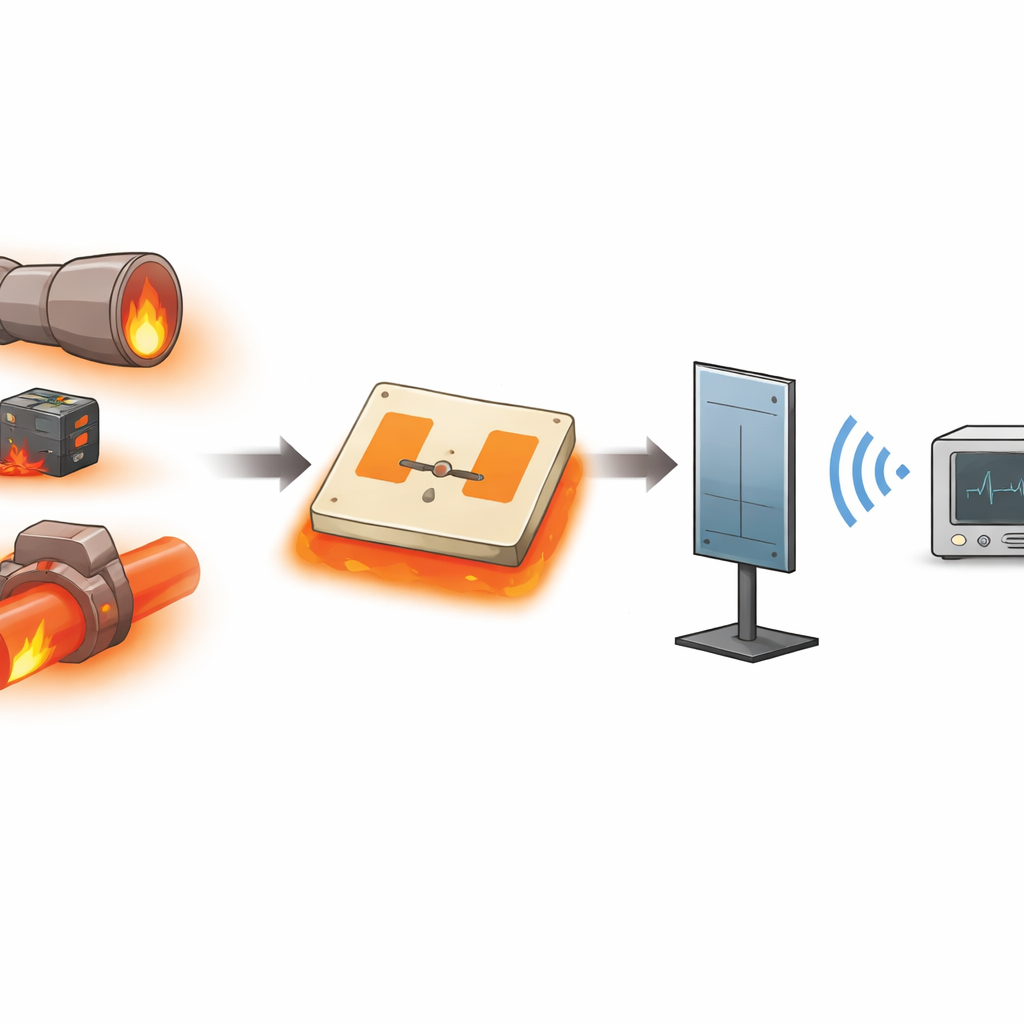
From jet engines to electric car batteries and buried pipelines, many of the hottest, most critical parts of modern technology are hard to reach and dangerous to touch. Knowing exactly how hot these parts get is vital to prevent fires, explosions, and costly failures, but running wires or installing electronics in such harsh spots can be nearly impossible. This paper describes a new kind of tiny, wireless “heat listener” that can survive up to 800 °C, work without a power supply or fragile chips, and still send clear temperature information through the air.
A small metal patch that feels the heat
At the heart of the device is a flat metal pattern called a microstrip patch, printed on a thin plate of alumina ceramic. This structure naturally responds to microwaves at a specific frequency, much like how a tuning fork rings at a single musical note. As temperature changes, the electrical properties of the ceramic shift, and the preferred microwave frequency of the patch slides in a predictable way. By tracking this shift, the system can “read” temperature without any batteries, wires, or direct contact electronics at the hot spot.
Turning noise into a clear signal
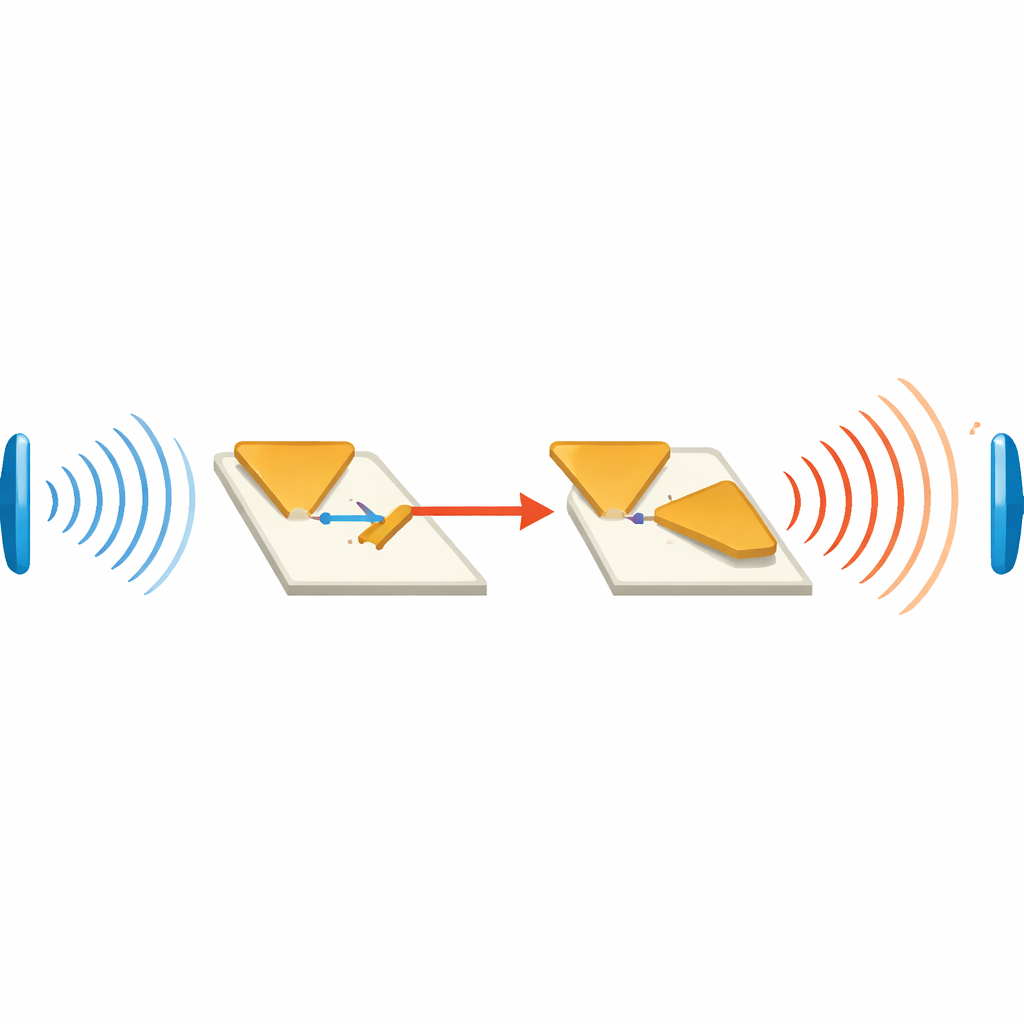
Simply bouncing a weak microwave echo off a hot object is not enough in a cluttered industrial setting filled with reflections and interference. To clean up the signal, the researchers added a tiny high-temperature Schottky diode and created a clever frequency‑doubling circuit. An external instrument sends in a microwave signal at one frequency; inside the sensor, the diode converts a portion of that energy into a signal at exactly twice the frequency. The patch tuned to this higher frequency then re-radiates the modified wave back through the air. Because the environment mostly reflects the original frequency, the returning doubled signal stands out sharply, boosting the signal-to-noise ratio and making it much easier to detect.
Antennas built for the heat
Traditional metal horn antennas and ordinary chips quickly fail when exposed to very high temperatures. To avoid this weak link, the authors designed both the sensing patch and the interrogation antenna on robust alumina ceramic using platinum conductors that withstand extreme heat. They carefully simulated the shapes of the patches so that one responds near 1 gigahertz and the other near 2 gigahertz, ensuring efficient transfer of energy into and out of the sensor. They also optimized a compact coplanar waveguide antenna, which replaces bulky horns and is better suited to tight spaces near furnaces, engines, or battery packs.
Putting the sensor in the hot seat
The team then tested the complete system in a high-temperature furnace. The sensor tile was mounted inside, with the two cooler interrogation antennas placed just 10 centimeters away, outside the hottest region. As the furnace warmed from about room temperature up to 800 °C, the researchers recorded how the sensor’s preferred frequency shifted. They found that the device could transmit reliably up to 20 centimeters and performed best at 10 centimeters. The shift in frequency tracked temperature smoothly, with higher sensitivity at higher temperatures, and the strongest design reached a temperature response equivalent to 181 kilohertz per degree Celsius. Across the entire range, the frequency error stayed below about 0.3 percent, and repeated heating cycles showed nearly identical behavior.
What this means for real-world safety
In simple terms, the authors have built a rugged, postage-stamp-sized tag that can sit on very hot parts and wirelessly report how hot they are, even when ordinary electronics would fail. By using a smart frequency-doubling trick, they separate the true temperature signal from background clutter, extending the useful range beyond earlier chip-free designs while keeping the ability to withstand 800 °C. This approach could make it easier to monitor jet engine nozzles, high-power batteries, and industrial pipes continuously, helping engineers catch dangerous overheating before it leads to disaster.
Citation: Dong, H., Guo, L., Zhen, C. et al. Design and testing of frequency-doubling microstrip antenna sensor for wireless monitoring of high temperatures. Microsyst Nanoeng 12, 109 (2026). https://doi.org/10.1038/s41378-026-01174-8
Keywords: high-temperature sensing, wireless passive sensor, microstrip antenna, frequency doubling, Schottky diode