Clear Sky Science · en
Terahertz MEMS actuators and applications
Moving Tiny Machines to Tame New Waves
Terahertz waves sit between microwaves and infrared light, in a part of the spectrum long called the “terahertz gap” because it is so hard to use. This review article explains how microscopic moving machines—MEMS actuators—are finally giving engineers precise control over terahertz signals. That control could underpin ultra-fast 6G communications, sharper scanners at airports and factories, and new kinds of medical and environmental sensors. 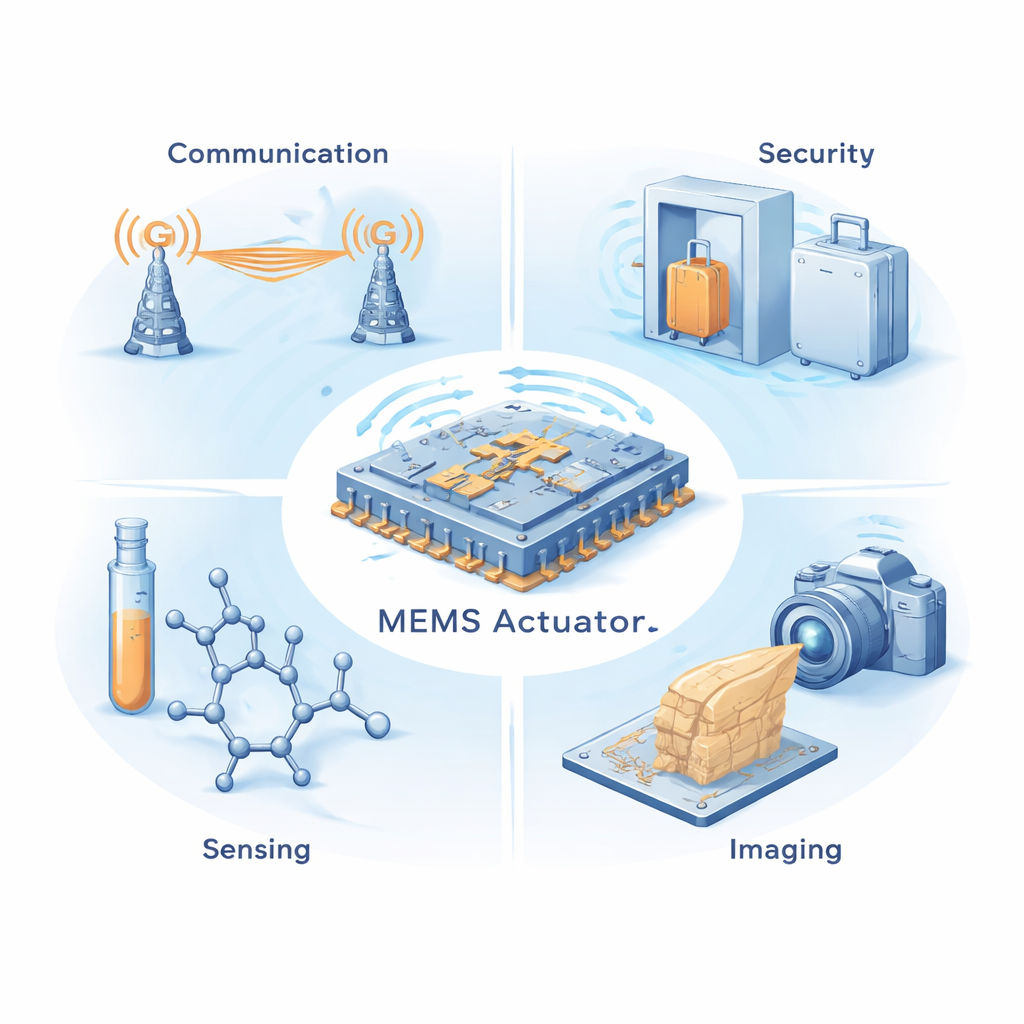
What Makes Terahertz Waves Special
Terahertz waves occupy frequencies from about 0.1 to 10 trillion cycles per second. Unlike X‑rays, they are non‑ionizing, and unlike visible light, they can pass through many common materials such as plastics, fabrics, and paper, while being strongly affected by water and certain molecules. Those traits make them attractive for security screening, quality inspection, wireless links, and even molecular fingerprinting. Yet practical devices have lagged because ordinary materials do not interact strongly with terahertz waves, and because components borrowed from microwave technology suffer high loss and poor tunability at these higher frequencies. This long‑standing mismatch between promise and practice is what researchers call the terahertz gap.
Tiny Moving Parts as Terahertz Knobs
Micro‑electromechanical systems, or MEMS, are millimeter‑to‑micron‑scale structures—beams, plates, combs, spirals—that can move when driven by electrical, thermal, magnetic, pneumatic, or piezoelectric forces. When such parts are woven into terahertz circuits and patterned metal structures called metamaterials, their motion changes key properties of the wave: how strongly it passes, at what frequency it resonates, and how its phase and polarization are oriented. Electrostatic drives are especially mature: by pulling down a cantilever with a modest voltage, researchers have built switches with very low loss and high isolation well into the hundreds of gigahertz. Other drives trade speed, stroke, power use, and complexity: thermal expansion enables wide but slower tuning; magnetic and pneumatic schemes provide non‑contact, large‑range motion; piezoelectric elements give fine, low‑power adjustment.
From Switches and Resonators to Smart Surfaces
The authors review two workhorse building blocks: switches that turn terahertz paths on and off, and tunable resonators that shape which frequencies are enhanced or suppressed. MEMS switches embedded in waveguides and transmission lines now span 180–750 GHz with insertion losses around 1–3 decibels and isolation often above 20–30 decibels—performance hard to match with conventional semiconductor devices. Tunable resonators, frequently based on split‑ring or spiral geometries, can shift their resonant frequencies by tens to hundreds of gigahertz when a tiny gap or overlap is mechanically adjusted. By arranging many such elements into metasurfaces, engineers can not only filter frequencies but also steer beams, focus energy, and convert polarization in real time. These reconfigurable surfaces serve as hardware foundations for agile links, compact spectrometers, and programmable optical functions such as logical operations on terahertz signals. 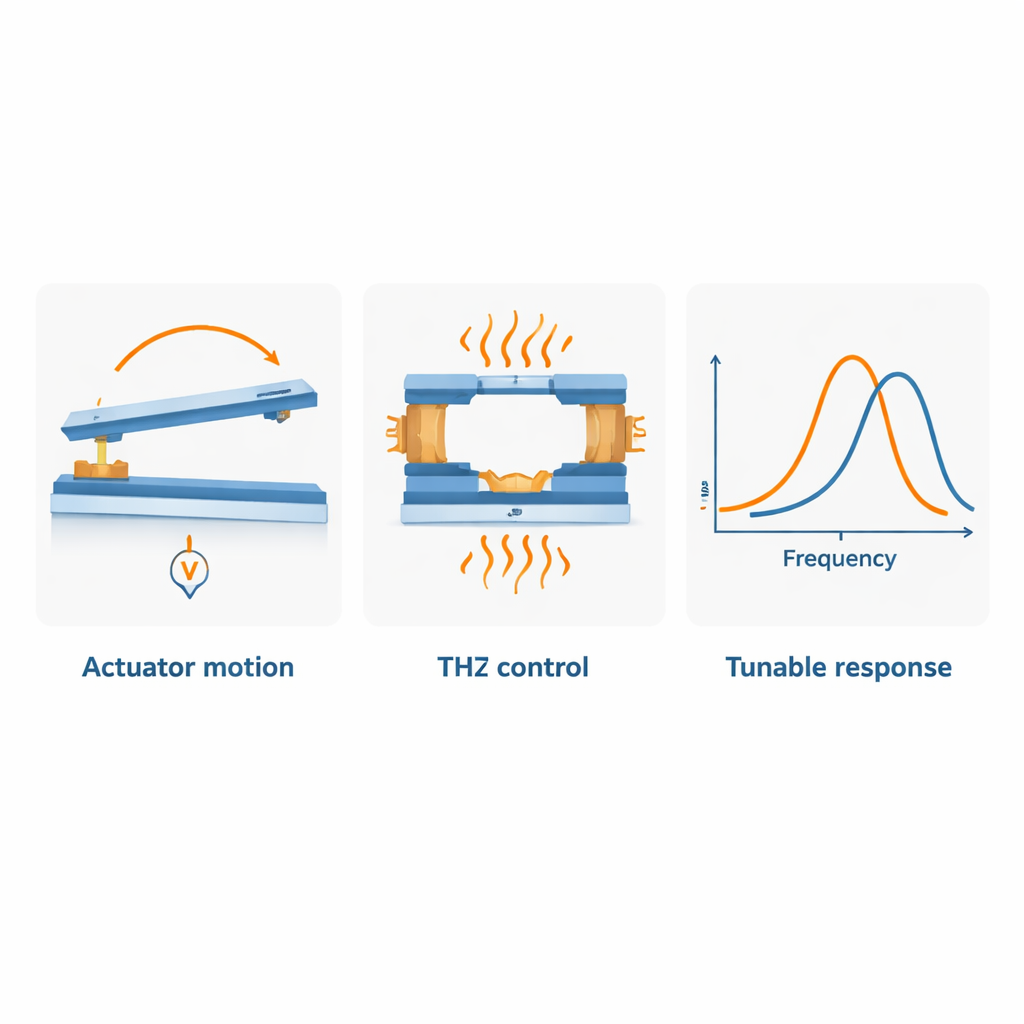
Turning Sensing, Beams, and Logic into One Platform
Because MEMS parts translate environmental changes into motion, the same mechanisms used for control can act as sensitive detectors. The review highlights pressure and flow sensors whose terahertz resonance shifts as a cantilever bends, and ultra‑thin absorbers and bimaterial beams that convert absorbed terahertz power into tiny deflections, readable as temperature or intensity changes. In communications, MEMS‑based phase shifters in waveguides and dielectric lines provide large, low‑loss phase adjustments critical for phased‑array beam steering. When tied to metasurfaces, these actuators can redirect terahertz beams by tens of degrees or sculpt multiple beams at once. By assigning “on” and “off” states of resonances to digital 0 and 1, researchers have even assembled optical versions of familiar logic gates such as AND, OR, XOR, and XNOR directly in the terahertz domain, laying groundwork for secure physical‑layer encryption and on‑chip signal processing.
Challenges on the Road to Everyday Devices
Despite impressive demonstrations, the article stresses that real‑world deployment still faces hurdles. Many electrostatic designs require tens of volts to operate, some thermal and pneumatic concepts need significant power or external pressure sources, and delicate moving parts must survive packaging, temperature swings, and billions of cycles. Fabrication demands precise layering of metals, dielectrics, and sacrificial films on substrates like high‑resistivity silicon, quartz, or flexible polymers, often followed by intricate wafer‑level packaging. The authors foresee progress through new materials (such as phase‑change compounds, magnetic alloys, graphene, and flexible polymers), hybrid drive schemes that combine the strengths of electrostatic, thermal, magnetic, and piezoelectric actuation, and three‑dimensional integration that merges MEMS with microfluidic channels, optical components, and electronics.
Closing the Terahertz Gap
To a layperson, the message of this review is that researchers are turning what used to be a stubbornly inaccessible band of the spectrum into a controllable toolset by adding microscopic moving parts. These MEMS actuators act like adjustable valves and mirrors for terahertz waves, enabling low‑loss switches, tunable filters, nimble beam steering, ultra‑sensitive detectors, and even optical logic. As materials, fabrication, and packaging mature—and as artificial intelligence helps optimize designs—the authors expect terahertz MEMS technology to migrate from lab prototypes into the core of future 6G networks, high‑resolution imagers, and intelligent sensing systems, effectively bridging the terahertz gap.
Citation: Wang, Z., Zhang, N., Zhang, Y. et al. Terahertz MEMS actuators and applications. Microsyst Nanoeng 12, 69 (2026). https://doi.org/10.1038/s41378-026-01169-5
Keywords: terahertz, MEMS actuators, metamaterials, 6G communication, beam steering