Clear Sky Science · en
Smart Dura: a functional artificial dura for multi-modal neural recording and modulation
Why a "Smart" Brain Cover Matters
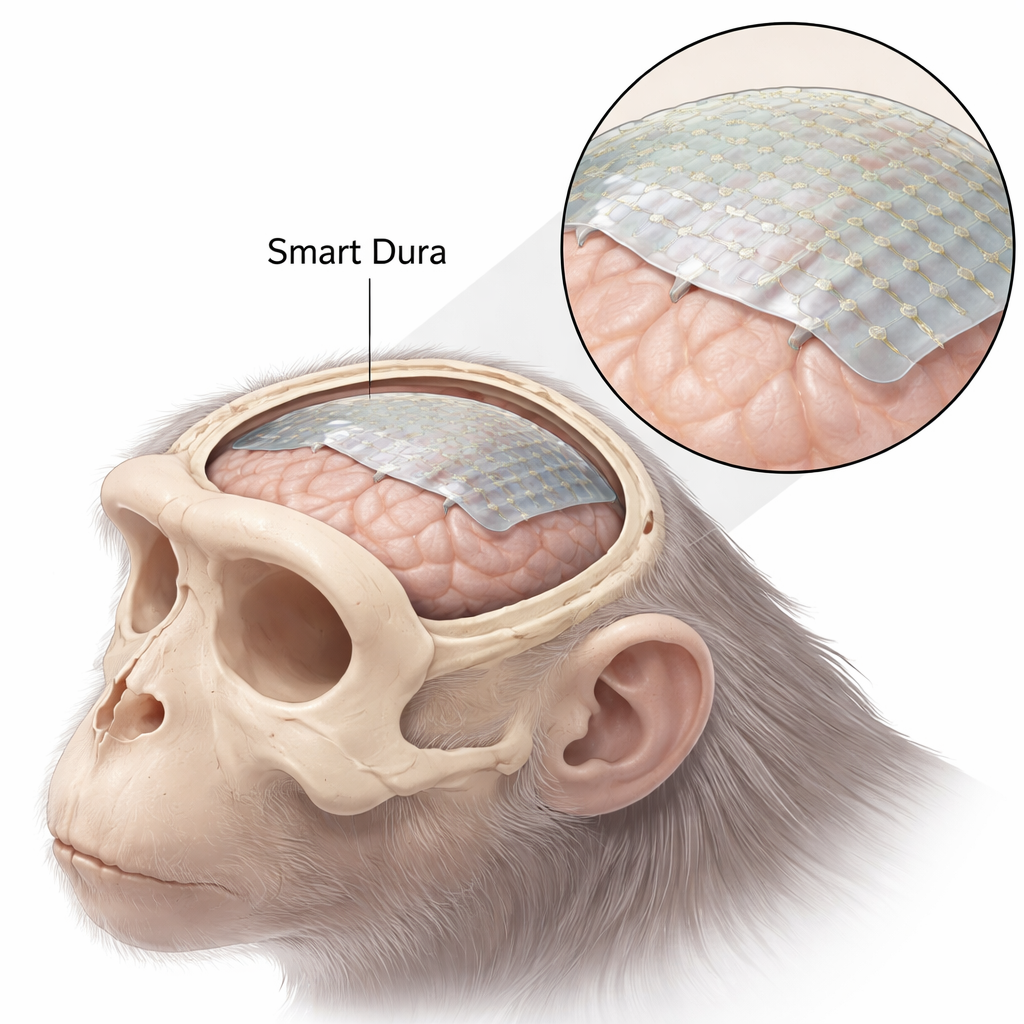
When surgeons open the skull to study or treat the brain, they temporarily remove a tough protective membrane called the dura. For years, researchers have replaced it with a soft, transparent "artificial dura" so they can look into the brain and shine light on it. But this clear window has been mostly passive: it protects, but it cannot listen to or talk with the brain. This paper introduces “Smart Dura,” a new kind of artificial dura that not only shields the brain but also records its electrical activity, stimulates it, and still lets light pass through—opening the door to more precise treatments and a deeper understanding of brain disorders.
A Window That Thinks
Smart Dura is designed as a flexible, transparent film that gently replaces the brain’s natural covering after a section of skull has been removed. Embedded in this film is a dense grid of tiny metal electrodes that rest on the surface of the brain. These electrodes can pick up electrical signals produced by groups of nerve cells and can also deliver small, carefully controlled pulses of current. What makes Smart Dura stand out is that it does all this while remaining clear enough for powerful microscopes and light-based tools, such as optogenetics, to see and act through it. In other words, it turns a simple protective layer into a multi-purpose communication port with the brain.
How the Smart Layer Is Built
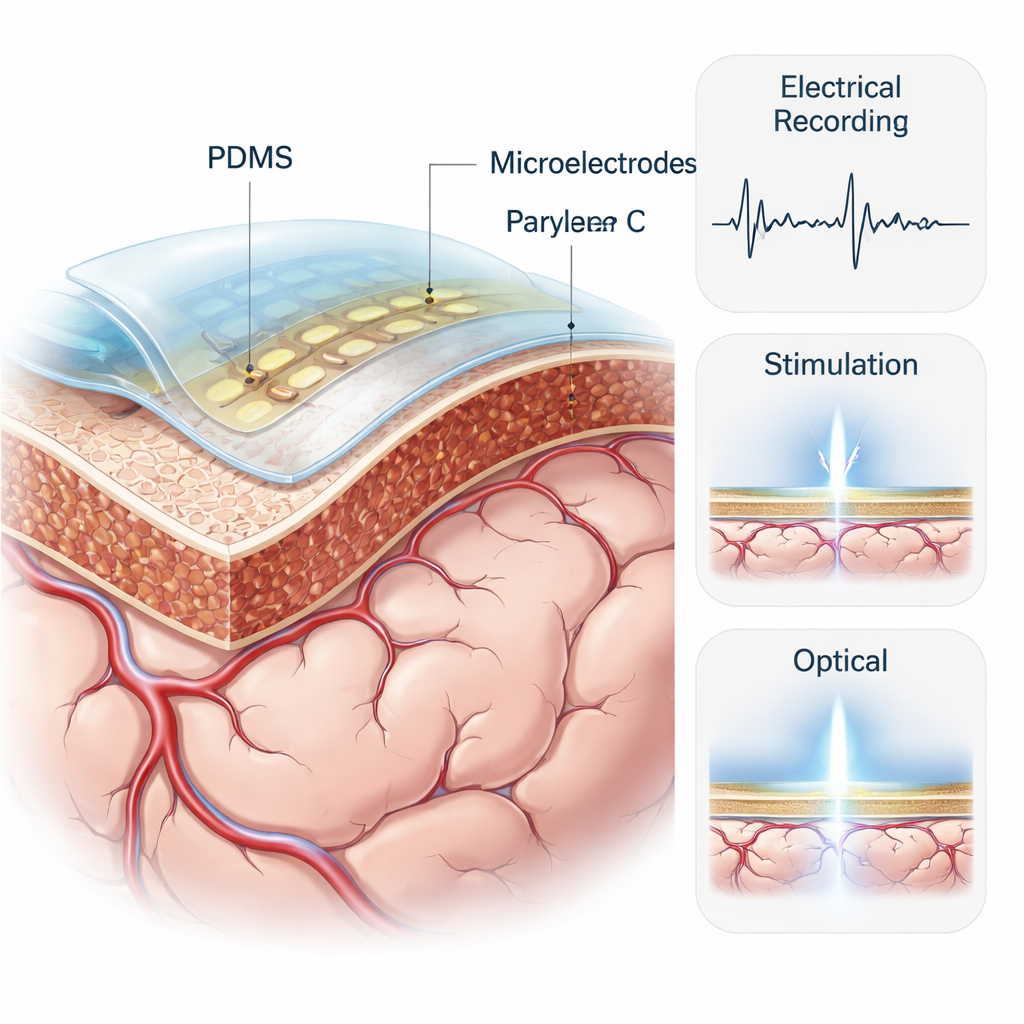
To achieve this mix of strength, softness, and clarity, the team used two main materials: PDMS, a rubbery silicone often used for medical implants, and Parylene C, a thin, transparent plastic used in electronics. PDMS gives the device a softness close to that of the natural dura, helping it sit comfortably on the brain over long periods without causing damage. Parylene C, laid down in very thin layers, makes it possible to carry out microchip-style manufacturing, allowing metal traces and electrodes only tens of micrometers wide to be patterned with high precision. The result is a 20-millimeter-wide circular array that can host up to 256 electrodes for monkeys, plus smaller versions suitable for rodent studies. Careful design keeps the metal occupying only a tiny fraction of the surface, so more than 98 percent of the area remains optically open.
Listening, Talking, and Seeing Through the Same Device
The researchers thoroughly tested Smart Dura in the lab before moving to animal experiments. They measured the electrical impedance of the electrodes, which relates to noise and signal quality, and improved it by coating the metal with a conductive polymer layer. This treatment lowered the noise enough to cleanly detect brain signals, including the rapid spikes that represent the firing of individual neurons. Long soaks in salty solution showed that the device remained stable for at least 81 days. Optical tests using a broadband light source and water (to mimic brain fluid) confirmed high transmission across visible and near-infrared wavelengths used for calcium imaging and two-photon microscopy. Importantly, two-photon imaging through Smart Dura in monkeys revealed fine blood vessels as small as about 20 micrometers at depths of 100–200 micrometers beneath the brain surface, demonstrating that the thin metal lines do not meaningfully block high-resolution views.
Probing Real Brains in Action
Smart Dura was then placed onto the brains of monkeys in several scenarios. In awake animals performing reaching tasks, the device recorded changes in rhythmic brain activity linked to planning and executing movements, including low-frequency “theta” waves and faster “gamma” rhythms. Recordings taken just above the dura and directly on the brain surface showed that moving closer to the tissue revealed richer, higher-frequency details. In anesthetized monkeys, the array reliably captured responses in the touch-processing cortex when the fingertips were vibrated, matching known maps of how the body is laid out on the brain. The same device was also used to deliver gentle electrical stimulation to pairs of sites, which changed activity patterns across the network even at distant electrodes. Finally, thanks to its transparency, Smart Dura enabled optogenetic experiments: red light shone through the film onto genetically light-sensitive neurons in parietal cortex silenced local activity in a focused way, and the electrodes simultaneously recorded the resulting changes.
What This Means for Future Brain Therapies
For non-specialists, the key idea is that Smart Dura blends protection, sensing, and intervention into a single thin layer that can stay on the brain for long periods. It offers a rare combination: large-area coverage, fine-grained electrical recording, the ability to stimulate specific regions, and nearly unobstructed paths for light-based methods. In animal models, this allows scientists to watch and control brain circuits across many scales—from individual cells to entire networks—while the animal moves and behaves naturally. In the longer term, similar technology could help refine treatments for conditions like stroke, epilepsy, depression, and movement disorders, by enabling closed-loop systems that detect unhealthy patterns and respond instantly with tailored electrical or optical therapy.
Citation: Montalvo Vargo, S., Hong, N., Belloir, T. et al. Smart Dura: a functional artificial dura for multi-modal neural recording and modulation. Microsyst Nanoeng 12, 67 (2026). https://doi.org/10.1038/s41378-026-01166-8
Keywords: neural interface, brain stimulation, optogenetics, electrocorticography, artificial dura