Clear Sky Science · en
A 3D modeling framework for accurate trajectory-based prediction of critical diameter in deterministic lateral displacement microfluidics
Sorting Tiny Particles with Tiny Mazes
Imagine a lab test that can pick out rare cancer cells or viruses from a blood sample in a few minutes, using only a droplet of fluid and a clear plastic chip. This paper explores one of the key technologies behind such tests — a microscopic "obstacle course" for particles called deterministic lateral displacement (DLD) — and introduces a new way to predict exactly which particles will be separated and which will slip through.
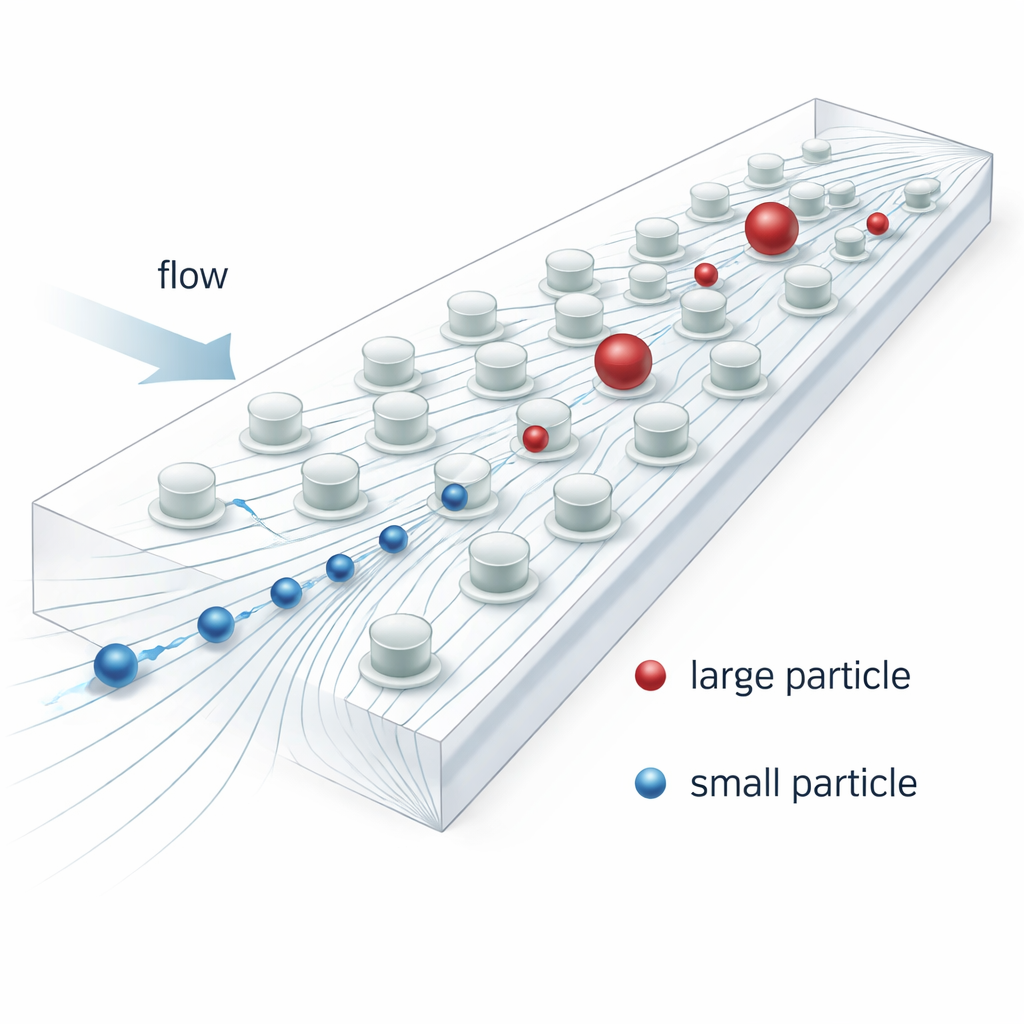
How Micro-Obstacle Courses Sort by Size
DLD devices are flat microfluidic channels filled with regularly spaced pillars, like an orderly forest of posts. Fluid flows steadily through the gaps. Small particles follow the fluid’s streamlines and weave straight through in a zigzag pattern. Larger particles, however, cannot fit into the narrowest flow lanes; they repeatedly bump against the pillars and are nudged sideways, eventually emerging at a different outlet. The boundary size that decides whether a particle zigzags or gets bumped is called the critical diameter. Knowing this critical diameter in advance is essential for designing chips that reliably separate cells, droplets, or nanoparticles for medical diagnostics and research.
Why Current Design Rules Fall Short
Until now, most design rules for DLD devices have treated particles as ideal points and the channel as perfectly two-dimensional. Simple formulas or computer models estimated the critical diameter using only pillar spacing in a flat plane. But real devices have a finite height, and the fluid slows down near the top and bottom walls. Pillars can be non-circular, spaced unevenly, and manufactured with slight imperfections. Earlier three-dimensional simulations either relied on empirical fitting factors that changed from design to design or were so computationally heavy that they were impractical for routine use. As a result, predictions of which particle sizes would separate were often inaccurate, especially for more advanced pillar shapes or tightly tuned devices.
A 3D Map of Forces on Each Particle
The authors present a new three-dimensional modeling framework that tackles the problem from the particle’s point of view. They first compute a detailed 3D flow field in a small, representative block of four neighboring pillars using finite element software. Then, instead of assuming a particle is a point, they divide the surface of a spherical particle into many tiny patches. For each patch, they calculate how local fluid velocities and pressures push or pull on the particle, including viscous drag, pressure forces, and subtle lift forces created by velocity gradients and nearby walls. These local forces are combined to update the particle’s motion step by step. By tracking many particle sizes through repeated copies of the same four-pillar block, the method reveals whether each size follows a zigzag path, a bump path, or something in between.
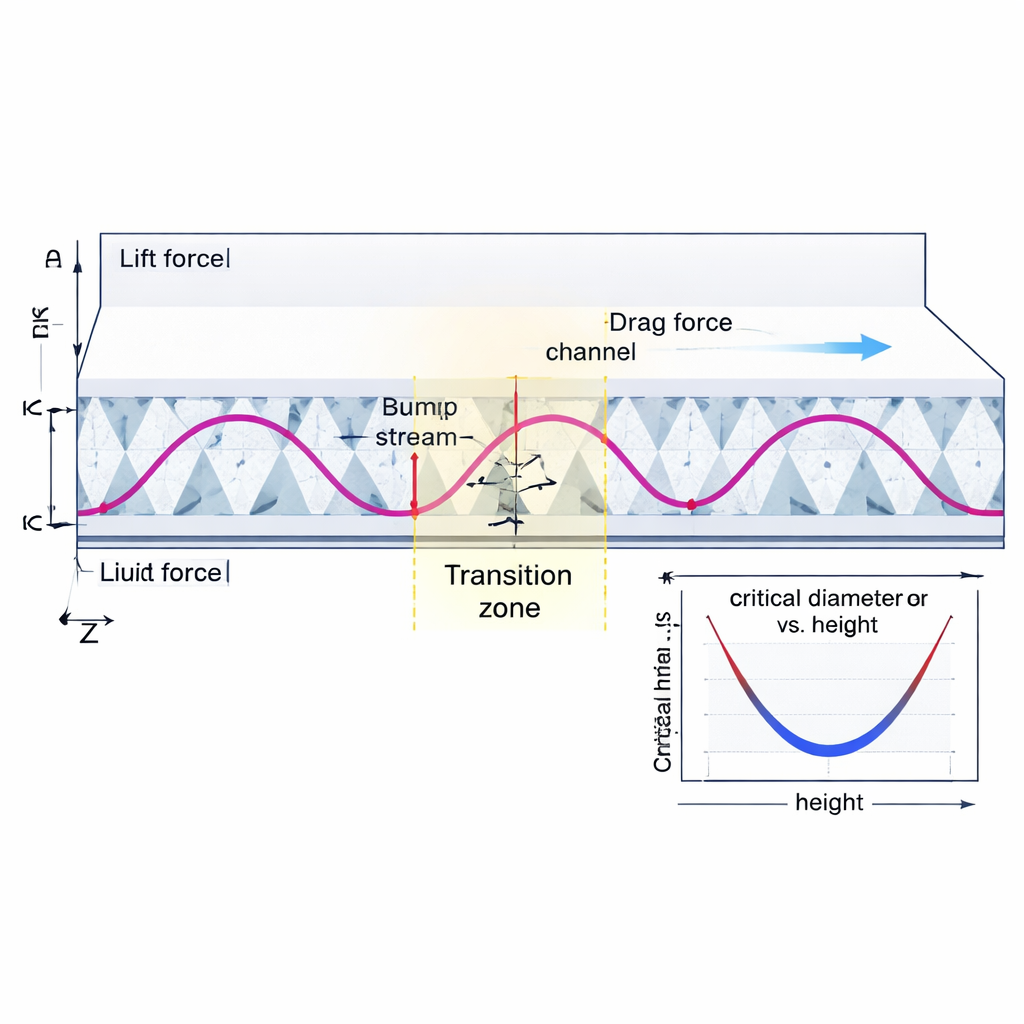
A Hidden Third Behavior in the Vertical Dimension
Using this 3D approach, the researchers discovered that the critical diameter is not a single fixed number but changes across the channel’s height. In fact, it forms a U-shaped curve: particles at mid-height are separated at the smallest size, while those near the top and bottom walls require a larger size difference to be deflected. Between these extremes lies a transition zone where a particle of a given size may switch back and forth between zigzag and bump modes as it subtly oscillates up and down. This mixed behavior creates an "altered zigzag" trajectory, with a net sideways shift that is weaker and more variable than pure bumping. The team’s simulations match published experiments and new tests on custom-made chips, with measured particle paths agreeing to within about a micrometer.
Designing Sharper and Smarter Sorting Chips
For non-specialists, the key takeaway is that the vertical structure of the flow — not just the pillar layout when viewed from above — strongly influences how well a DLD device can distinguish between similar-sized particles. By explicitly modeling 3D forces, the new framework can predict and explain ambiguous trajectories that previously blurred separation performance. It also shows how certain pillar shapes, such as inverted triangular designs, can shrink the transition zone and sharpen the device’s resolution. Because the method uses only one steady 3D flow solution and then reuses it efficiently, it offers a practical tool for rapidly exploring new chip geometries. In the long term, the authors envision combining this physics-based model with automation so that microfluidic separators can be designed on demand for tasks ranging from rare cell isolation to point-of-care diagnostics.
Citation: Chen, J., Huang, X., Xuan, W. et al. A 3D modeling framework for accurate trajectory-based prediction of critical diameter in deterministic lateral displacement microfluidics. Microsyst Nanoeng 12, 78 (2026). https://doi.org/10.1038/s41378-025-01139-3
Keywords: microfluidic separation, deterministic lateral displacement, particle sorting, lab-on-a-chip, cell and nanoparticle analysis