Clear Sky Science · en
Advanced reusable SAW-based particulate matter sensor with microheater and porous microstructured filter membrane for simultaneous PM10 and PM2.5 detection
Why Cleaner Air Needs Smarter Sensors
Air pollution from tiny airborne particles is one of today’s most serious, yet invisible, health threats. These specks of dust and soot are linked to heart disease, lung problems, and even higher death rates during viral outbreaks. Yet most people rarely see how these particles are measured. This study introduces a new kind of tiny chip-based sensor that can separately track both coarse dust (PM10) and finer, more dangerous particles (PM2.5), while also cleaning itself so it can be reused again and again. The work points toward smaller, cheaper, and more reliable tools for monitoring the air we breathe in homes, cities, and workplaces. 
Tiny Dust, Big Health Risks
Airborne particles come in a range of sizes, and size matters. Coarser particles, known as PM10, are about one-fifth the width of a human hair. Finer particles, PM2.5, are four times smaller still and can slip deep into the lungs, where they are tied to strokes, heart attacks, and respiratory disease. Even small increases in these particles can noticeably raise the risk of death and serious illness. Existing monitoring methods—such as weighing filters or shining light through dusty air—are accurate but bulky, slow, or sensitive to humidity and particle shape. That makes it hard to build compact, low-cost devices that can continuously watch over the air in many locations at once.
Listening to Dust with Sound Waves
The researchers turned to surface acoustic wave (SAW) technology, which uses ripples of sound traveling along the surface of a crystal chip. When particles land on this surface, they slightly change the speed of the traveling wave, shifting the chip’s natural frequency. By measuring that shift in real time, the device can “feel” how much material has settled on it without any weighing step. The team designed two nearly identical SAW chips that operate at about 222 megahertz, a frequency chosen so the sound waves are especially sensitive to particles around the size of PM2.5. To avoid false readings from temperature changes or vibrations, each sensing chip is paired with a protected reference chip, and custom electronics compare their signals to cancel out environmental noise.
Smart Size-Selective Filters
The key challenge is telling PM10 and PM2.5 apart. Instead of relying on bulky external hardware, the team built a delicate metal membrane filled with microscopic circular holes and placed it just above the sensing area on each chip. One membrane has larger openings, around 11 micrometers across, so both coarse and fine particles can pass through and reach the surface below. The other has smaller, roughly 3 micrometer openings, which block larger dust grains while letting only the finer particles through. Careful computer simulations and high-resolution microscope images confirmed that these membranes are smooth, sturdy, and have precisely controlled hole sizes—crucial for steering particles by size while still allowing air to flow. 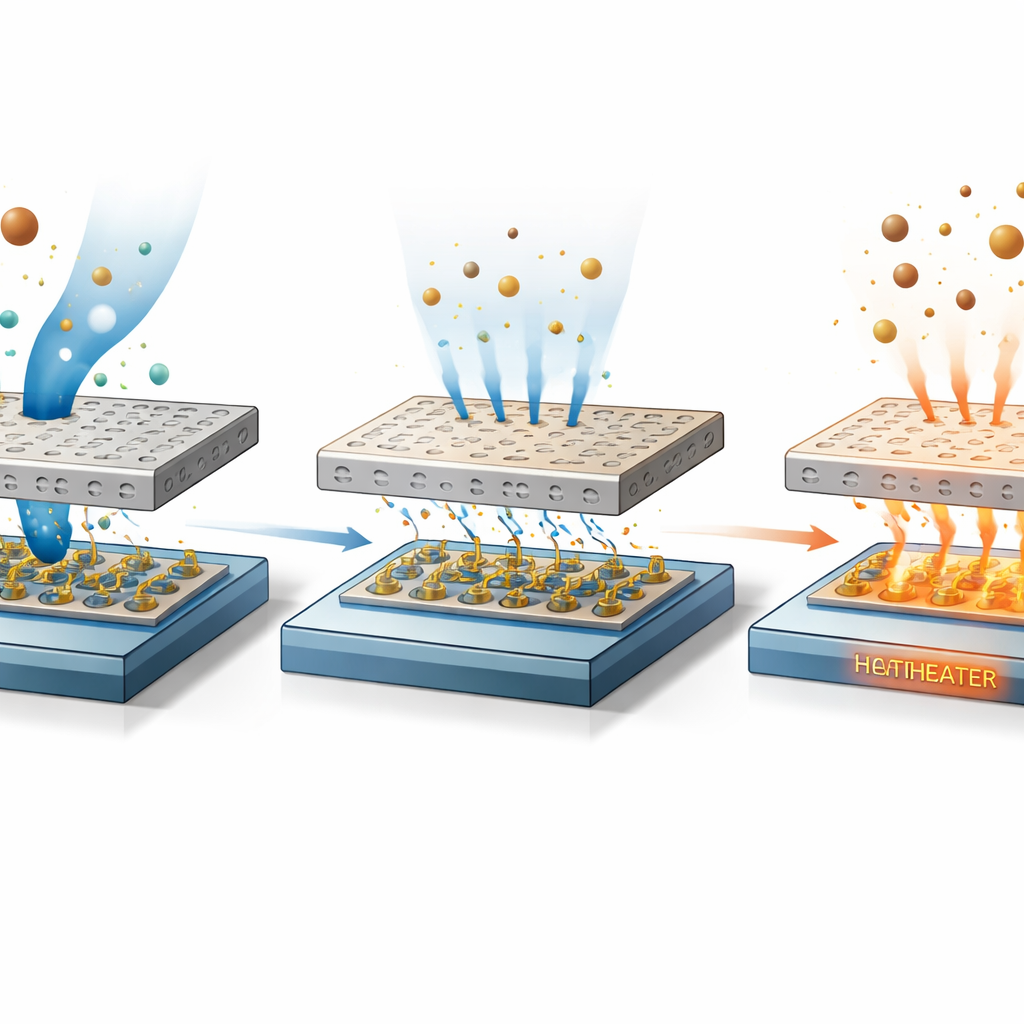
A Sensor That Cleans Itself
Any dust sensor will eventually clog if particles keep piling up. To solve this, the authors integrated a slim metal heating element directly onto the same chip. After the sensor has collected particles and its signal has saturated, applying a modest voltage warms the sensing area to around 100 degrees Celsius. This burst of heat weakens the forces holding particles to the surface and to the filter, allowing them to detach and be removed under vacuum. Thermal camera images and detailed electrical tests show that the heater warms the chip evenly and predictably. In repeated trials, the sensors recovered almost completely to their original baseline after each cleaning cycle and maintained most of their response over several days of use.
Turning Raw Signals into Clear Air Readings
In controlled experiments, the team introduced known amounts of commercial PM2.5 and PM10 test dust into a small chamber containing both sensors. The larger-hole sensor responded to both particle types, while the smaller-hole sensor responded only to the fine fraction as intended. By comparing the two responses and using calibration data, the researchers could separate the contribution from fine particles and the coarser ones between 2.5 and 10 micrometers. The custom electronics, built around compact radio-frequency circuits and a programmable logic chip, tracked tiny shifts in frequency—down to about one hertz—providing a sensitive, miniaturized readout system that could, in principle, be built into handheld or networked devices.
What This Means for Everyday Air Monitoring
To a non-specialist, the key message is that this study shows how a single, reusable chip can simultaneously distinguish and measure two important classes of harmful airborne particles, while automatically cleaning itself between uses. By combining a size-selective filter, a sound-wave-based weighing method, and an on-chip microheater, the device avoids many drawbacks of traditional bulky instruments. If further developed and ruggedized, this type of sensor could help power dense networks of air monitors in cities, inside buildings, and even in portable gadgets, giving people a clearer, more detailed picture of the invisible dust that affects their health.
Citation: Nawaz, F., Tavakkalov, N. & Lee, K. Advanced reusable SAW-based particulate matter sensor with microheater and porous microstructured filter membrane for simultaneous PM10 and PM2.5 detection. Microsyst Nanoeng 12, 104 (2026). https://doi.org/10.1038/s41378-025-01137-5
Keywords: particulate matter, air quality sensor, surface acoustic wave, PM2.5 and PM10, microheater