Clear Sky Science · en
Highly stable diamagnetically levitated mechanical resonators with large masses exceeding 1.5 gram
Floating Objects You Can Measure With
Imagine a solid object the size of a postage stamp hovering steadily in midair, without spinning away or needing any power to hold it up. Now imagine using that floating piece as an ultra-steady ruler for motion, acceleration, or even tiny magnetic fields. This article describes how researchers have built just such a system, using clever magnet design and a special graphite-based material to make heavy, coin-sized plates levitate stably and vibrate with remarkable precision.
Why Engineers Want Things to Float
Modern sensors, from smartphone accelerometers to navigation systems in airplanes and spacecraft, often rely on tiny vibrating structures called mechanical resonators. When these structures feel a force, their vibration frequency shifts slightly, and electronics read out that change. The problem is that these resonators are usually attached to a frame, so some of their energy leaks away through the supports, blurring the vibration and reducing sensitivity. One way around this loss is to remove the supports altogether and let the resonator “float,” or levitate, so it barely touches anything. Several kinds of levitation already exist—using light, sound, or superconductors—but they often need intense lasers, special low-temperature setups, or work only for very small objects.
Making Heavy Plates Hover Over Magnets
The team focused on diamagnetic levitation, where certain materials are gently pushed away by magnetic fields. They built flat plates from a mixture of tiny graphite particles and an insulating epoxy glue, then placed them above a checkerboard array of permanent magnets. In the right magnetic pattern, the plates feel an upward push that balances gravity and sideways forces that nudge them back into place if disturbed. Computer simulations and experiments show that the plates levitate at heights of about 50 to 100 micrometers—roughly the thickness of a human hair—and, importantly, that this levitation height barely changes as the plate area and mass increase. Using this approach, the researchers fully levitated plates weighing more than 1.5 grams, far heavier than in earlier diamagnetic devices. 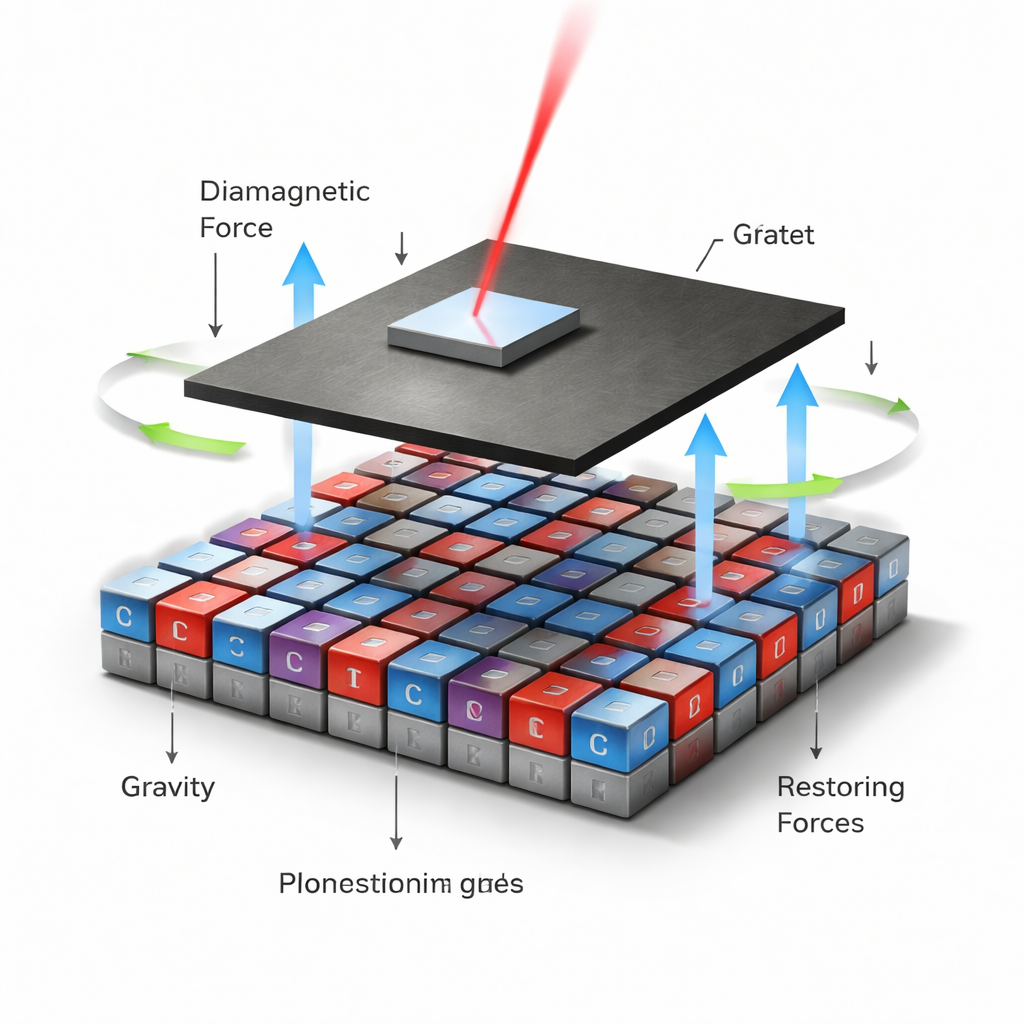
Building the Special Floating Material
To make these hovering plates, the researchers mixed high-purity graphite powder with a commercial epoxy and a bit of alcohol to thin the mixture. They centrifuged the blend to spread the particles evenly, poured it into molds, let the alcohol evaporate, and cured the mixture in an oven. After polishing the cured blocks to the desired thickness, they glued a small mirror on top so that a laser beam could be reflected for precise position measurements. The key twist is that the graphite particles are separated by insulating epoxy. Graphite is both diamagnetic and electrically conductive, and in a changing magnetic field it can form eddy currents that waste energy as heat. By breaking up continuous paths of graphite with the epoxy, the plates keep their levitation ability but strongly suppress these energy-sapping currents.
Measuring Tiny Motions and Vibrations
To probe how well the plates behave as resonators, the team used an optical interferometer: a low-power red laser focused on the little mirror, with the reflected light picked up by a detector. Inside a vacuum chamber, they gently drove the plates near their natural vibration frequency (around 20 hertz, about the speed of a slow wobble) and then switched the drive off to watch how long the motion took to fade. The slow decay revealed very high “quality factors,” up to 32,000, meaning the vibrations retain their energy for many cycles. Measurements of undriven motion showed that the plates barely drift at all, with residual velocities of roughly one micrometer per second or less. Using a feedback loop that continuously tracks the vibration frequency, the researchers also found that the frequency stays stable to better than a thousandth of a hertz over many minutes—comparable to very good timing references. 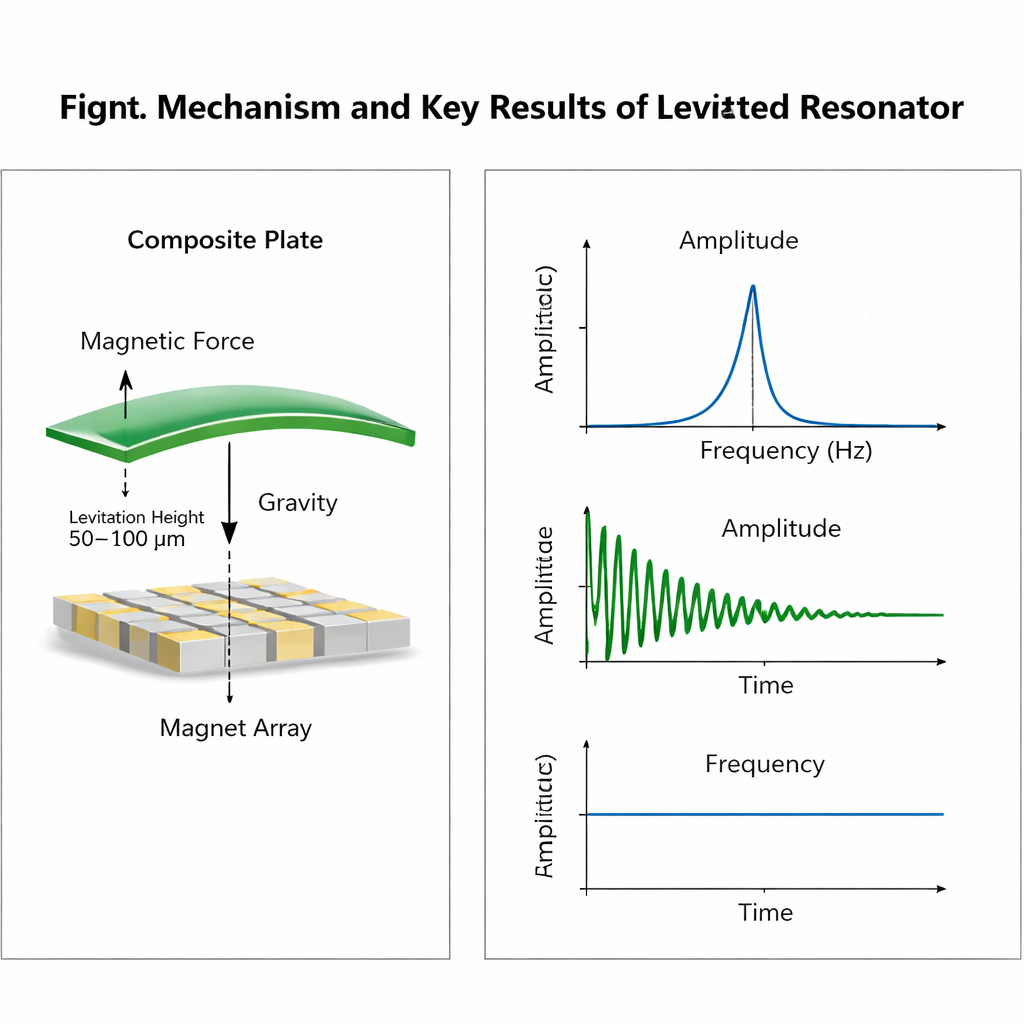
From Hovering Plates to Future Sensors
Beyond simply floating, these plates can sense their surroundings. Bringing a small extra magnet close by slightly shifts the resonant frequency, letting the device act as a magnetometer whose ultimate magnetic sensitivity is on par with standard Hall sensors. Thanks to the combination of large mass, low energy loss, and high stability, the thermal-noise-limited acceleration sensitivity reaches about 2.4 × 10⁻¹¹ times Earth’s gravity for each square root of bandwidth, making these levitated plates promising candidates for next-generation inertial sensors. In plain terms, the work shows that carefully designed, magnetically levitated graphite-epoxy plates can float stably without anchors, respond to extremely small forces, and operate at room temperature without complex support systems, opening a path to more sensitive and robust measurement devices.
Citation: Roy, P., Yasmin, S., Wang, Y. et al. Highly stable diamagnetically levitated mechanical resonators with large masses exceeding 1.5 gram. Microsyst Nanoeng 12, 79 (2026). https://doi.org/10.1038/s41378-025-01122-y
Keywords: diamagnetic levitation, mechanical resonator, inertial sensor, graphite composite, precision sensing