Clear Sky Science · en
Optimized stress transfer interfaces enabled wearable nano-electronics for fatigue driving monitoring
Smarter Seatbelts for Your Pulse
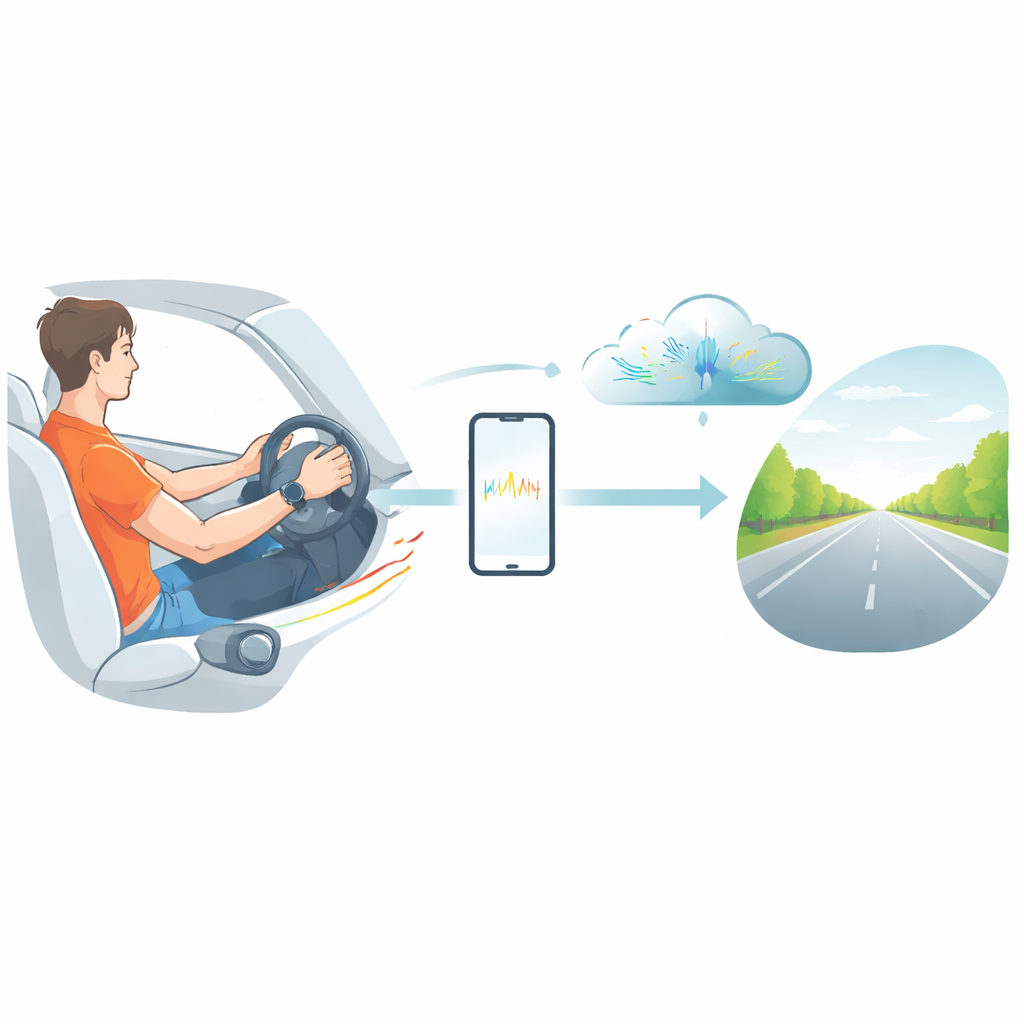
Long drives can turn dangerous in seconds if a driver suddenly dozes off or suffers a hidden heart problem. This study introduces a new kind of ultra-sensitive wrist-worn sensor that can “listen” to tiny pulse waves in your wrist, even when the watch strap is tight and you are moving. Paired with simple electronics and machine learning, it aims to warn drivers of fatigue and heart trouble before disaster strikes.
Why Reading the Pulse Is So Hard
Many wearables today track heart rate using light, but they struggle to measure how hard the heart is working or how stiff the arteries are. Mechanical sensors that feel the slight thump of blood in the arteries can reveal richer information, such as blood pressure trends and vessel elasticity. The problem is that these pulse signals are extremely weak, and real-world use demands a snug band or patch that presses the sensor into the skin. That pre-pressure, along with tiny gaps between the skin and a flat sensor, often squashes the sensor’s ability to notice the delicate flicker of each pulse wave.
Shaping the Contact Between Skin and Sensor
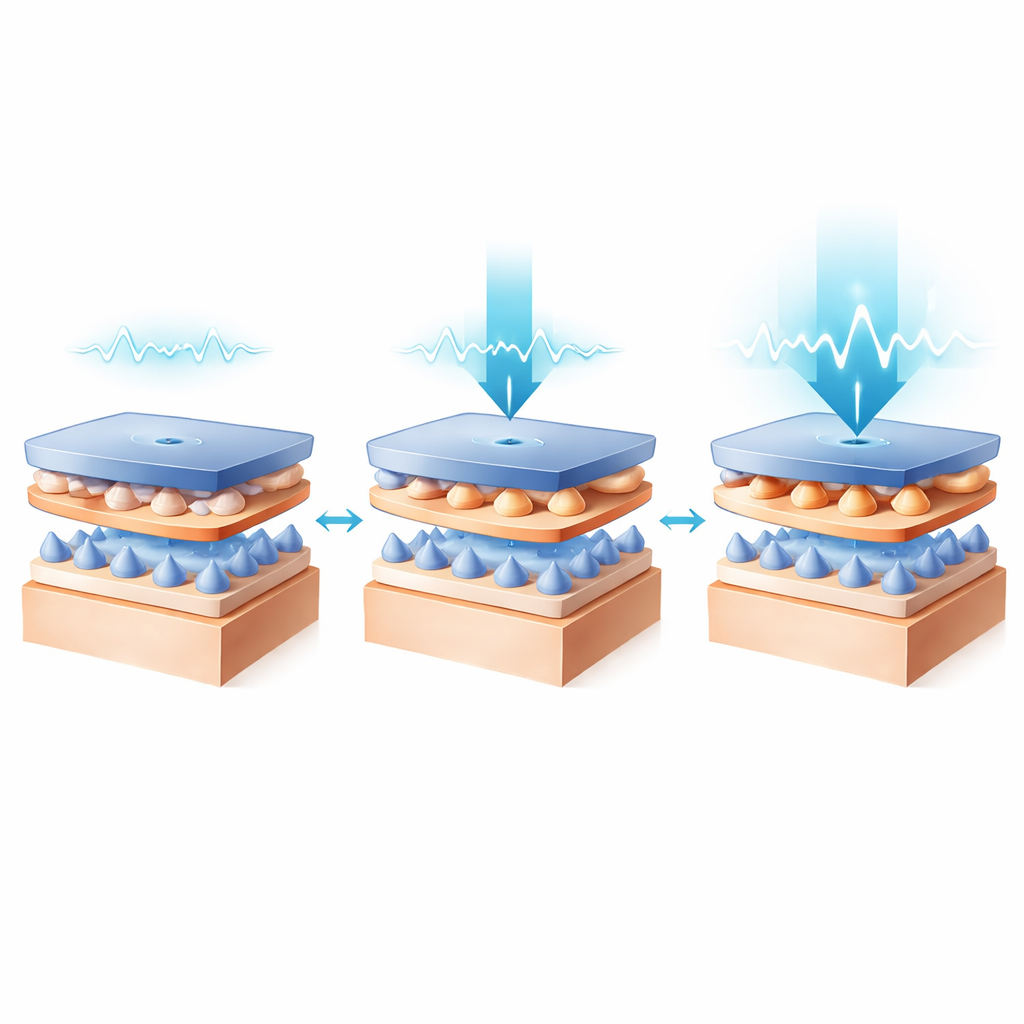
The researchers tackled this by rethinking the way stress travels from the skin into the electronics. Their device, called an interfacial engineered triboelectric sensor (IETS), stacks two types of layers. On the skin side, a forest of tiny pillar-like “piezo-frustums” fills in the natural dips and curves of the wrist, so even recessed areas press firmly on the sensor. These pillars not only guide mechanical pressure into the device but also create extra electric charge when squeezed. On the inside, the contact surface is sculpted into repeated mountain-like peaks rather than simple cones or flat films. These twin peaks focus stress into small regions so that even faint pulses produce clear electrical responses, and the structure keeps deforming smoothly instead of quickly flattening out under a tight strap.
From Laser-Cut Micropeaks to Real-World Sensitivity
To build these unusual surfaces, the team used a carbon-dioxide laser to carve patterns into plastic molds. Because the laser’s heat follows a smooth bell-shaped profile, it naturally forms conical cavities whose size can be tuned by adjusting power. By slightly overlapping two etched spots, they created double-peaked, mountain-like shapes. Casting soft silicone into these molds produced flexible layers dotted with uniform micro-mountains. Tests and computer simulations showed that, under the same pressure, these twin peaks deform more than standard cones and keep their responsiveness over a wider pressure range. Combined with the skin-side pillars, the full IETS could detect pressures as tiny as the weight of a few milligrams of sandpaper or the accumulation of individual water drops, even while held under a steady background load.
Turning Pulse Waves into Warnings
Built into a watch strap and connected to a flexible circuit board, the sensor converts each pulse beat into an electrical signal, which is then amplified, filtered, and sent via Bluetooth to a smartphone. The resulting waveforms clearly show the three main peaks of a typical arterial pulse, allowing the system to extract timing features linked to blood pressure, blood flow speed, and artery stiffness. By examining variations in the time between beats—heart rate variability—the device can distinguish between alert and fatigued states. The team used a one-dimensional convolutional neural network to classify short slices of pulse data, achieving high accuracy in identifying both driver behaviors and fatigue levels in near real time.
Watching the Whole Driver, Not Just the Wrist
Because the sensor remains sensitive from very low to very high pressures, it can be placed on more than just the wrist. The authors demonstrated uses on the face to catch changes in blinking and yawning, on pedals to detect abrupt braking or acceleration, and in the seat and seatbelt to sense whether the driver is properly seated and buckled. Across these scenarios, the same basic device could pick up everything from subtle eye movements to the full weight of a person, without losing signal quality or wearing out over thousands of cycles.
What This Means for Everyday Safety
To a non-expert, the core message is simple: by cleverly shaping the tiny contact structures between skin and sensor, the authors built a wristband that can feel your pulse with great precision, even under the snug fit needed for daily wear. This engineered interface boosts sensitivity and widens the useful pressure range, turning faint wrist pulses into strong, reliable electrical signals. When those signals are combined with smart algorithms, the system can track cardiovascular health and spot driver fatigue early enough to warn the user—and potentially prevent accidents—making future cars and wearables both safer and more attentive to our bodies.
Citation: Lei, H., Xie, L., Qin, X. et al. Optimized stress transfer interfaces enabled wearable nano-electronics for fatigue driving monitoring. Microsyst Nanoeng 12, 94 (2026). https://doi.org/10.1038/s41378-025-01107-x
Keywords: wearable pulse sensor, driver fatigue monitoring, triboelectric nanogenerator, cardiovascular health tracking, smartwatch health technology