Clear Sky Science · en
Intrinsically stretchable organic light-emitting-diode with high brightness and stretchability via elastic-microphase-engineered emitter and dual-embedded electrode
Bright Screens That Can Stretch Like Skin
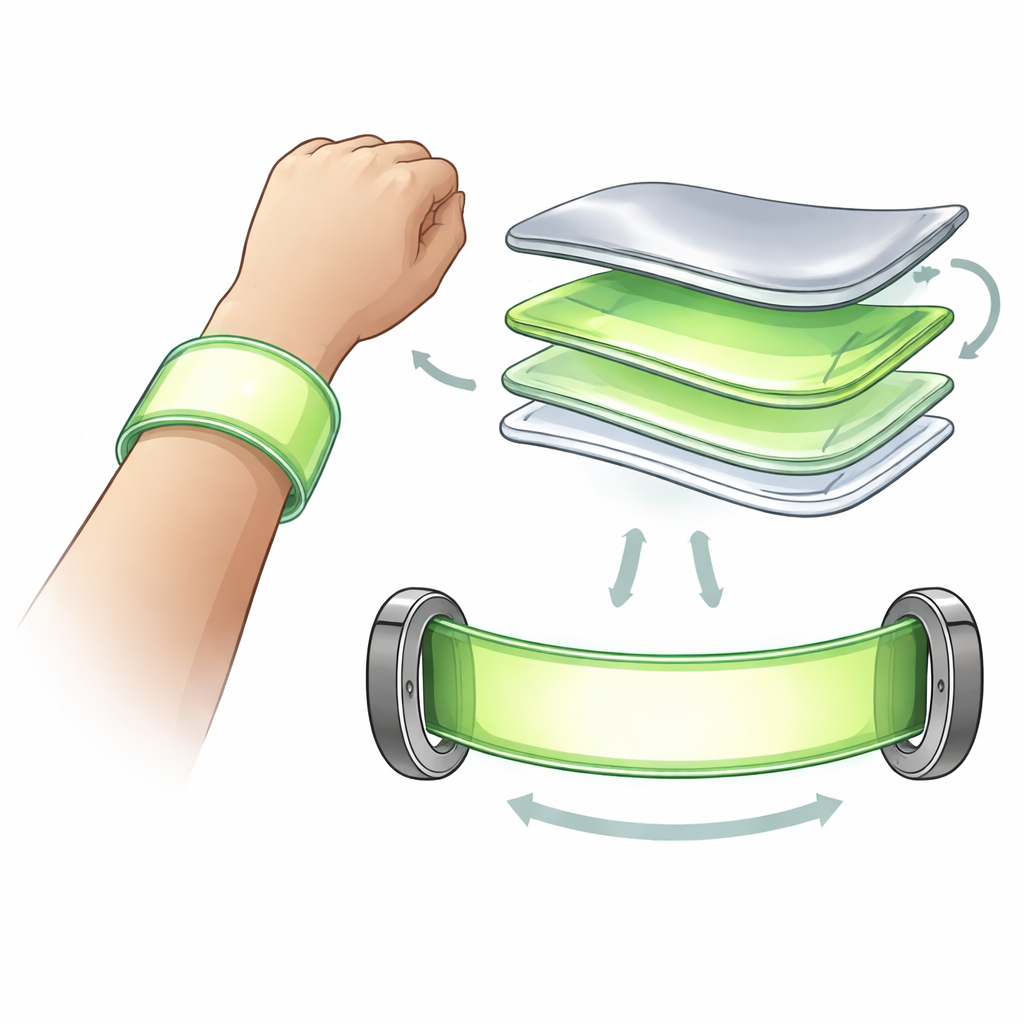
Imagine a glowing wristband display that bends, twists, and stretches with your skin without dimming or breaking. This study pushes that vision closer to reality by creating a new kind of organic light-emitting diode (OLED) that is not just flexible, but truly stretchable. The researchers show how to build light-emitting films and transparent electrodes that can both endure large stretching—well beyond what our bodies experience in motion—while still shining brightly. Their approach could underpin future wearable displays, soft medical monitors, and other electronics that feel more like clothing than gadgets.
Why Ordinary Screens Can’t Keep Up
Conventional OLED screens, even the bendable ones in today’s phones and watches, are not designed to handle the 40–100% stretching that can occur on elbows, knees, or around joints. The light-emitting materials are usually stiff, so they crack when pulled, and the transparent electrodes that feed them electricity tend to fracture like thin glass. The goal of intrinsically stretchable OLEDs is to solve this by making every layer—from the glowing film to the wiring—soft and stretchable from the start. Until now, however, no such device had combined very high brightness, good energy efficiency, and the ability to stretch beyond 100% without quickly degrading.
Making the Light-Emitting Layer More Like Rubber
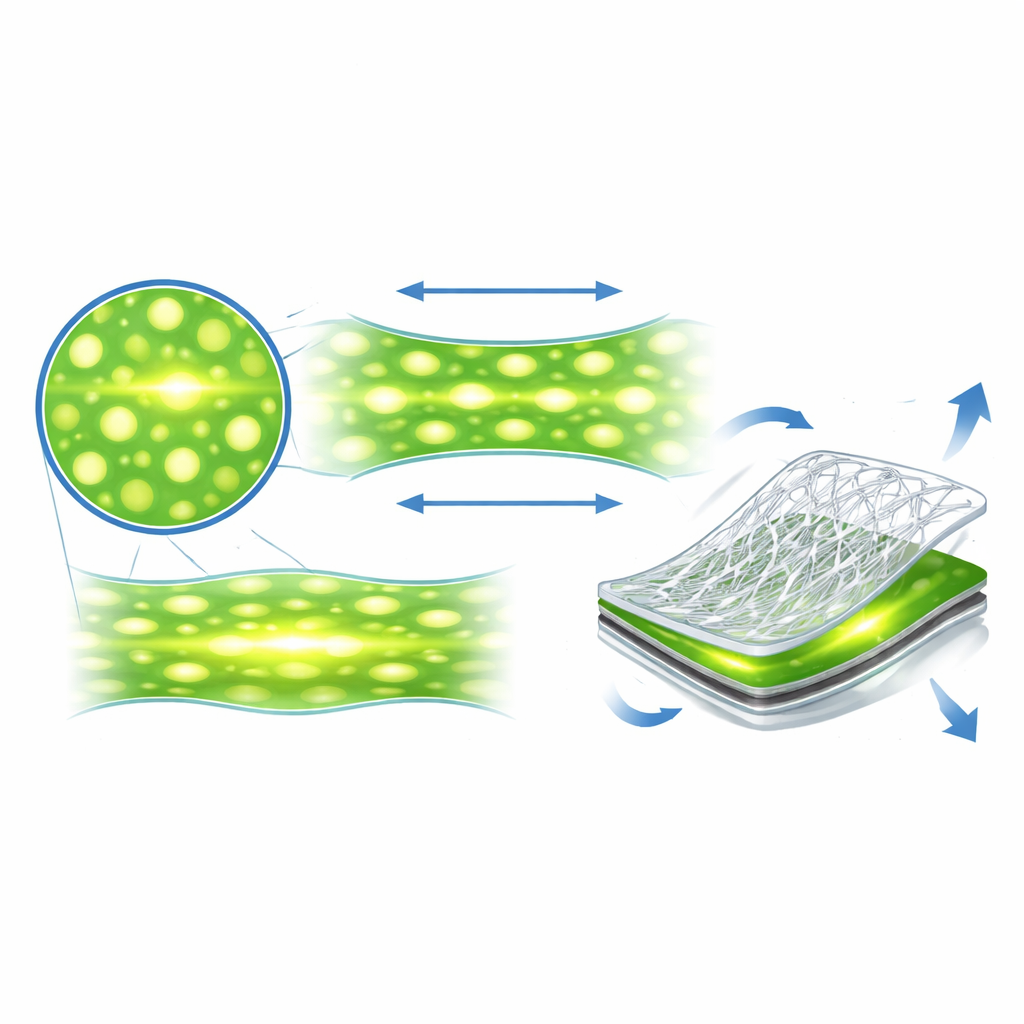
The team focused first on the green light-emitting film at the heart of the device. They mixed a standard glowing polymer with three different rubbery additives, each made from slightly different building blocks. A key insight was that it is not enough for the rubber to be stretchy on its own; it must also blend smoothly with the light-emitting polymer at the molecular level. When one of these additives, called SBS, was used in small amounts, it formed a fine, three-dimensional pattern within the glowing material rather than clumping into large blobs. In this structure, the light-emitting polymer forms a continuous network for electrical charges, while tiny SBS domains act as built‑in shock absorbers that spread out mechanical stress when the film is pulled.
Balancing Stretch, Strength, and Light
This carefully mixed film achieved a rare balance: it became much more stretchable while actually improving its electrical and optical behavior. Tests showed that films with about 10% SBS could be stretched several times more than the original while resisting cracks. At the same time, electrical measurements revealed that electrons and holes—the two types of charge that must meet to produce light—could move more evenly through the material. The film’s light output, efficiency, and color stability all stayed high, unlike blends with the other rubbers, which suffered from poor mixing and large internal separations. Microscopy and X‑ray studies confirmed that SBS helped the glowing polymer pack more neatly, boosting the pathways for charge and light while its soft domains diverted mechanical stress.
Designing a Stretchable Transparent Electrode
Just as important as the emissive layer is the transparent electrode that carries current in and out of the device. The researchers built a new “dual-embedded” electrode by weaving silver nanowires into a stretchy plastic and adding a thin conductive polymer layer underneath. Instead of peeling this delicate network off a rigid surface—a step that usually creates breaks—they floated it free in water so it could detach gently. The resulting film was smooth, highly transparent, and significantly more conductive than earlier designs, yet it could be stretched repeatedly with only modest increases in resistance. The plastic matrix also shielded the silver network from damage and corrosion over months in air.
A Record-Setting Stretchable Light
Combining the SBS‑enhanced light-emitting film with the dual-embedded electrode, and using a liquid-metal top contact that can also deform, the team built a fully stretchable OLED. This device reached brightness levels over 30,000 candelas per square meter—similar to rigid laboratory OLEDs—while stretching up to 120% of its original length. Even after 100 cycles of being stretched and released at 15% strain, it kept about 90% of its initial brightness. For everyday users, this means a future where glowing patches or bands on clothing and skin could flex, bend, and stretch during normal activity without going dark or falling apart. The work offers a blueprint for designing other soft light sources and displays that are as resilient and comfortable as the fabrics we wear.
Citation: Lu, Z., Huang, J., Liang, Q. et al. Intrinsically stretchable organic light-emitting-diode with high brightness and stretchability via elastic-microphase-engineered emitter and dual-embedded electrode. Light Sci Appl 15, 182 (2026). https://doi.org/10.1038/s41377-026-02271-z
Keywords: stretchable OLEDs, wearable displays, organic electronics, silver nanowire electrodes, elastomer blends