Clear Sky Science · en
Resonator-enhanced distributed Bragg reflector lasers
Sharper Light for Everyday Technologies
Lasers are at the heart of high-speed internet, GPS-like navigation, 3D sensing in cars, and the ultra-precise clocks that define our time. But building lasers that are at once extremely pure in color, easily tunable, small, and cheap has been a stubborn challenge. This research introduces a new kind of chip-based laser that promises to bring “lab-grade” performance to practical devices, potentially improving everything from long-haul data links to compact distance sensors.
Why the Exact Color of a Laser Matters
Many advanced technologies depend on lasers whose color (or frequency) hardly jitters at all. A laser with a very “narrow linewidth” has a tightly defined color that doesn’t wander much over time. This stability is vital for coherent optical communications, high-resolution chemical fingerprinting, ultra-clean microwave signal generation, and light-based radar (LiDAR). Large benchtop lasers can achieve such purity, but they are bulky and expensive. Small semiconductor lasers on chips are cheaper and easier to manufacture, yet they usually face trade-offs: if you make them quieter (narrower linewidth), you often lose tuning range or robustness; if you make them widely tunable, noise tends to increase.
Bringing Two Laser Ideas Together
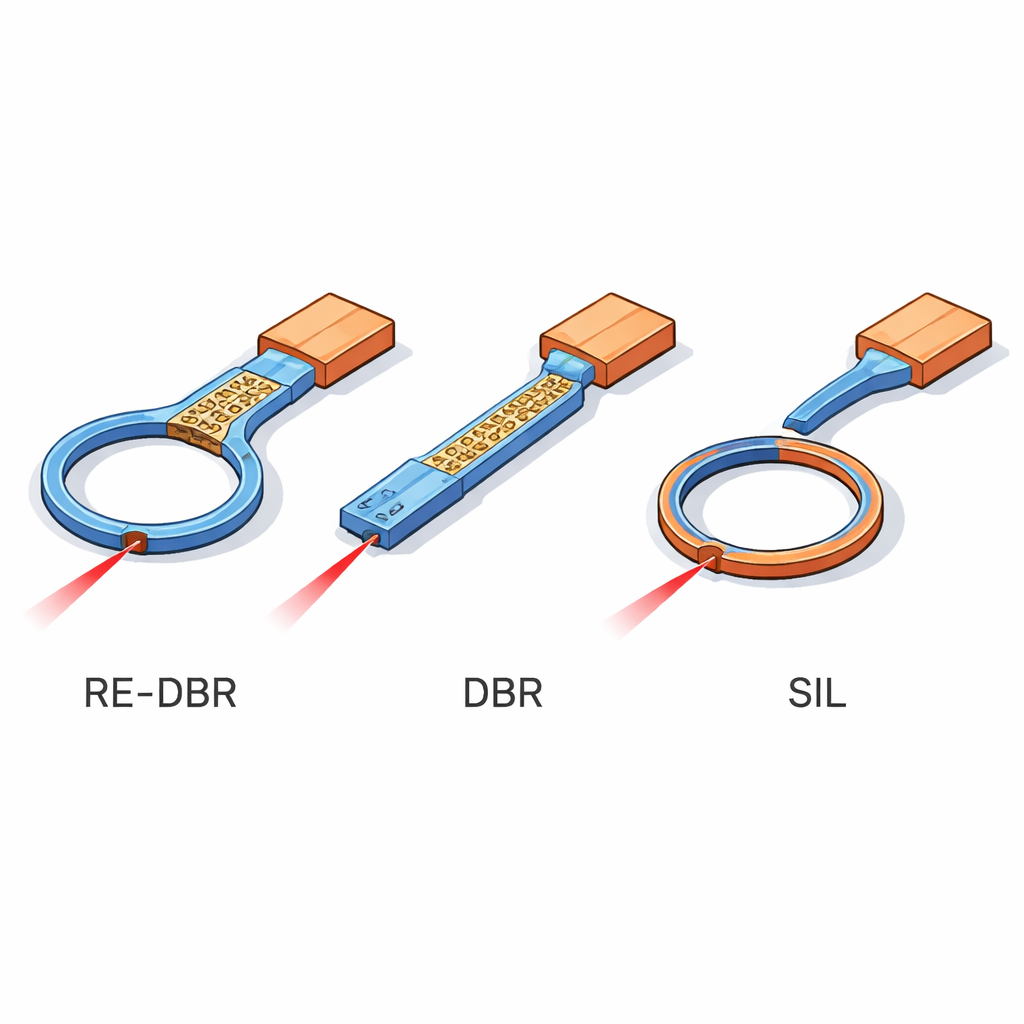
Existing integrated lasers mainly rely on two ideas. One, called a distributed Bragg reflector (DBR) laser, uses a finely patterned mirror to pick out a single color. These can be stable and fairly simple but are limited by a built-in trade-off: shrinking the linewidth usually means making the patterned mirror longer, which makes the device larger and harder to tune efficiently. The other, called a self-injection-locked laser, locks a tiny laser diode to an ultra-high-quality ring resonator, sharply cleaning up its color. While this can yield extraordinarily pure light, the setup is finicky—tiny changes in current or temperature can kick the laser out of its sweet spot, hurting reliability.
A Ring-Boosted Mirror on a Chip
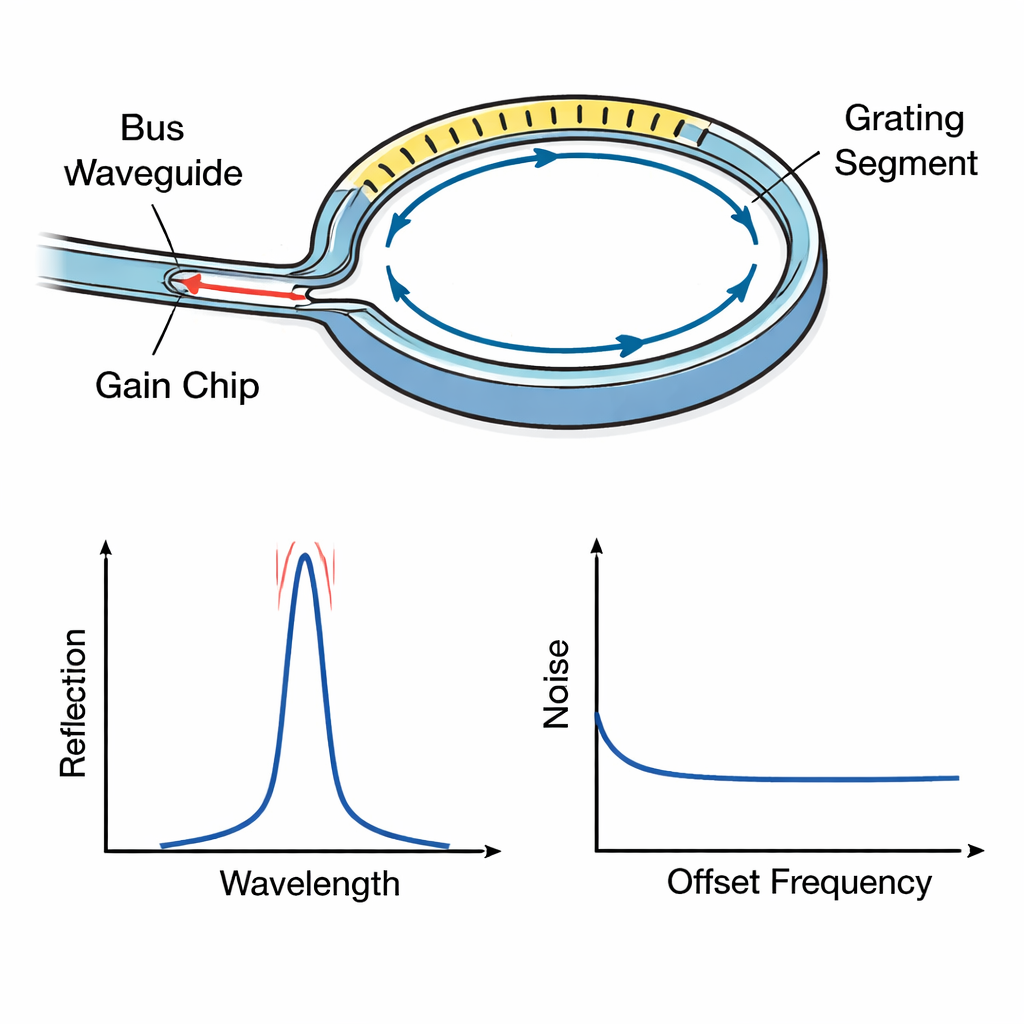
The authors propose and demonstrate a new architecture called a resonator-enhanced distributed Bragg reflector (RE-DBR) laser. Instead of using a long straight patterned mirror, they wrap that mirror around a ring-shaped path on a silicon nitride chip. Light circulates many times around the ring, so the grating acts like a much longer mirror than its physical size suggests. This “resonator enhancement” makes the feedback both stronger and much narrower in color, without needing a large footprint. A separate semiconductor chip provides the optical gain, and is butt-coupled to the ring chip. With only modest ring quality (a loaded Q of 0.56 million), the hybrid device delivers over 22 milliwatts of output power, a side-mode suppression ratio of 60 decibels (very clean single-color operation), an exceptionally narrow 24-hertz intrinsic linewidth, and a continuous tuning range of 34 gigahertz without mode jumps—all while fitting into a few square millimeters.
Stable Tuning Without Jumps
Changing a laser’s color smoothly is crucial for applications like swept-frequency LiDAR and spectroscopy. In many lasers, tuning leads to sudden “mode hops,” where the device abruptly jumps from one allowed color to another. Here, the authors use two tiny heaters on the chip: one on the ring that shifts the reflection peak, and one on a nearby waveguide that keeps the laser’s preferred internal color locked to that peak. By carefully coordinating these heaters, they sweep the laser’s color smoothly over 34 gigahertz with only about 2% fluctuation in power and no jumps. Importantly, they also show that, unlike self-injection-locked lasers, this RE-DBR design maintains its narrow linewidth across a wide range of drive currents and repeated on–off cycles, demonstrating true “turnkey” behavior—just power it up and it works.
What This Could Mean in Practice
To a non-specialist, the key message is that this work brings together the best of both worlds: the low noise of delicate laboratory lasers and the robustness and low cost of semiconductor chips. The RE-DBR approach breaks a long-standing trade-off between purity of color and ease of tuning, without relying on extreme manufacturing tolerances or elaborate control electronics. As the design is refined and adapted to other materials that support faster or wider tuning, it could serve as a compact, integrable light source for faster communication networks, sharper distance measurements in vehicles and drones, and more precise timing and sensing systems—all powered by lasers that are smaller than a grain of rice.
Citation: Yu, D., Geng, Z., Huang, Y. et al. Resonator-enhanced distributed Bragg reflector lasers. Light Sci Appl 15, 142 (2026). https://doi.org/10.1038/s41377-026-02249-x
Keywords: integrated lasers, narrow linewidth, silicon nitride photonics, tunable light source, optical communications