Clear Sky Science · en
Ion-pair pinning on perovskite quantum dots for high-efficiency air-processed light-emitting diodes with Rec. 2020 compliance
Brighter Screens Made in Ordinary Air
Today’s best-looking TVs and phone screens rely on tiny crystals called quantum dots to create vivid, pure colors. But many of the most promising quantum dot materials are so sensitive that they must be made in expensive, oxygen‑free factories. This study shows a clever way to protect one leading type of green-emitting quantum dot so it can be processed in normal air, potentially cutting costs and making ultra‑high‑definition displays more widely accessible. 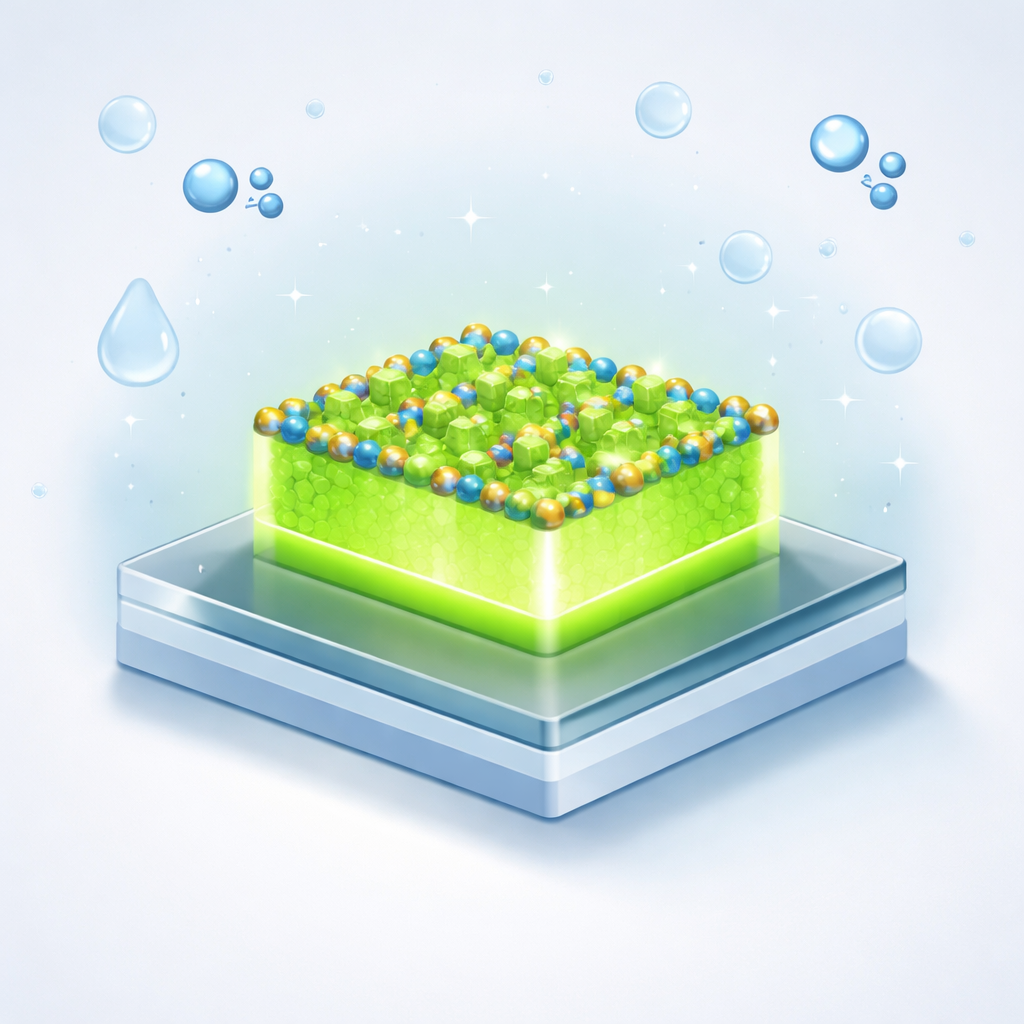
Why Fragile Crystals Limit Future Displays
Perovskite quantum dots are especially attractive for next‑generation displays because they shine very brightly, convert electricity to light efficiently, and emit extremely pure colors that match demanding standards such as Rec. 2020 for high-end TVs. However, one star material, formamidinium lead bromide (FAPbBr3), falls apart when it meets moisture or oxygen in the air. Water molecules tug out part of the crystal’s organic building blocks, and oxygen helps strip key atoms of hydrogen, triggering structural collapse and defects. At the same time, the oily molecules normally used to stabilize the dots are only loosely attached and can easily detach, leaving behind more defects. As a result, manufacturers usually have to process these quantum dots in dry nitrogen, which is costly and difficult to scale.
A Molecular “Armor” for Quantum Dots
The researchers introduce a simple additive—a paired positive and negative ion called tetrabutylammonium triflate—that acts like a molecular armor around each quantum dot. The negative part of this pair forms hydrogen bonds with the organic formamidinium inside the crystal and also latches onto exposed lead atoms, helping to hold the structure together and neutralize reactive sites. The positive part acts like a robust surface anchor, attaching strongly to the outer surface and making it harder for key components to escape or be attacked. Computer simulations and laboratory measurements confirm that this ion pair rearranges the local environment around the dots, guiding them to crystallize into more uniform, better-protected particles. 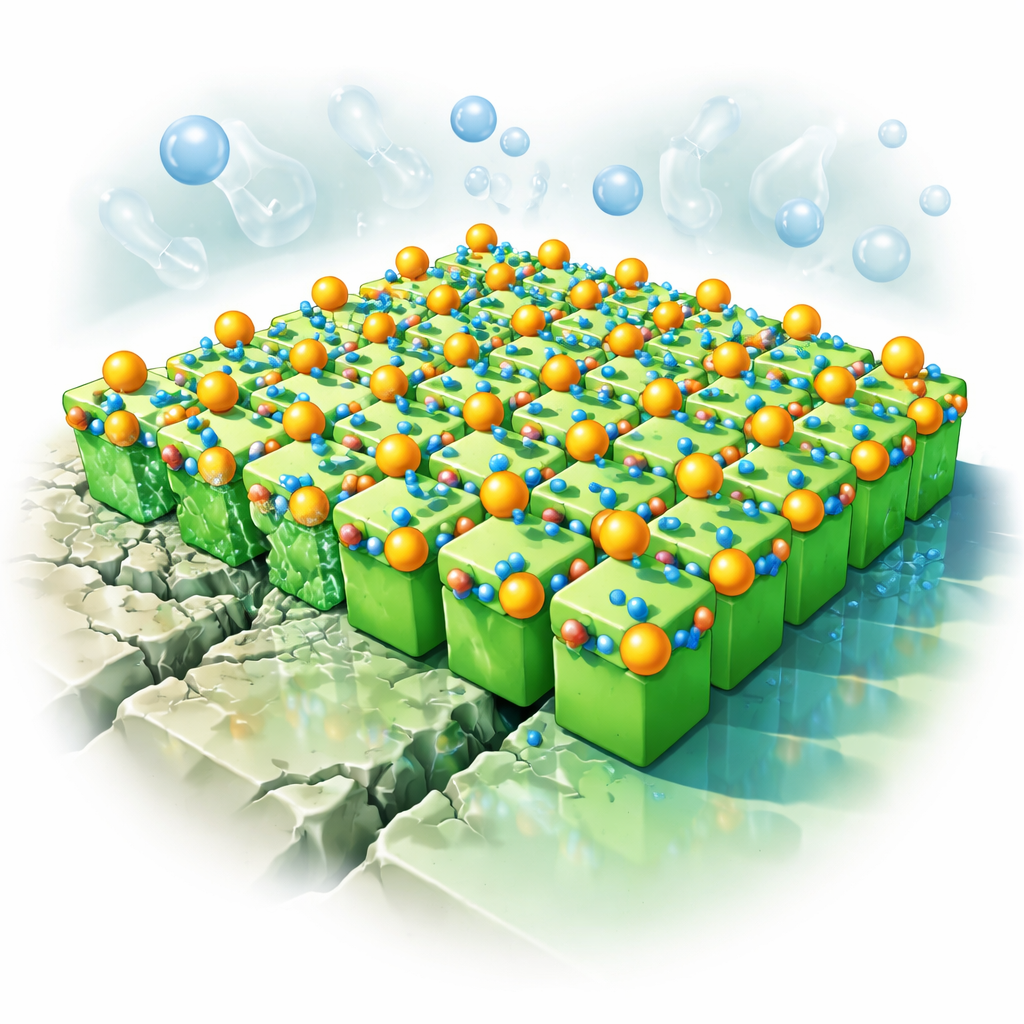
From Unstable Inks to Smooth, Tough Films
With the ion pair present, the quantum dot solutions stay bright and stable instead of quickly fading and clumping. When these solutions are spun into thin films in ordinary air, the protected dots produce smoother, more even layers with fewer holes and rough patches. Optical tests show that these films emit light more sharply and efficiently, with fewer non‑glowing defects where energy is wasted as heat. Surface analyses reveal that the protective ions are firmly attached, reducing the amount of oxygen‑driven damage and blocking the formation of unwanted by‑products. The strengthened crystal lattice also holds excitons—the bound electron–hole pairs that create light—more tightly, which boosts the chance that each injected charge ends up as a photon rather than being lost.
High-Performance Devices Without the Cleanroom
When built into full light‑emitting diodes, the air‑processed, protected quantum dot layers deliver performance that previously required careful nitrogen processing. The green devices reach an external quantum efficiency of 21.3 percent and very high brightness, with color coordinates that satisfy the strict Rec. 2020 green standard used for premium displays. Even under traditional nitrogen fabrication, the same ion‑pair strategy pushes performance further, setting record brightness values for this material and making the devices last significantly longer before dimming. This shows that the approach not only enables low‑cost, ambient processing but also improves the underlying material quality in any environment.
What This Means for Everyday Technology
In simple terms, the team has found a way to “pin” fragile quantum dots in place using a smart combination of ions, turning them from delicate lab curiosities into robust building blocks for real products. By allowing high‑quality perovskite quantum dot LEDs to be fabricated in normal air while still meeting top-tier color and efficiency targets, this ion‑pair pinning method brings us closer to brighter, more energy‑efficient, and more affordable displays and lighting based on perovskite technology.
Citation: Cui, Y., Zhu, D., Chen, J. et al. Ion-pair pinning on perovskite quantum dots for high-efficiency air-processed light-emitting diodes with Rec. 2020 compliance. Light Sci Appl 15, 151 (2026). https://doi.org/10.1038/s41377-026-02247-z
Keywords: perovskite quantum dots, light-emitting diodes, display technology, materials stability, air processing