Clear Sky Science · en
Highly efficient and ultrahigh-resolution quantum dot light-emitting diodes via photoisomeric transformation
Sharper Screens for the Next Wave of Displays
Imagine virtual reality headsets, smart glasses, and ultra‑compact projectors whose screens are so sharp that individual pixels are far smaller than a grain of dust, yet still bright and energy‑efficient. This study presents a clever light‑driven chemistry that helps build such extreme‑resolution, full‑color pixels from quantum dots—tiny crystals that glow brilliantly—without sacrificing their brightness or durability.
Why Tiny Light Pixels Are Hard to Make
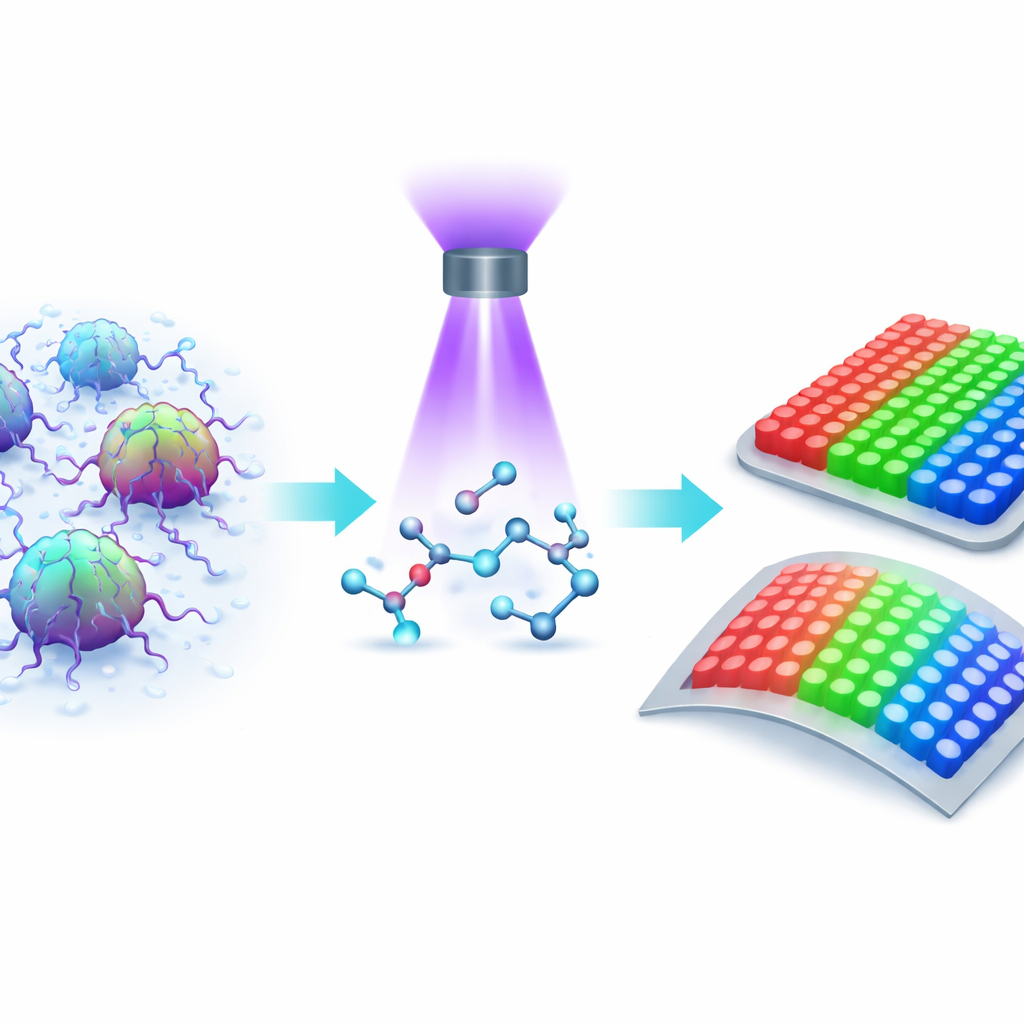
Quantum dots are already used to boost color and brightness in high‑end televisions. They shine in pure reds, greens, and blues, can be processed from liquid inks, and convert electricity to light efficiently. But turning a uniform quantum dot coating into finely patterned pixels—thousands of dots packed into each inch—has been a stubborn challenge. Conventional patterning techniques often involve harsh chemicals or extra layers that damage the dots, blur the pixel edges, reduce brightness, or make it hard for electrical charges to reach the dots. As devices like near‑eye and 3D displays demand pixel densities well above 2000 pixels per inch, these drawbacks become show‑stoppers.
Using Light to Rearrange the Molecular Shell
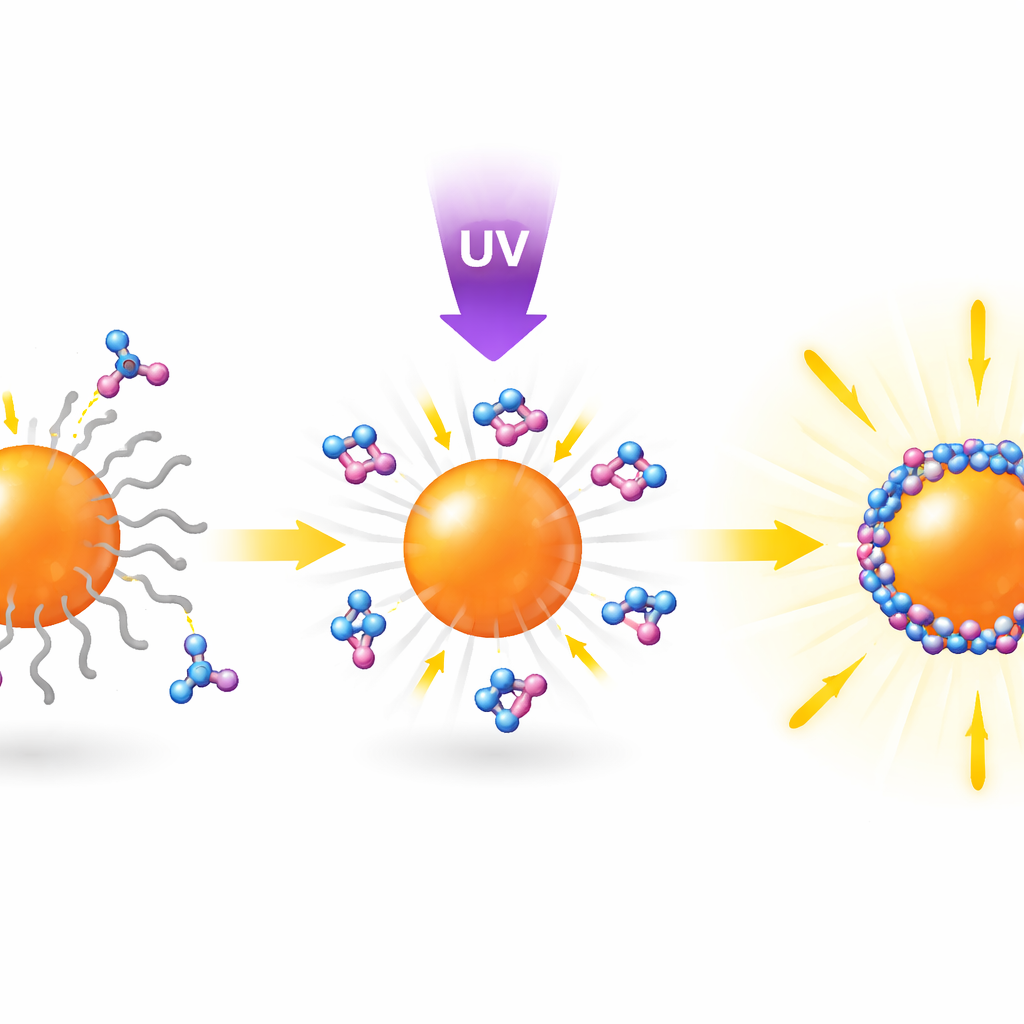
The authors tackle this by redesigning the thin molecular shell that coats each quantum dot. Normally, the dots are wrapped in long oily molecules that keep them dispersed in solvents but make it difficult to form robust patterns. The team adds a special light‑responsive molecule, which quietly coexists with the dots until they shine ultraviolet light on the film through a patterned mask. The light flips this molecule into a new shape that binds much more strongly to specific atoms on the dot surface. In doing so, it helps dislodge some of the original long chains and replaces them with a tighter, more compact shell. This change makes the exposed regions of the film insoluble, so they stay in place while the unexposed parts wash away, leaving behind crisp quantum dot patterns.
Turning Lost Brightness into Extra Glow
A key twist is how the researchers prevent a common side effect: dimming. When quantum dots lose parts of their original coating or sit near certain molecules, excited energy can leak away instead of being emitted as light. Here, the light‑triggered molecules initially quench the glow by siphoning off energy. But as more of them bind tightly to the dot surface under continued UV exposure, their light‑absorbing behavior shifts. The energy “handoff” channel between dot and molecule effectively shuts down, and the dots’ brightness not only recovers but surpasses the original. Measurements show that these patterned films can reach photoluminescence efficiencies higher than the unpatterned starting films, thanks to both the blocked energy leakage and extra healing of tiny surface defects on the dots.
Microscopic Pixels with Full‑Color Freedom
With this chemistry in hand, the team demonstrates just how far they can push pixel design. They create stripes, circles, crescents, and other intricate shapes from red, green, and blue quantum dots with almost perfect fidelity to the mask design. Most impressively, they achieve pixel sizes down to about 0.8 micrometers—corresponding to an extraordinary 15,800 pixels per inch—far beyond today’s consumer displays. The method works not only for traditional cadmium‑based quantum dots, but also for fragile perovskite dots and on both rigid glass and flexible plastic films. Multicolor arrays and large, detailed images can be built up by repeating the exposure and development steps with different quantum dot colors.
From Lab Patterns to Real Light‑Emitting Devices
To prove this is more than a patterning trick, the researchers build complete light‑emitting diodes using these patterned quantum dot layers as the active light source. In these devices, electrons and holes are injected from opposite sides and meet inside the patterned pixels, where they recombine to produce light. The resulting red quantum dot devices, with pixel densities of thousands of pixels per inch, reach record‑level efficiencies—converting nearly a quarter of incoming electrons into photons—while also delivering very high brightness. Similar devices made from green perovskite dots also perform among the best reported for pixelated versions of this material, underscoring the broad usefulness of the strategy.
What This Means for Future Displays
In simple terms, this work shows that shining patterned UV light onto a smartly formulated quantum dot film can both carve out ultrafine pixels and make them shine even more efficiently. By carefully orchestrating how molecules rearrange on the dot surface, the authors avoid the usual trade‑off between tiny pixels and bright, stable emission. While scaling the process to mass production and ensuring long‑term durability remain important next steps, the approach points directly toward the kinds of ultra‑sharp, energy‑frugal displays needed for next‑generation virtual reality, wearables, and other compact visual technologies.
Citation: Wu, C., Luo, C., Huo, Y. et al. Highly efficient and ultrahigh-resolution quantum dot light-emitting diodes via photoisomeric transformation. Light Sci Appl 15, 157 (2026). https://doi.org/10.1038/s41377-026-02246-0
Keywords: quantum dot displays, ultrahigh resolution pixels, direct photopatterning, light-emitting diodes, perovskite quantum dots