Clear Sky Science · en
Tunable structured laser over full spatial spectrum
Shaping Light Like Never Before
Lasers usually shine as smooth, featureless beams, but many of today’s most exciting technologies—quantum communication, ultra‑precise sensing, and advanced microscopy—need light whose brightness varies in intricate patterns across the beam. This paper reports a practical laser that can be tuned to produce almost any such pattern directly from the source, rather than sculpting it afterwards with extra optics. It is a step toward “do‑anything” lasers that let engineers and scientists dial in exactly the shape of light they want.
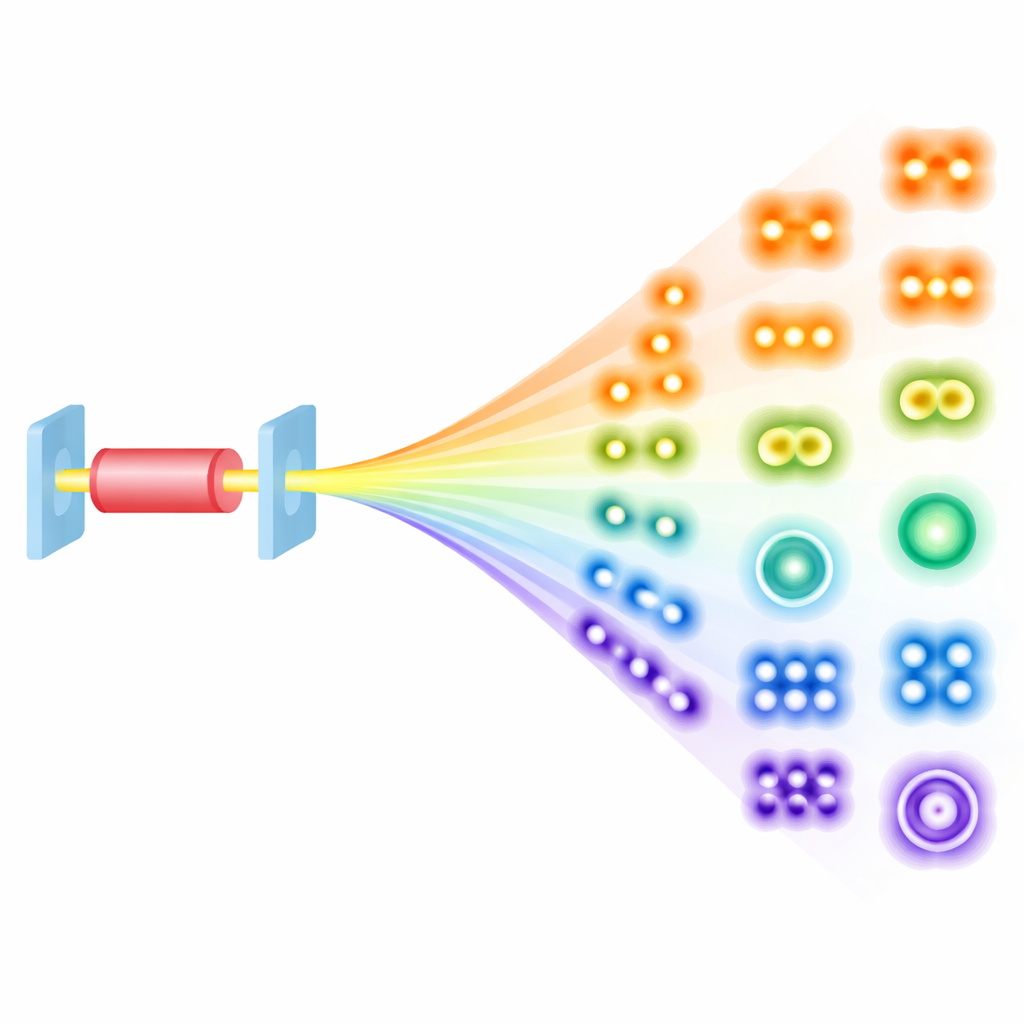
From One Kind of Tuning to Another
Conventional tunable lasers are built to adjust color, or more precisely, optical frequency. For decades, engineers have learned how to favor one color at a time inside a laser cavity by tweaking its internal geometry and how it bends light of different wavelengths. The beam’s cross‑section, however, is typically kept in the simplest possible form—a single bright spot—because this makes controlling the color easier and the devices more efficient. As interest has grown in “structured light,” where the brightness and phase vary in complex ways across the beam, researchers have started to ask a different question: can we tune not just the color, but also the transverse pattern of the light in a controlled and flexible way?
Why Spatial Patterns Matter
The transverse patterns of a laser beam can be organized into families of well‑defined shapes, such as Hermite‑Gauss and Laguerre‑Gauss modes. These include beams that carry optical orbital angular momentum, sometimes visualized as corkscrewing light. Each pattern can serve as a separate channel of information, a distinct probe for imaging, or a tailored tool for interacting with atoms, molecules, or tiny particles. Until now, however, no commercial laser could reliably generate every single allowed pattern as a clean, single mode over a broad range. Existing designs often required complicated pump shaping and still struggled to suppress unwanted patterns that crept into the beam.
Combining Off‑Axis Pumping and Subtle Asymmetry
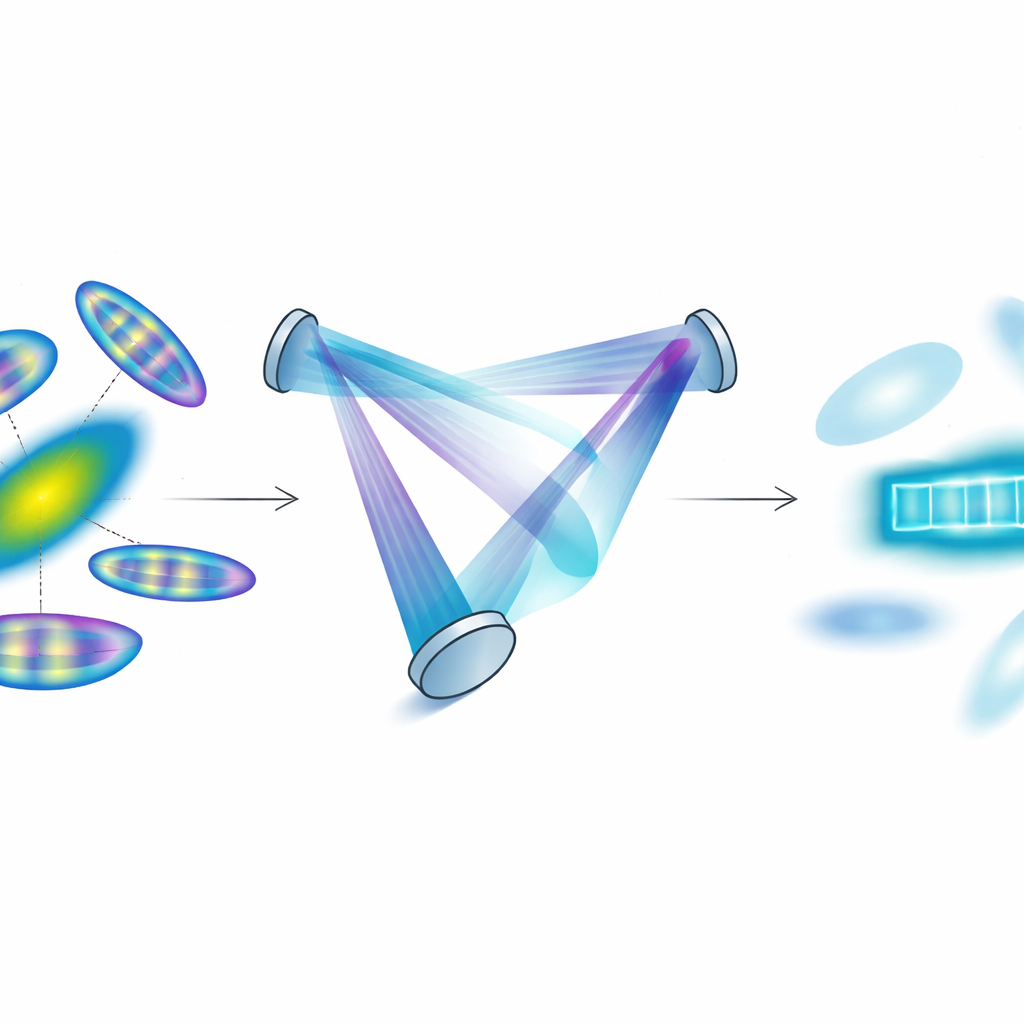
The authors’ key insight is to marry two physical tricks inside the laser cavity. First, they shift the pump beam—the light that excites the gain crystal—slightly away from the cavity’s center. This off‑axis pumping naturally favors patterns whose brightest regions overlap the displaced pump spot, giving them a head start in the race to reach lasing threshold. On its own, however, this method creates competition between different patterns that share similar bright spots, particularly between one‑dimensional stripe‑like modes and fully two‑dimensional grid‑like modes, limiting tunability. To break this deadlock, the team introduces a controlled astigmatism: the cavity focuses light slightly differently in the horizontal and vertical directions. This tiny built‑in asymmetry causes many unwanted patterns to morph as they bounce back and forth, losing their good overlap with the pump, while the chosen pattern periodically “revives” in the right orientation and keeps its gain.
A Laser That Covers the Full Pattern Map
Using a V‑shaped cavity at a wavelength of 1064 nanometers, the researchers demonstrate that by simply sliding the pump spot sideways and up or down inside the crystal, they can reliably select any desired two‑dimensional Hermite‑Gauss pattern within the system’s spatial bandwidth. In practice, they access more than 40,000 distinct modes, reaching very high orders where the beam is divided into hundreds of bright lobes. Careful measurements of both the brightness and phase across the beam show that these patterns are extremely pure, closely matching the ideal mathematical shapes. Outside the cavity, a compact set of additional optics can smoothly convert these patterns into Laguerre‑Gauss and more general “hybrid” modes, effectively filling out an entire three‑dimensional map of possible laser beam structures.
What This Means for Future Technologies
To a non‑specialist, the achievement can be viewed as giving lasers a finely graduated “pattern dial” that was missing before. Instead of building a different laser or bulky add‑on optics for each new beam shape, a single compact device can be tuned to produce almost any pattern within a huge library, and do so with high quality and without jumping unpredictably between patterns. This opens the door to practical, off‑the‑shelf structured lasers for applications from high‑capacity data links that use many spatial channels, to microscopes that tailor light to biological samples, to precision manipulation of microscopic objects. Because the method relies only on pump positioning and a cleverly designed cavity, it is well suited to commercialization and adaptation to other nonlinear light sources, hinting at a future in which fully programmable light fields are routine tools in science and technology.
Citation: Sheng, Q., Geng, JN., Jiang, JQ. et al. Tunable structured laser over full spatial spectrum. Light Sci Appl 15, 169 (2026). https://doi.org/10.1038/s41377-026-02243-3
Keywords: structured light, tunable laser, spatial modes, orbital angular momentum, Hermite-Gauss beams