Clear Sky Science · en
Making UV light visible by exciting polarization-gate phototransistor to achieve energy transfer into GaN-based blue emission
Turning Invisible Rays into Visible Warnings
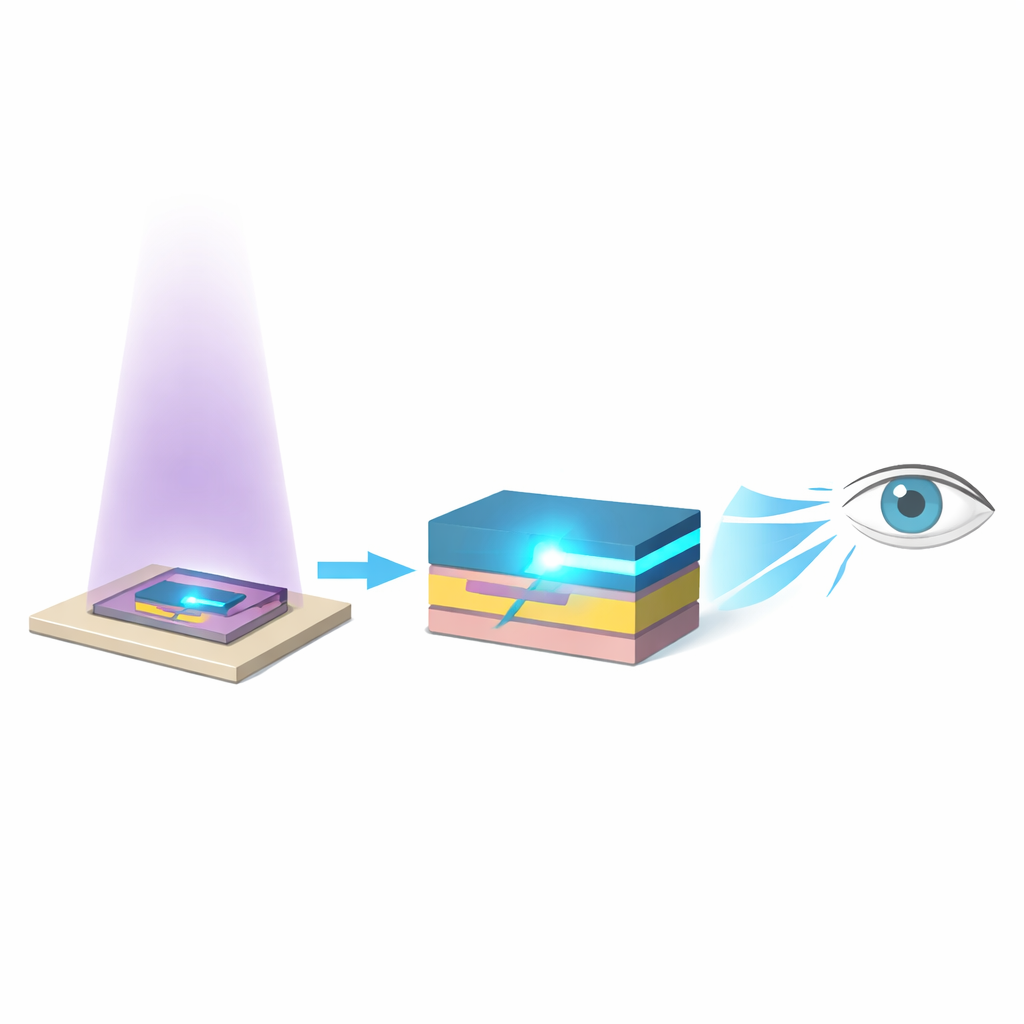
Ultraviolet (UV) light is a double-edged sword: it helps disinfect water and air and supports many modern technologies, yet it can quietly damage our eyes and skin long before we notice anything is wrong. This paper presents a tiny chip that acts like an electronic “translator,” converting invisible UV light into bright blue light that our eyes can easily see. Such a device could serve as a built-in warning signal in everyday objects, alerting people whenever potentially harmful UV light is present.
Why We Need to See Hidden Light
UV light is widely used in sterilization, medical sensing, and communications, but because our eyes cannot see it, we have no natural way to judge when the exposure is getting too strong. Traditional UV detectors turn incoming rays into electrical current, which then must be read by external electronics or displays. That is fine for instruments, but less ideal for quick, intuitive, human-friendly warnings. The authors of this study set out to build a single, simple chip that not only senses UV radiation but directly turns it into visible blue light bright enough to be noticed by the naked eye, acting as a self-contained “UV-to-visible” alert pixel.
How the Smart Light Chip Is Built
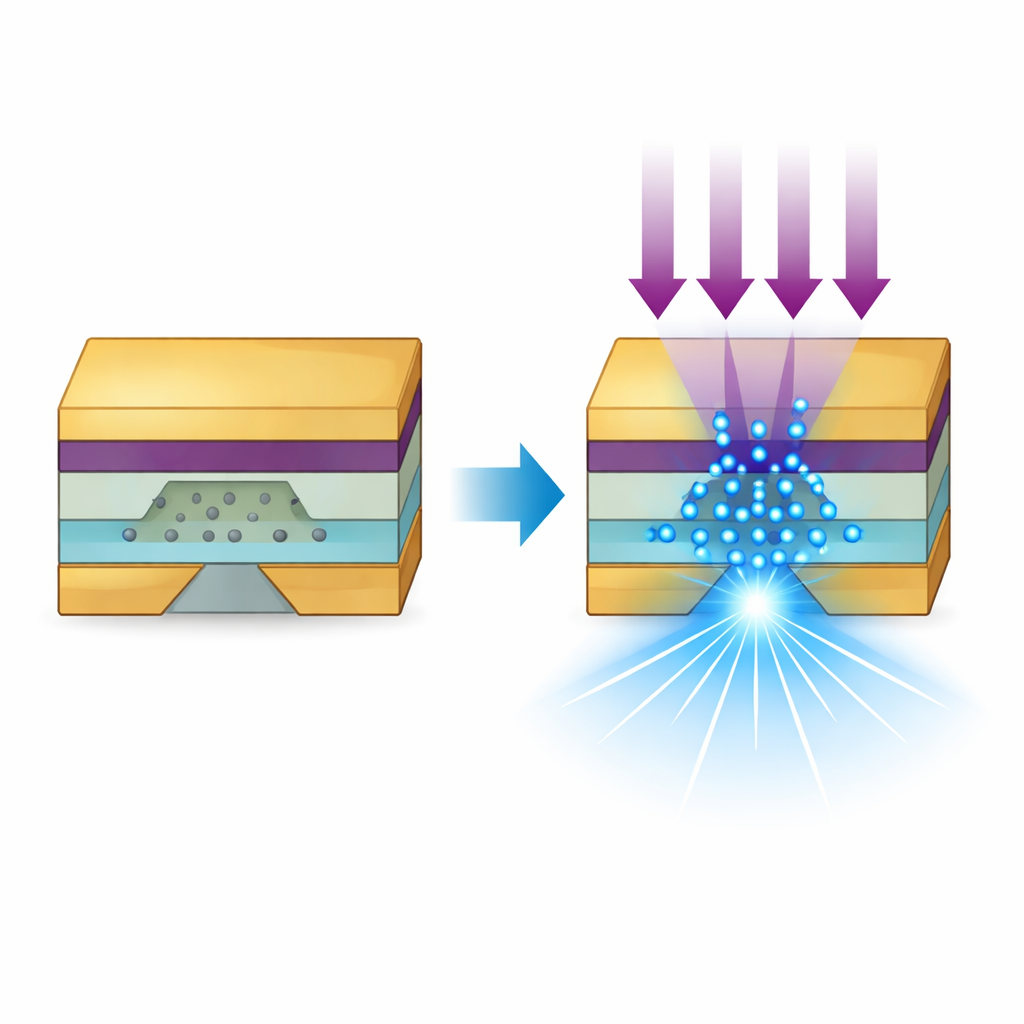
The device combines two main parts grown together on a sapphire wafer: a tiny blue light-emitting diode (mini-LED) and a special UV-sensitive transistor. Both are made from gallium nitride–based materials, which are already common in commercial blue and UV LEDs. The transistor includes a carefully engineered stack of layers where the crystal structure naturally creates built-in electric charges at one internal boundary. These charges deplete the background electrons in a key region, effectively shutting off the path for current when the device sits in the dark. Cleverly, this “polarization gate” replaces a separate control electrode, so the whole system needs only two terminals, like a simple LED, making it easier to drive and integrate.
How Invisible Rays Switch On Blue Light
When no UV light shines on the chip, the polarization gate keeps the transistor in an off state, and almost no current can reach the blue mini-LED. Even if a voltage of 10 volts is applied, the current stays extremely low and the blue emission is essentially undetectable. Once UV light, centered around a wavelength of 305 nanometers, hits the transistor region through a transparent insulating layer, it generates extra electrons and holes in that area. These photogenerated charges weaken the internal electric field that had been blocking the current. As a result, a conductive channel forms, current surges through the device, and the blue mini-LED lights up strongly around 460 nanometers. With 12.7 milliwatts of incoming UV power, the output blue light reaches about 81.1 milliwatts, corresponding to nearly fifty times more visible photons than incoming UV photons.
How Well the Device Performs in Practice
The researchers carefully measured how the chip behaves electrically and optically. They found that the dark current without UV remains extremely small, helping the detector distinguish weak UV signals from background noise. Under UV illumination, the current increases by several orders of magnitude, and the device’s resistance drops dramatically, confirming that the transistor is being switched on by the light. The team also tested the response to short UV pulses: after a brief delay of about 0.08 seconds, the current and blue emission rise, creating a clear visual cue. The device can also respond to deeper UV wavelengths (255 and 275 nanometers), which are even more energetic and potentially hazardous, though the minimum detectable power is still in the milliwatt range.
Looking Ahead to Wearable and Everyday Uses
From a user’s perspective, the most important outcome is that weak UV light can now be “seen” directly as bright blue light, without needing extra readout electronics. Because the polarization gate is built into the material itself, the chip keeps a simple two-terminal layout, reducing complexity and making it attractive for future integration into flexible or wearable platforms. The authors argue that such devices could one day be embedded in goggles, clothing, or surfaces to warn people in real time about unsafe UV exposure, and might even be adapted for simple light-based communication between UV and visible signals.
Citation: Chu, C., Jiang, Y., He, C. et al. Making UV light visible by exciting polarization-gate phototransistor to achieve energy transfer into GaN-based blue emission. Light Sci Appl 15, 162 (2026). https://doi.org/10.1038/s41377-026-02242-4
Keywords: UV detection, gallium nitride, mini-LED, phototransistor, wearable light sensor