Clear Sky Science · en
Superextensive electrical power from a quantum battery
Turning Faint Light into Extra Power
Imagine a solar cell that not only charges up faster as you make it bigger, but also delivers more power per unit of material instead of less. This is the promise of a new kind of “quantum battery” demonstrated in this work. By carefully trapping light between mirrors and letting it interact collectively with special dye molecules, the researchers show that they can squeeze more electrical power out of weak, everyday light than ordinary devices would allow.
A Tiny Power Plant Made of Layers
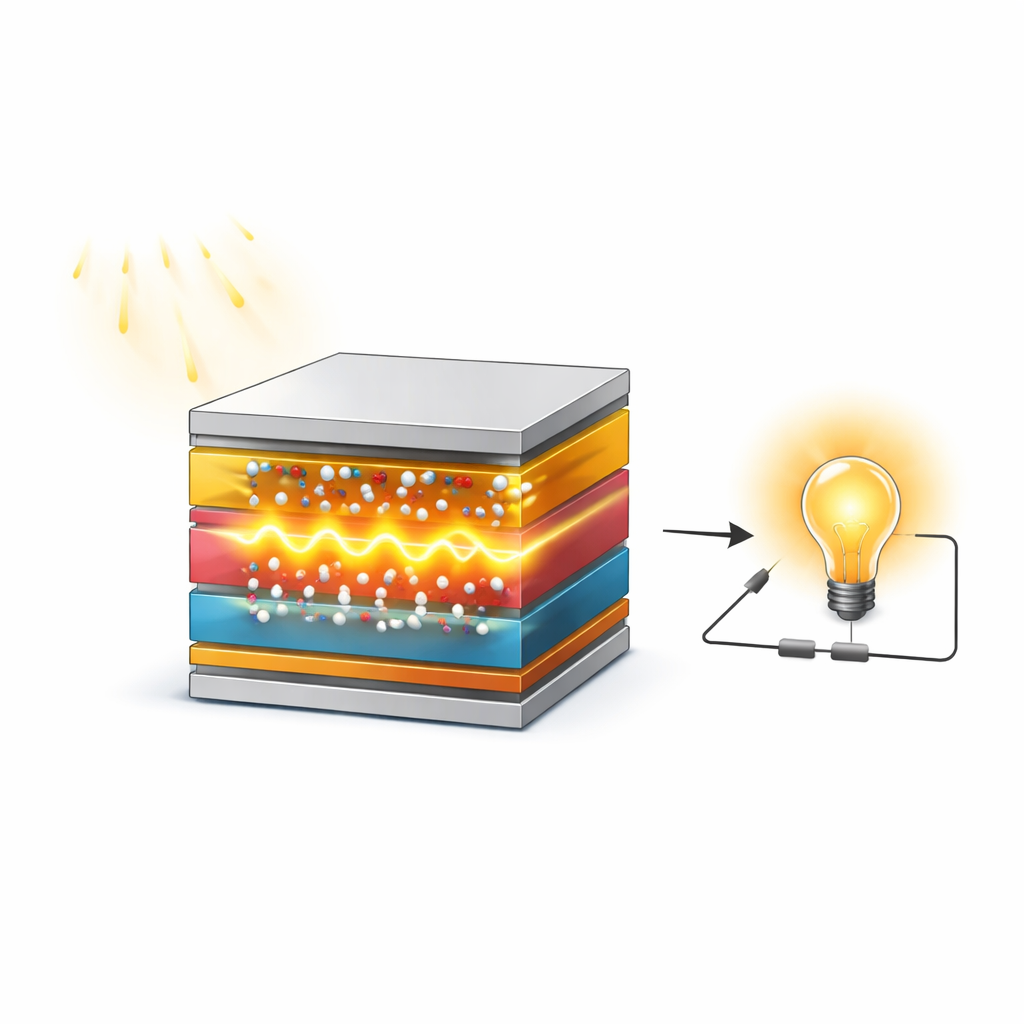
At the heart of the device is a microscopic sandwich of thin layers built inside a reflective cavity. Two silver mirrors form the top and bottom of the structure, and between them sit several organic materials that control how charges move. One key ingredient is a dye molecule called copper phthalocyanine, paired with fullerene molecules that help pull charges apart. When light enters this cavity, it bounces back and forth between the mirrors and interacts so strongly with the dye molecules that light and matter merge into new hybrid states. These hybrids, called polaritons, behave differently from either bare light or bare molecules, and they are crucial to the battery’s unusual performance.
Crowd Power from Quantum Effects
In a normal solar cell, doubling the number of absorber molecules simply doubles the energy it can handle, at best. In this quantum battery, the story is different. Because the cavity couples collectively to many molecules at once, the interaction strength grows faster than the number of molecules itself. Using ultrafast laser pulses, the authors show that as they increase the number of dye molecules in the cavity, the rate at which the device stores energy and the energy stored per molecule both rise more than proportionally. At the same time, the charging time actually shrinks. This “superextensive” behavior—where performance improves faster than size—has long been predicted for quantum batteries, but rarely observed in practice.
Parking Energy for Later Use
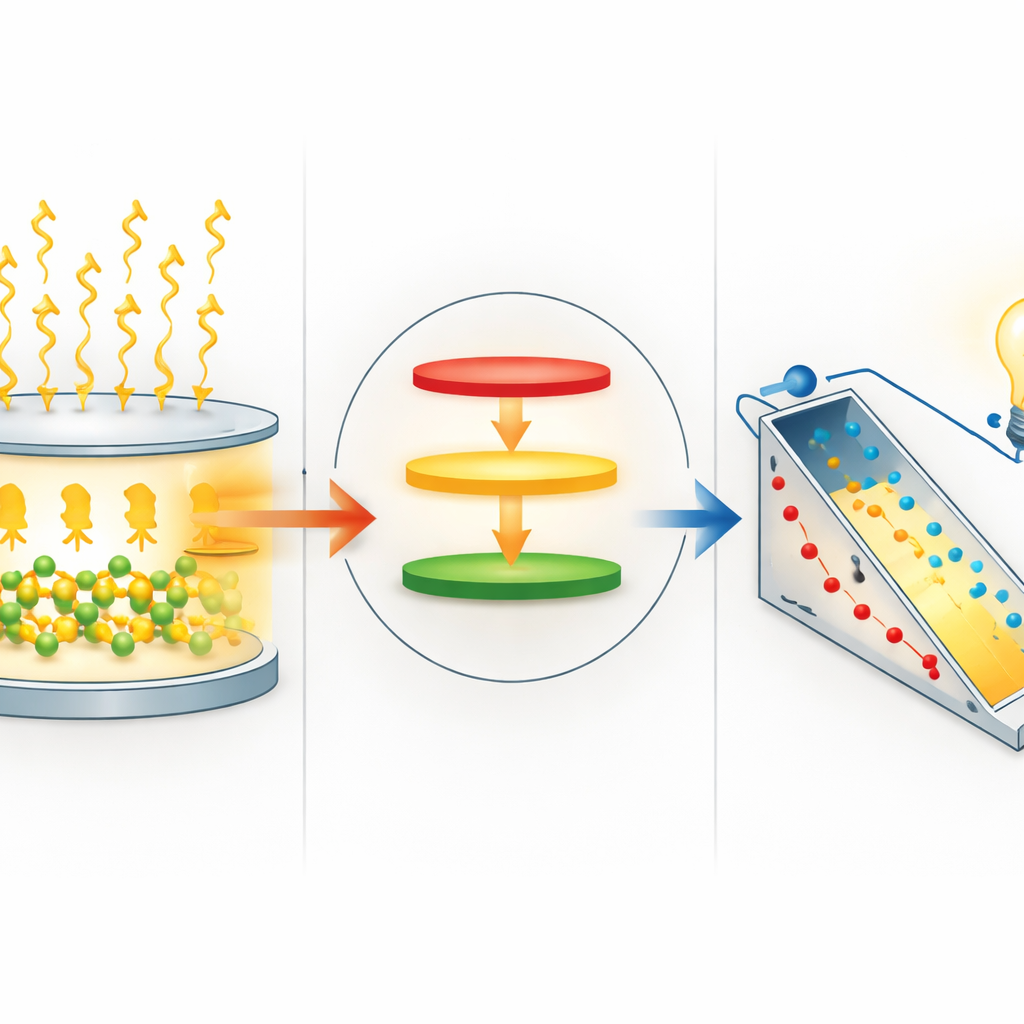
Charging quickly is only half the job; the stored energy must also last long enough to be useful. After polaritons are excited, the energy does not immediately leak away as light. Instead, it flows into a lower-lying “triplet” state inside each dye molecule. This state is harder to empty because flipping the electron’s spin is forbidden by simple rules of quantum mechanics, so the energy becomes trapped for tens of billionths of a second—around a million times longer than the charging pulse. While still short compared with chemical batteries, this extended lifetime is vastly longer than the tiny fractions of a trillionth of a second over which the device charges, and it is far better than earlier room‑temperature quantum batteries based on similar cavities.
From Stored Light to Flowing Current
The final step is turning that parked energy into useful electrical work. The layered structure of the device is designed like a downhill track for charges: once the triplet state is populated, electrons and holes can separate at the interface between the dye and the fullerene layer, then move in opposite directions through dedicated transport layers. When the researchers shine steady, low‑intensity light on the device, they measure a current and a power output that beat otherwise identical control devices lacking one of the cavity mirrors. More strikingly, as they scale up the number of dye molecules, the electrical power produced by the cavity devices grows faster than linearly, while the controls do not. This means the quantum battery’s discharge power is also superextensive, a behavior not previously predicted for continuous electrical output.
Why This Quantum Battery Matters
In everyday terms, this work shows that carefully engineered quantum effects can make small, thin devices gather and deliver energy more efficiently, especially under dim or diffuse light where conventional solar cells struggle. By combining rapid collective charging, long‑lived storage, and enhanced electrical output in one platform, the authors demonstrate a full charge–hold–discharge cycle for a quantum battery operating at room temperature. While not ready to replace household batteries, this approach points toward future energy harvesters and always‑charging power sources that exploit the strange rules of quantum physics to do more with less light.
Citation: Hymas, K., Muir, J.B., Tibben, D. et al. Superextensive electrical power from a quantum battery. Light Sci Appl 15, 168 (2026). https://doi.org/10.1038/s41377-026-02240-6
Keywords: quantum battery, microcavity, superabsorption, exciton-polariton, energy harvesting