Clear Sky Science · en
Compact and programmable large-scale optical processor in free space
Light Circuits Without the Chip
Modern technologies from the internet to quantum computers increasingly rely on light to carry and process information. Most photonic circuits today are built on chips, where light is confined inside tiny waveguides. This paper explores a very different route: performing powerful optical computations in free space, using only a few flat programmable screens. For a general reader, the appeal is clear: it points toward lighter, more flexible "light processors" that can be reprogrammed like software, yet still tackle problems in advanced computing and quantum simulation.
Turning Flat Screens into Light Processors
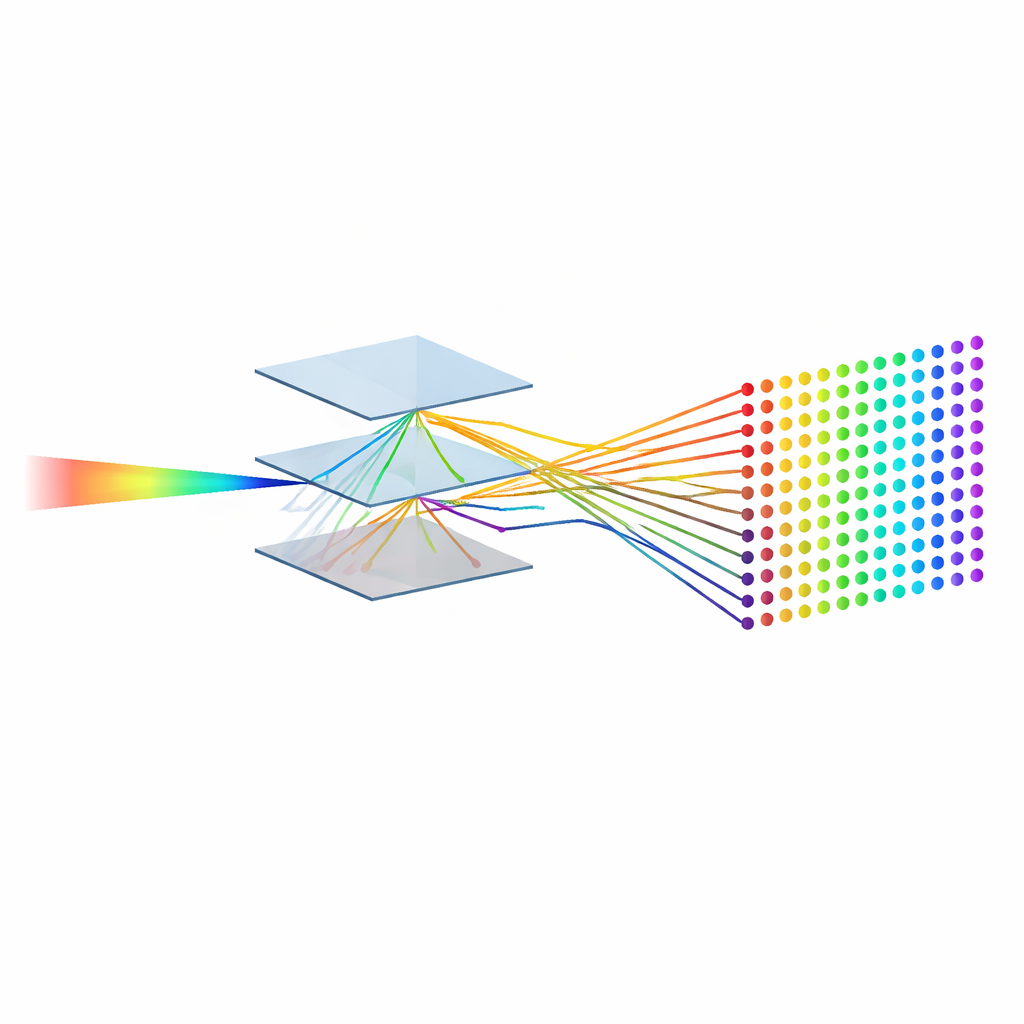
The researchers show how to build a compact optical processor using three liquid-crystal spatial light modulators, devices that look a bit like high-end projector panels. Instead of guiding light down narrow tracks, they let a broad beam travel freely while its properties are nudged and twisted at each layer. Information is stored in the detailed pattern of the light beam: its circular polarization (the direction in which the electric field spins) and its tiny sideways momenta, which correspond to a grid of spots in the beam’s cross-section. By carefully programming the three modulators, the team can implement complex, mathematically exact transformations that would normally require dozens or hundreds of separate optical components.
Simulating Quantum Walks on a Flat Table
To test what their processor can do, the authors focus on a family of processes called quantum walks. These are the quantum cousins of random walks, in which a particle explores a grid of positions step by step. Unlike a drunkard’s walk, a quantum walker spreads ballistically: its probability distribution fans out much faster thanks to interference between different paths. In this setup, each possible position on the lattice is represented by a distinct light spot in the focal plane of a lens, and the internal “coin” that drives the walk is encoded in light’s circular polarization. With a single input beam and a fixed three-layer hardware layout, the team reprograms the modulators so that the same physical device can perform the effect of up to 30 time steps of a one- or two-dimensional quantum walk in a single shot, distributing light over more than 7,000 output modes.
Watching Disorder, Fields, and Topology in Action
Because the platform is fully programmable, the authors can go beyond simple spreading and explore richer scenarios that mirror complex materials. By randomly varying the effective step of the walk over time, they create different levels of “temporal disorder” and directly watch the transition from fast quantum spreading to slower, diffusion-like behavior, all by analyzing how the pattern of light spots widens. They also mimic the effect of a constant electric field on a charged particle by subtly shifting their programmed pattern at each step, causing the walker distribution to periodically refocus in a signature known as Bloch oscillations. Even more intriguingly, they probe the hidden topological properties of the simulated systems—global features that remain robust against many imperfections. By separating the two circular polarization components and tracking a quantity called the mean chiral displacement, they extract an integer “winding number” that labels distinct topological phases. In a two-dimensional, graphene-like model, they go further and map out the so-called quantum metric, a geometric measure of how sensitively the system responds to changes, by scanning through different momenta with the same optical hardware.
From Classical Beams to Single Photons
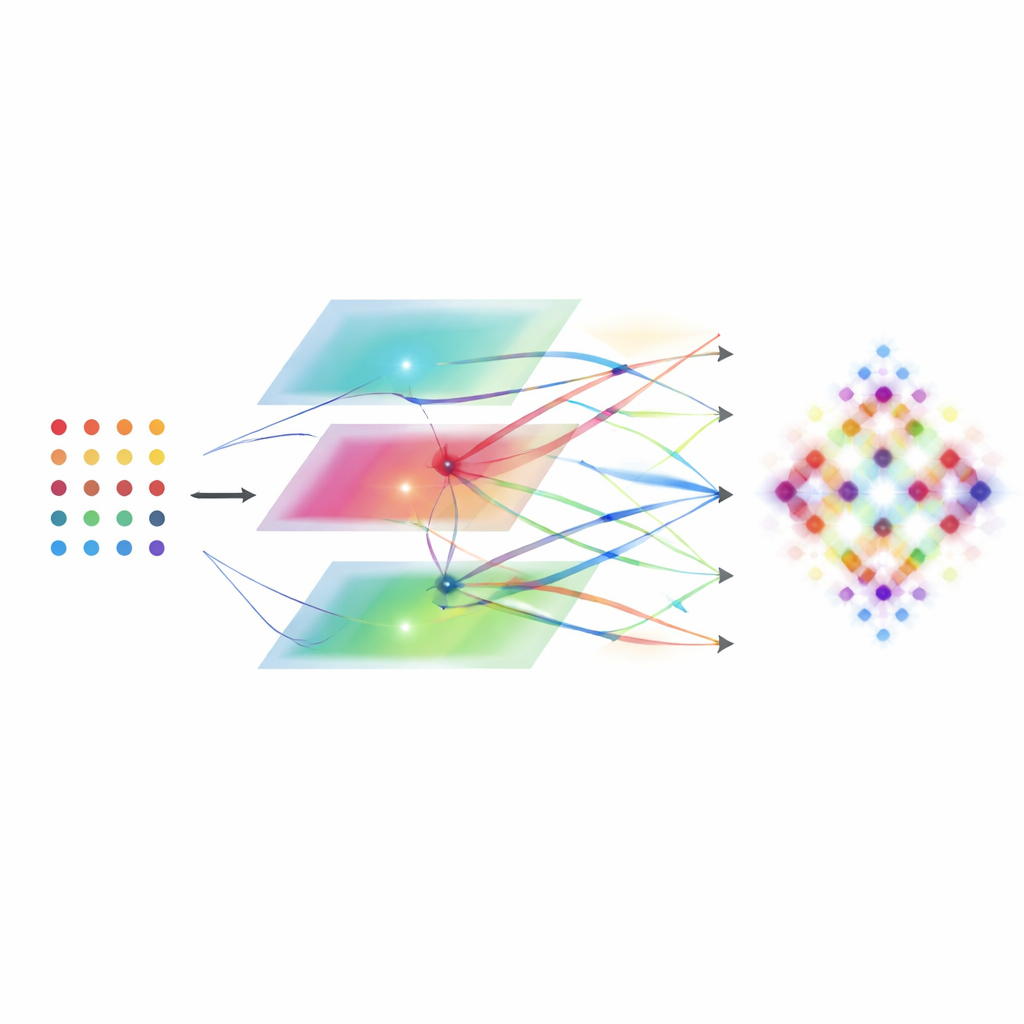
All of these demonstrations are first carried out with a conventional laser, where the brightness of each spot reflects the probability distribution of a quantum walker. To show that the platform is ready for genuine quantum experiments, the team replaces the laser with a source of entangled photon pairs. One photon serves as a herald, confirming that its partner is present, while the other enters the three-layer processor. Using a fast, time-resolved camera, they register coincident detections and reconstruct the same quantum-walk patterns at the single-photon level. The close match to theory and to the laser-based data indicates that the device preserves delicate quantum superpositions across thousands of modes, despite involving multiple reflections and complex polarization control.
Why This Matters for the Future of Photonics
In simple terms, this work shows that a handful of programmable optical elements in free space can stand in for a deep, intricate photonic circuit, without paying an extra price in loss as the simulated process grows more complex. By exploiting an analytical “inverse design” method, the required patterns for the modulators can be computed directly rather than painfully optimized. The result is a compact, reconfigurable light processor capable of realizing large-scale quantum walks, exploring disorder and synthetic fields, and accessing subtle topological and geometric properties—all within the same hardware. For future technologies, this suggests a practical path toward versatile, high-dimensional optical processors that can switch roles on demand, from quantum simulators to advanced classical and quantum information tools, simply by loading new patterns onto three flat screens.
Citation: Ammendola, M.G., Dehghan, N., Scarfe, L. et al. Compact and programmable large-scale optical processor in free space. Light Sci Appl 15, 179 (2026). https://doi.org/10.1038/s41377-026-02236-2
Keywords: free-space photonics, quantum walks, spatial light modulators, topological photonics, quantum simulation