Clear Sky Science · en
High-dimensional multiplexing through vortex electromagnetic wave manipulation by space-time-coding metasurfaces
Why many data streams need a new highway
Our phones, homes, and cities are all demanding more wireless data, but the airwaves they use are limited. This paper explores a clever way to pack far more information into the same slice of spectrum by teaching radio waves to twist like tiny tornadoes and by controlling these twists with an ultrathin electronic surface. The result is a compact transmitter that can send many independent data streams at once, pointing to future short-range links that are faster and more efficient.
Twisting waves as extra data lanes
Light and radio waves can carry not only color (frequency) and vibration direction (polarization), but also a kind of twist known as orbital angular momentum, or OAM. A beam with OAM has a corkscrew-shaped wavefront and a doughnut-shaped intensity pattern. Different twist orders act like separate, non-interfering channels that can, in principle, be stacked on top of one another along the same line of sight. Until now, however, devices that create such vortex beams have mostly been static and bulky, and each extra twist channel usually needed its own dedicated radio hardware, making real systems complex and power-hungry.
A paper-thin surface that reshapes waves in time
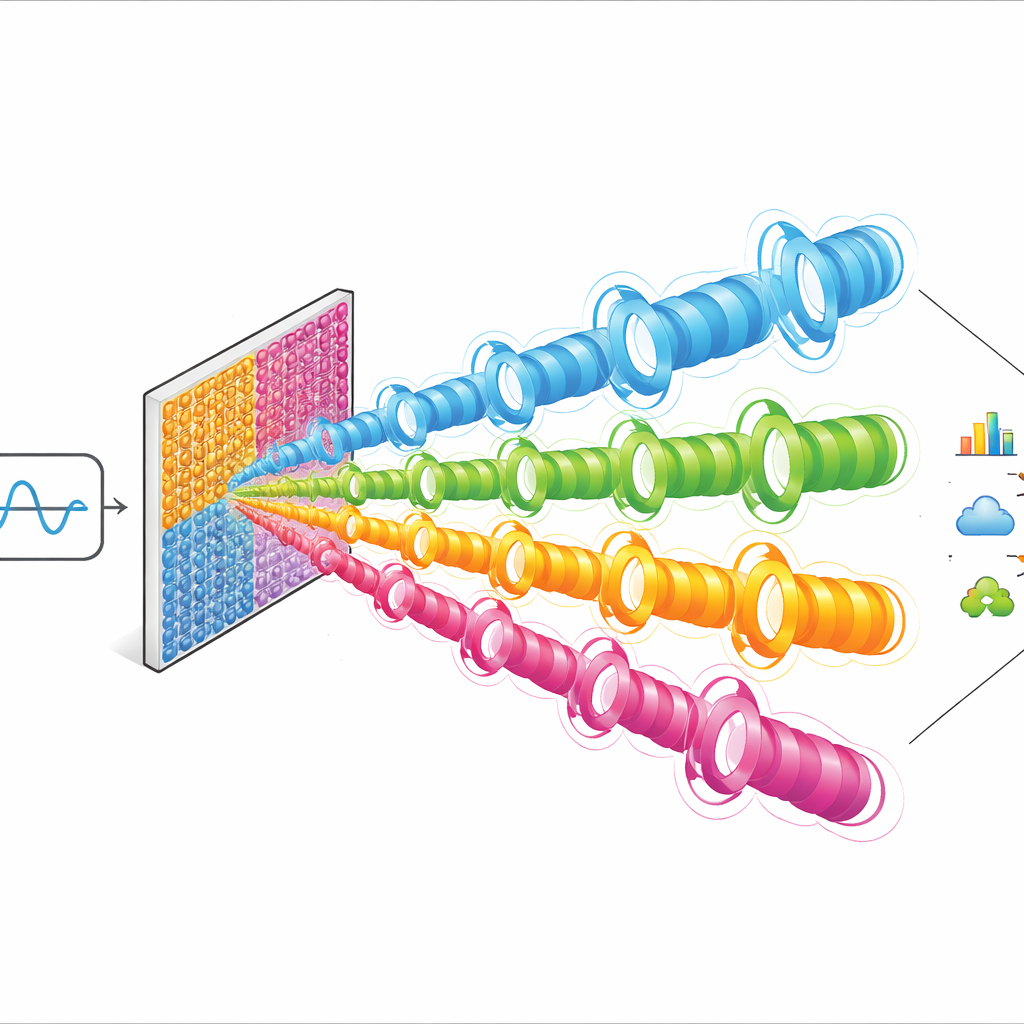
The authors introduce a device called a dual-polarized asynchronous space-time-coding metasurface, or DASM. It looks like a flat, patterned panel made of a 12-by-12 array of tiny metallic building blocks, each smaller than the wavelength of the millimeter-wave signal it controls. Two tiny diodes in every building block allow a control circuit to switch its behavior very rapidly in time for both horizontal and vertical polarizations. By driving each element with its own digital blinking pattern, the panel can sculpt the outgoing wave’s strength and phase almost continuously across its surface and in time, while also nudging some of the energy into slightly shifted frequencies.
Mixing twists, colors, and polarizations
With this fine control, the metasurface can generate vortex beams with many different twists, or even combine several twist orders into one beam while still keeping track of the information in each. The team demonstrates vortex beams with twist indices of plus or minus one and two, used either one at a time or all together. They also take advantage of the panel’s ability to treat horizontal and vertical polarizations separately, and to split its area into regions that follow different time patterns, which shift the outgoing waves to two close but distinct frequencies. In effect, the same flat surface becomes a three-dimensional switchboard that can independently address channels based on twist, polarization, and frequency.
A simpler transmitter with many channels
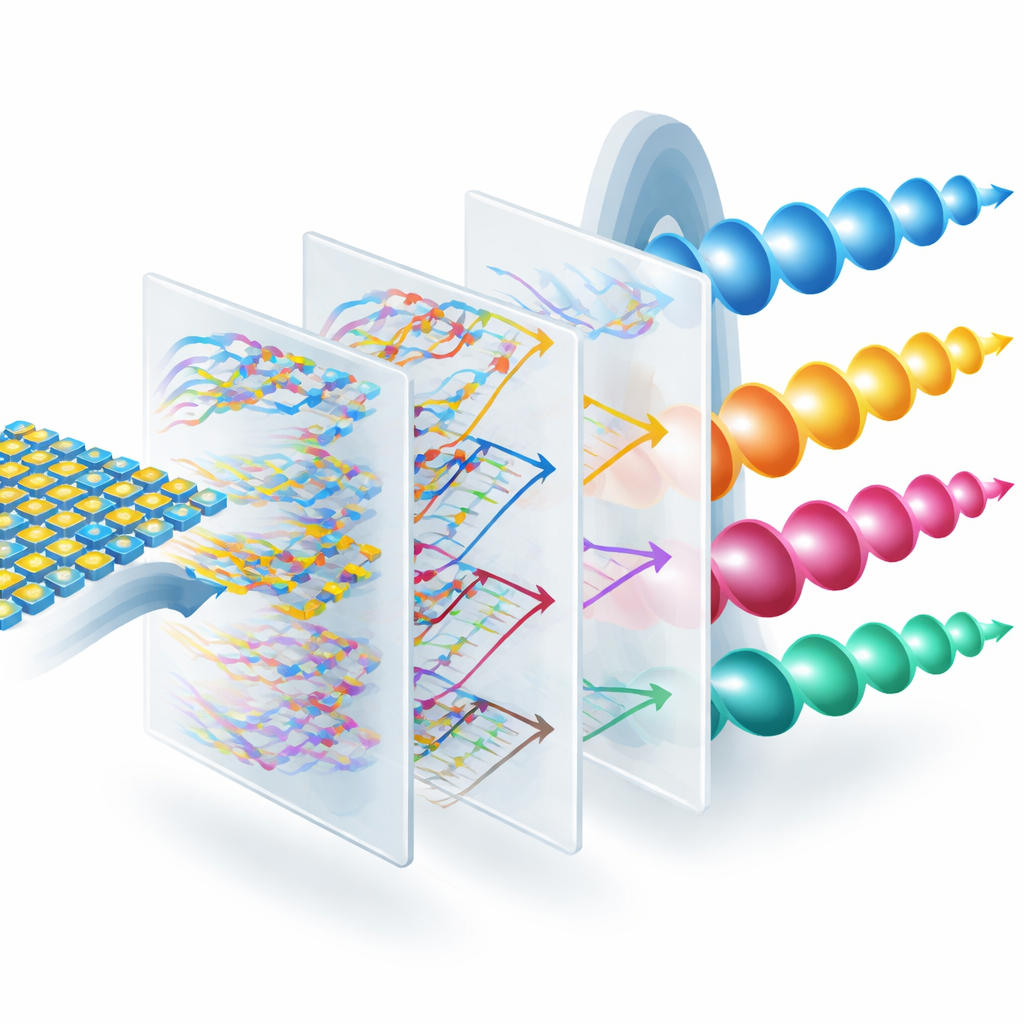
Traditional systems that use vortex beams often need a separate high-speed radio chain for each OAM channel, including mixers, oscillators, and converters. In the new design, a single continuous-wave source feeds the metasurface, and the data are written directly into the wavefront by the digital control signals. The researchers compare this to a conventional approach and show that their method can greatly cut down on hardware complexity and power consumption. At the receiving end, specially shaped lenses undo a chosen twist order so that its energy focuses into a single spot, where a standard antenna can read out the data while ignoring the other twist channels.
Eight images at once and room to grow
To prove the idea, the authors build a complete short-range link at around 26.8 gigahertz. They send pictures encoded with a common digital format (QPSK) over different combinations of twist direction, polarization, and frequency. In one set of tests, two opposite twist orders carry two different images with very little mixing between them. In another, two orthogonal polarizations of the same twisted beam each deliver an independent image. A third test uses two nearby frequencies on the same twist order. Finally, by combining two twists, two polarizations, and two frequencies, they create an eight-channel “signal cube.” Due to equipment limits, they operate four channels at a time but show that all eight can be recovered almost perfectly, with only a handful of bit errors per two-million-bit image.
What this means for future wireless links
The study shows that a thin, electronically steered surface can weave together several physical properties of radio waves to unlock high-dimensional multiplexing in a compact package. While the current demonstration works over modest distances—well suited to chip-to-chip links, data centers, or indoor connections—the same principles could be extended with larger panels and more elements. By scaling up the number of twist orders, frequencies, and controlled regions, such metasurfaces could become flexible, software-defined front ends that dramatically boost the capacity of future wireless systems without requiring equally dramatic increases in hardware complexity.
Citation: Yang, C., Wang, S.R., Du, J.C. et al. High-dimensional multiplexing through vortex electromagnetic wave manipulation by space-time-coding metasurfaces. Light Sci Appl 15, 160 (2026). https://doi.org/10.1038/s41377-026-02232-6
Keywords: orbital angular momentum, metasurface communications, high-dimensional multiplexing, millimeter-wave links, space-time coding