Clear Sky Science · en
Ultra-Low Efficiency Roll-Off High Color Purity Blue Perovskite Quantum Dot LEDs with Exceeding 20% Efficiency
Why Better Blue Light Matters
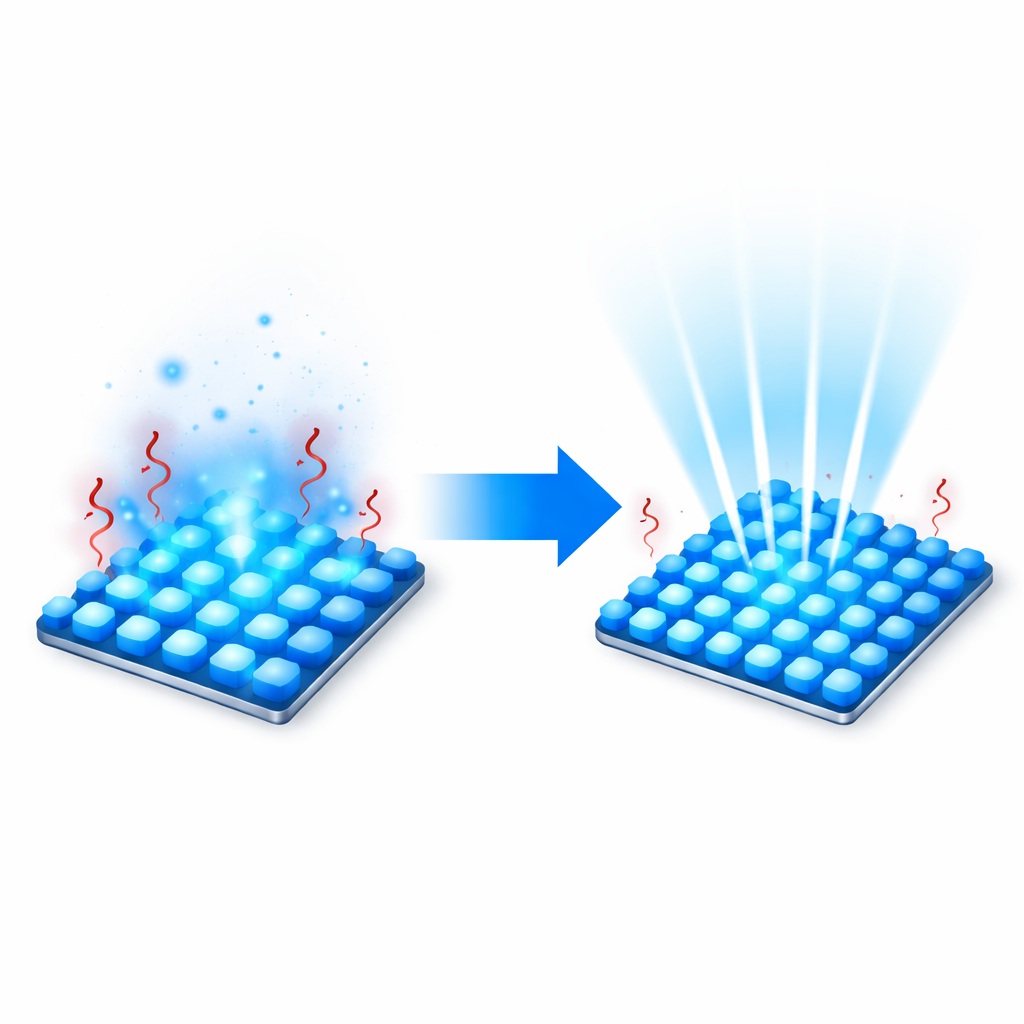
Every screen you look at—from your phone to the latest virtual reality headset—relies on tiny red, green, and blue light sources working together. Among them, blue is the troublemaker. It is the hardest color to make both bright and pure, and it often wastes a lot of power as heat, shortening device lifetimes. This paper reports a way to build tiny blue light sources called perovskite quantum dot LEDs that shine a very pure shade of blue, stay efficient even at high brightness, and last far longer than previous versions, bringing next‑generation ultra–high‑definition displays closer to reality.
Small Crystals for Sharper Color
The work centers on perovskite quantum dots—nanometer‑scale crystals that can be tuned to emit extremely narrow bands of color, ideal for wide‑gamut standards such as Rec. 2020 used in cutting‑edge displays. To hit the deep blue region of this standard, the researchers make very small cesium lead bromide crystals whose emission falls squarely in the desired color range. However, shrinking the dots introduces problems: their surfaces are covered with incomplete bonds and defects that trap energy, neighboring dots can couple too strongly and leak energy to each other, and the material’s ability to screen electrical charges weakens. Together, these effects cause energy losses, color drift, and a sharp drop in efficiency when the devices are driven to practical display brightness levels.
A Helper Molecule with Two Jobs
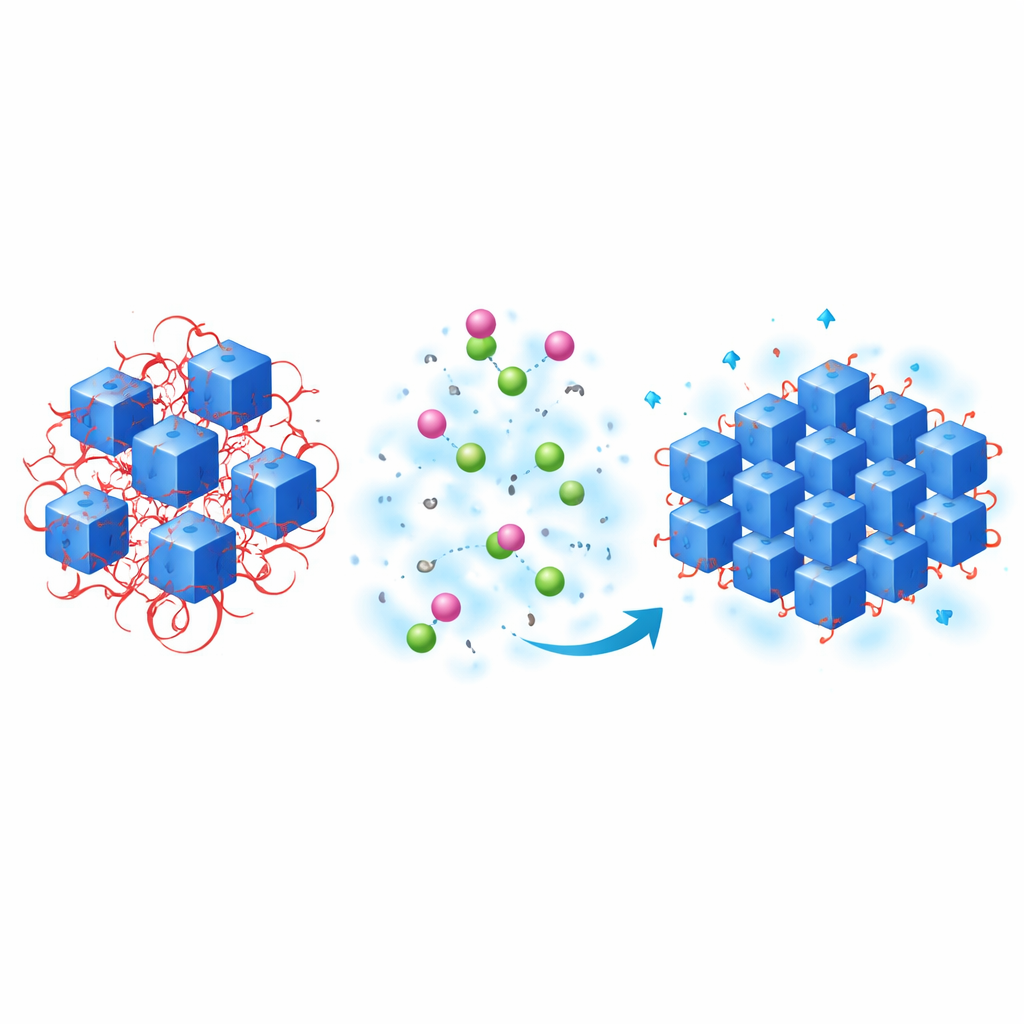
To tackle these intertwined issues, the team introduces a specially chosen ionic liquid molecule called EMIMPF₆. In the device, this molecule falls apart into a positively charged part and a negatively charged part. Computer simulations and a suite of measurements show that the negative part tends to attach to exposed lead and cesium atoms on the quantum dot surfaces, while the positive part prefers under‑coordinated bromine sites. In simple terms, both sides of the molecule “plug the gaps” on the crystal surface, calming down the most troublesome defects. This passivation reduces unwanted energy‑wasting pathways, weakens excessive coupling between neighboring dots, and helps keep the surface electronic structure stable without disturbing the internal crystal lattice.
Cleaner Light and Less Waste
These molecular repairs translate directly into better light emission. Films of treated quantum dots show narrower blue emission around 472–475 nanometers and a jump in light‑emitting efficiency: the fraction of absorbed energy that comes back out as useful light rises from 78% to 92%. Time‑resolved measurements reveal that the excited states live longer, indicating that they are more likely to radiate light instead of vanishing as heat. Tests that probe trap densities and stability under illumination and heat show fewer defects, less formation of unwanted metallic lead, and more robust performance at elevated temperatures. Importantly, the high‑permittivity positive ion increases the material’s ability to screen charges, which weakens a destructive process known as Auger recombination—a three‑body interaction that usually becomes severe at high brightness and is a prime cause of efficiency loss and self‑heating.
Brighter Devices That Keep Their Cool
When these improved quantum dots are built into LED structures, the benefits are striking. The energy levels of the treated dots align better with surrounding layers, so electrical charges flow in more evenly from both sides. As a result, the devices turn on at lower voltage, reach higher brightness, and maintain high efficiency across a wide range of light output. The best devices achieve an external quantum efficiency above 20% at over 6000 candela per square meter and still remain near 18.5% even close to 10,000 candela per square meter, with the blue color purity meeting strict Rec. 2020 display standards. Thermal imaging confirms that these LEDs run cooler than earlier designs, consistent with reduced non‑radiative losses, and lifetime tests show an order‑of‑magnitude improvement in operating time before the brightness falls to half its initial value.
What This Means for Future Screens
Put simply, the authors demonstrate that carefully tailoring a single multifunctional molecule around each quantum dot can fix several long‑standing weaknesses of blue perovskite LEDs at once: surface defects, excessive dot‑to‑dot coupling, and high‑brightness energy loss. The result is a deep‑blue light source that is bright, efficient, color‑pure, and much more stable under real‑world operating conditions. If these advances can be translated to large‑area manufacturing, they could enable thinner, more vivid, and more energy‑efficient displays and head‑mounted devices, where blue performance has been the final missing piece.
Citation: Xie, M., Bi, C., Wei, S. et al. Ultra-Low Efficiency Roll-Off High Color Purity Blue Perovskite Quantum Dot LEDs with Exceeding 20% Efficiency. Light Sci Appl 15, 176 (2026). https://doi.org/10.1038/s41377-026-02231-7
Keywords: blue perovskite LEDs, quantum dots, display technology, efficiency roll-off, ionic passivation