Clear Sky Science · en
Sub-1-volt, reconfigurable Gires-Tournois resonators for full-coloured monopixel array
Why tiny, power-sipping pixels matter
From bright outdoor billboards to virtual-reality headsets that sit millimetres from our eyes, modern displays are being pushed to show sharper images while using less power. Yet shrinking pixels usually means higher voltages, more heat and dimmer screens. This paper reports a new kind of ultra-thin, reflective "monopixel" technology that can produce vivid, full-spectrum colours using less than one volt of electrical drive, pointing toward future glasses-like displays and low-power information panels.
A new way to make colour without light bulbs
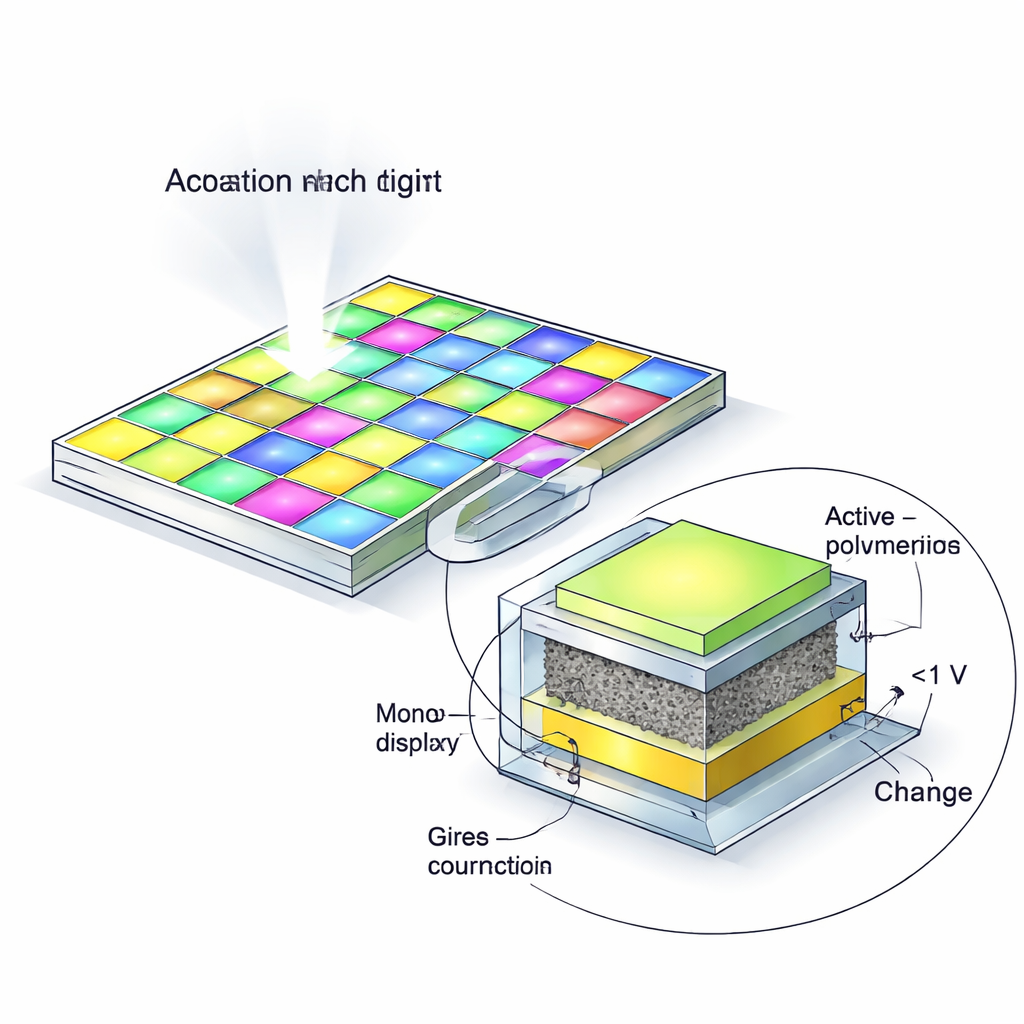
Most of today’s screens create colour by emitting light from tiny lamps such as LEDs or OLEDs. That approach works well but wastes energy, especially in bright environments where the screen must outshine sunlight. Reflective displays take a different route: they use ambient light and simply modulate how it is reflected, more like coloured paper than a flashlight. The authors build on this idea with a structure called a reconfigurable Gires–Tournois (r-GT) resonator. It is an ultrathin stack of layers that traps and releases light in a controlled way, so that the colour we see depends sensitively on the optical properties of the layers inside. Crucially, their design packs all colour control into a single active pixel, avoiding the usual red–green–blue subpixel layout that complicates manufacturing at micrometre scales.
How an ultrathin colour stack works
The heart of the device is a three-layer sandwich: a gold mirror at the bottom, a porous germanium layer in the middle and a thin film of a conductive polymer called polyaniline (PANI) on top, all sitting on a transparent electrode. When white light hits this stack, some of it bounces between the layers. Depending on how fast light travels and how much it is absorbed in each layer, certain colours are enhanced while others are suppressed, much like the shifting rainbow on a soap bubble. By carefully choosing the thickness and porosity of the germanium layer, the researchers achieve near-perfect matching of optical impedance, which produces very sharp resonances – narrow bands of colour that can be strongly amplified or turned off. This thin-film design, only tens to hundreds of nanometres thick, naturally lends itself to making very small pixels without the optical leakage and misalignment problems that plague thicker display technologies.
Switchable chemistry that remembers its colour
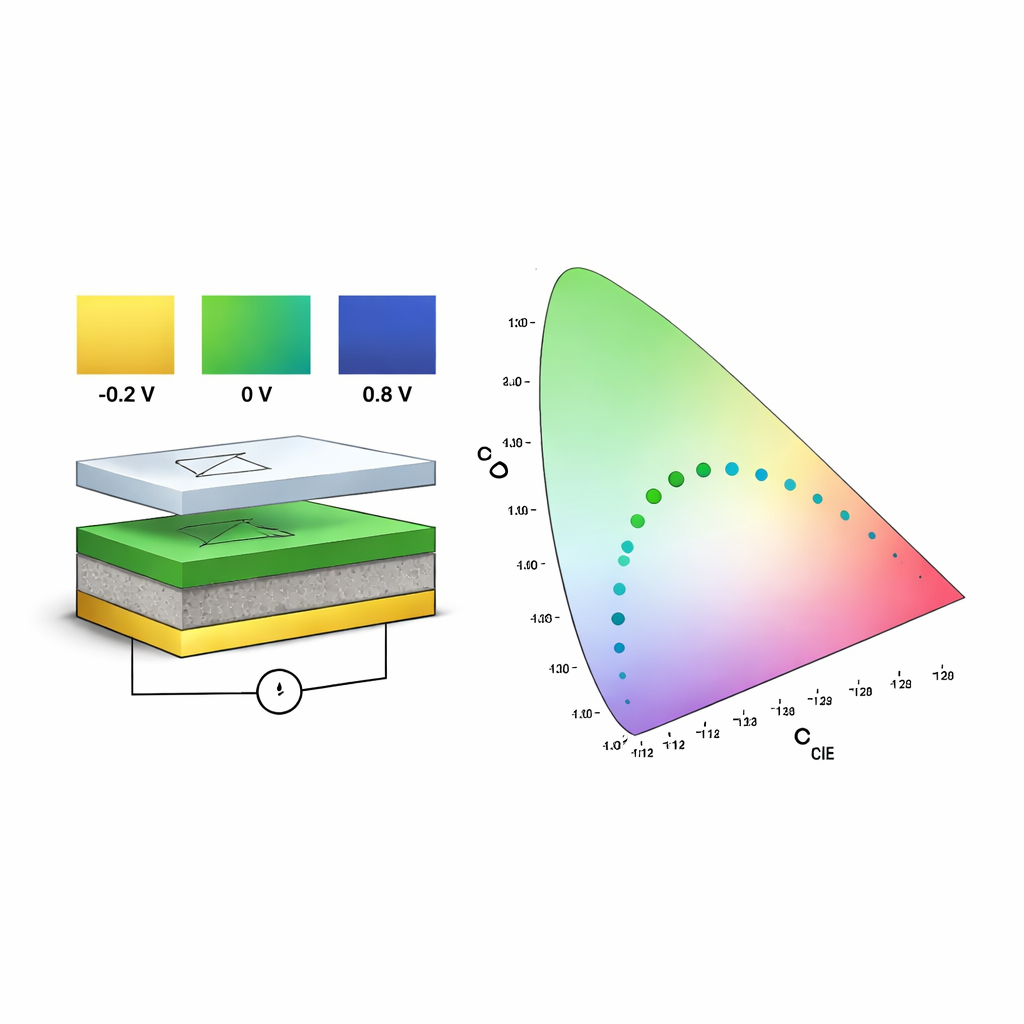
The PANI layer supplies the tunability. Its molecules can reversibly gain or lose charge when a small voltage is applied in an electrolyte, stepping through three distinct redox states. Each state has a different refractive index and light absorption, so switching voltage effectively "retunes" the resonant colour of the stack. The device operates between about −0.2 and 0.8 volts, yet can sweep through more than 220 degrees of hue – beyond simple complementary colour changes – and cover a large fraction of the standard RGB colour space. Power consumption is extremely low, around 90 microwatts per square centimetre. Moreover, PANI exhibits metastable states: once you set a colour, it can persist for hours even after the driving voltage is removed. This memory-in-pixel behaviour means the display only needs energy when changing images, not to keep them on the screen.
Stable, fast and scalable from micro to billboard
Electrochemical colour-changers often suffer from corrosion and slow switching. To address this, the team lets the porous germanium layer partially oxidize during the first operating cycle, forming a self-passivation layer of germanium oxide that protects the structure while still allowing ions and light to pass. Measurements over hundreds of cycles show that colour and reflectivity remain stable, and response times can be as fast as a few tens of milliseconds when using protons as the mobile ions, fast enough for video-rate updates. Importantly, the same r-GT design scales remarkably well: the authors demonstrate centimetre-scale image panels, patterned artworks and micro-patterns down to 1.5 micrometres, corresponding to about 16,900 pixels per inch – well beyond what the human eye can resolve in near-eye displays. They also build a 5×5 electrically addressable array to spell out words and animate simple shapes like Tetris blocks, highlighting the feasibility of multiplexed control.
What this could mean for future screens
For non-specialists, the key takeaway is that this work points toward displays that behave more like coloured electronic paper than glowing phone screens, but with far richer colour and much finer detail. Because each ultrathin pixel can be tuned across the visible spectrum at sub-1-volt levels, and then left to "remember" its state without constant power, such r-GT monopixel arrays could drastically cut energy use in devices that mostly show static or slowly changing content. Combined with their ability to operate at very high pixel densities and to remain visible even under strong ambient light, these reflective colour pixels could help power future smartwatches, e-readers, outdoor signage and augmented-reality glasses that are easier on both eyes and batteries.
Citation: Ko, J.H., Jeong, H.E., Kim, S. et al. Sub-1-volt, reconfigurable Gires-Tournois resonators for full-coloured monopixel array. Light Sci Appl 15, 134 (2026). https://doi.org/10.1038/s41377-026-02228-2
Keywords: reflective display, electrochromic pixel, low-power colour, high-resolution microdisplay, conductive polymer